Lisianthus Flower: Meaning, Types and How to Grow It
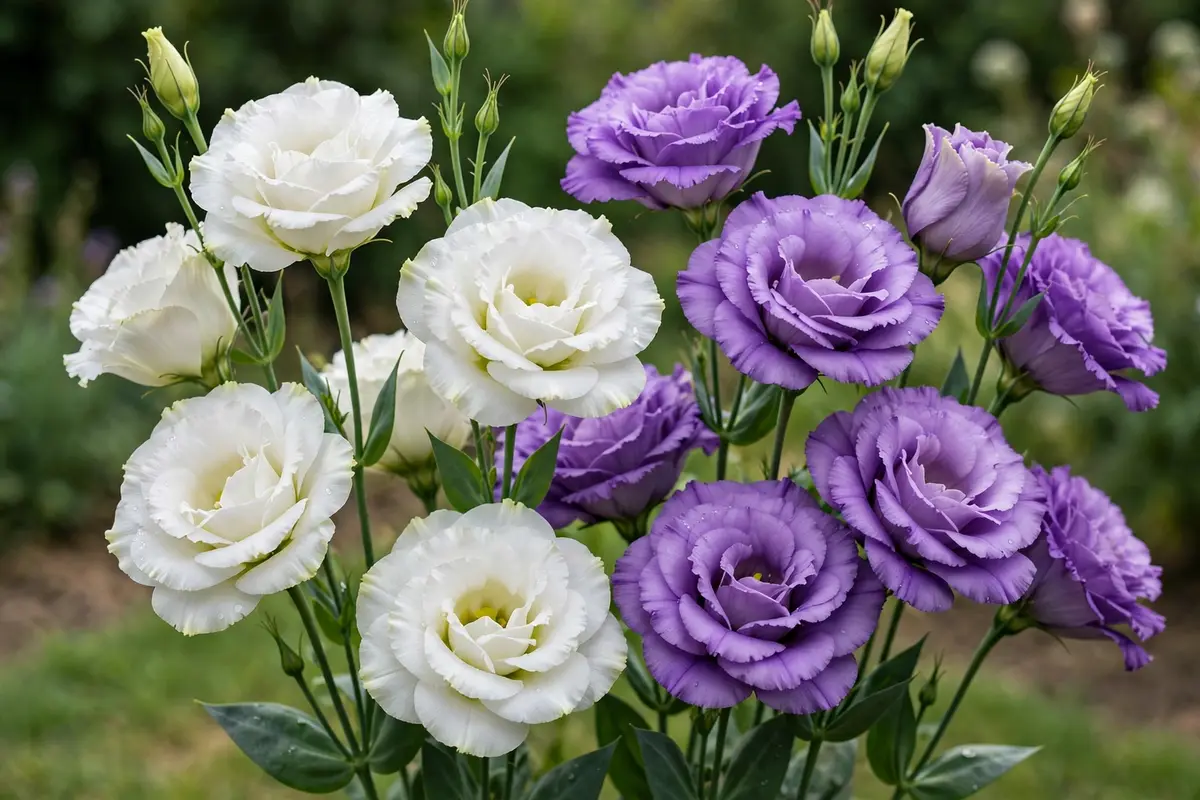
Every florist knows the trick: a bride wants roses in August, the budget says otherwise, and the lisianthus goes into the bouquet — where it outlasts the real roses by a week and nobody at the wedding can tell. Lisianthus is the prairie gentian of Texas dressed for the ball: ruffled, rose-like blooms in purple, white, pink and picotee, on stems that keep opening buds in the vase for a fortnight.
This guide covers the six lisianthus worth knowing (from the wild single purple to the frilled ‘Rosanne’ series), its meanings — lasting love, appreciation and calm — the lisianthus-vs-rose comparison it keeps winning, and the one growing fact that explains everything: it is magnificently, almost comically, slow from seed.
Quick Answer
Lisianthus is the rose-like cut flower of Eustoma grandiflorum, a prairie plant in the gentian family Gentianaceae native to the southern United States, Mexico and the Caribbean — also called prairie gentian and Texas bluebell. Cut stems carry buds that open in sequence over 10 to 14 days in the vase. As a garden plant it grows 1 to 3 feet in USDA zones 8 to 10 as a short-lived perennial (an annual elsewhere), flowering in summer in full sun. Lisianthus means lasting love, appreciation, gratitude and calm. Japanese breeders turned the wild purple single into the doubles that now anchor the wedding trade.
Table of Contents
- What Is a Lisianthus Flower?
- Types of Lisianthus and 6 Kinds Worth Knowing
- Lisianthus Flower Meaning and Symbolism
- Lisianthus Flower Colours and Their Meanings
- How to Grow Lisianthus
- Common Mistakes When Growing Lisianthus
- Lisianthus vs Rose: The Understudy That Outlasts the Star
- Frequently Asked Questions
What Is a Lisianthus Flower?
Eustoma grandiflorum — “good mouth, big flower” in Greek — is a plant of American grasslands and river edges: blue-grey, waxy leaves (an adaptation to prairie drought) and, in the wild, single goblet flowers of deep violet-purple in early summer. Its old genus name, Lisianthus, stuck as the common name. The modern flower is a Japanese creation: from the 1930s onward, breeders in Japan (where lisianthus is now a major ceremonial flower) selected doubles, frills, picotees and colours until the prairie single became the ruffled, rose-mimicking bloom of today — a transformation on the scale of the chrysanthemum’s. You can read more on the Eustoma page on Wikipedia.
Its commercial magic is in the stem: unlike a rose, which arrives with its flowers already made, a lisianthus stem carries a staircase of buds that open one after another in the vase, so a bunch refreshes itself for ten days to two weeks — and it does it thornless, scentless (kind to allergy sufferers) and in colours roses cannot do, including true picotees and greens. Growers, though, pay for all this in patience: lisianthus seed is dust, the seedlings sit as a ground-hugging rosette for months, and from sowing to flower can take five to six months — the reason almost everyone buys it as plugs or plants, and the reason a stem costs what it costs.
Lisianthus Flower Quick Facts
- Botanical name: Eustoma grandiflorum (syn. Lisianthus grandiflorus).
- Family: Gentianaceae, the gentian family.
- Hardiness: zones 8 to 10 as a short-lived perennial; grown as an annual in cooler zones.
- Height: 1 to 3 feet (dwarf pot series ~8 inches).
- Bloom time: summer (florist stems year-round under glass).
- Sun and soil: full sun; fertile, well-drained soil; steady moisture.
- Good to know: vase life 10–14+ days with buds opening in sequence; thornless and scent-free; extremely slow from seed — buy plugs.
Types of Lisianthus and 6 Kinds Worth Knowing
The wild prairie single, the florist standards, and the frilled novelties. The table separates them; the profiles follow. For the full list of flower names, see our flower names A to Z guide.
| Type | Form | Height | Character | Best use |
|---|---|---|---|---|
| Wild prairie gentian | Single, violet goblets | 1–2 ft | The original | Wildflower and native gardens |
| ‘Echo’ series | Double, rose-form | 2–3 ft | Classic doubles | Cutting gardens, early colour |
| ‘ABC’ series | Large double | 3 ft | Florist standard | Weddings, professional cutting |
| ‘Rosanne’ series | Frilled, swirling | 2–3 ft | Ruffled novelty | Statement arrangements |
| ‘Voyage’ series | Very large double | 3 ft | Giant blooms | Premium stems |
| ‘Florida’ series | Double, compact | 8–12 in | Heat-tough dwarf | Pots, bedding, warm climates |
1. Wild Prairie Gentian — the Original
The single-flowered species of the Texas and Oklahoma prairies: violet-purple goblets over blue-grey foliage in early summer, beloved of native-plant gardeners and a different creature entirely from its florist descendants. Shorter-lived and less showy, but the only lisianthus that belongs in a wildflower meadow — and a reminder that the wedding flower began as a grassland weed of real beauty.
2. ‘Echo’ — the Classic Double
The series that brought double lisianthus to home gardens: fully double, rose-like flowers in blue-purple, pink, white, champagne and picotee, on stems tall enough to cut. Echo is a spring-to-early-summer flowerer (day-length sensitive, bred for the year’s first half), and still the name most seed catalogues lead with. For a first lisianthus, start here.
3. ‘ABC’ — the Florist Standard
Bred for the professional bench (the name is a breeder’s code, not poetry): tall, strong stems carrying very large double flowers in the full palette — ABC 2-3 Purple, Misty Blue, the whites and picotees. When a wedding bouquet holds “roses” in July that look suspiciously fresh on day ten, ABC lisianthus is the usual explanation. Group numbers within the series denote season timing, which growers, not brides, need to know.
4. ‘Rosanne’ — the Frilled One
The novelty line: petals frilled, waved and swirled into something between a rose and a ranunculus, in fashion colours — ‘Rosanne Brown’ and the antique shades are florist catnip. Rosanne is what designers reach for when the arrangement must look expensive; the frilling reads as pure luxury at bouquet distance.
5. ‘Voyage’ — the Giant
The largest-flowered doubles of the modern series, bred in Japan for the premium ceremonial market: huge, layered blooms on long stems, in white, blue picotee, champagne and pink. Voyage stems are the ones sold singly by name in Japanese flower shops. In the garden they need the longest season and the most patience — and repay both extravagantly.
6. ‘Florida’ — the Pot and Patio Series
The compact answer: double flowers on plants under a foot tall, bred (as the name promises) to flower through heat that stalls the tall series. Florida lisianthus is the one for pots, window boxes and warm-climate bedding — proof the prairie gentian remembers its hot homeland even in its smallest form.
Lisianthus Flower Meaning and Symbolism
Lisianthus means lasting love and appreciation — gratitude, calm and a bond that endures — which is why it has become a wedding flower of the first rank and a standard “thank you” and anniversary stem. The logic again is the vase: this is the flower still opening fresh buds on the tenth day, an emblem of feelings that renew themselves rather than fade. In Japan, where its breeding was perfected, it carries the same ceremonial weight as the rose does in the West, given for admiration and heartfelt thanks.
Send lisianthus for weddings, anniversaries, gratitude and sympathy — it is one of the few glamorous flowers that also reads as serene, which is why it bridges celebration and condolence better than the rose itself. The whites do much of the wedding work in our white flowers guide’s spirit: pure, calm and built to last the whole reception.
Lisianthus Flower Colours and Their Meanings
- Purple and violet — admiration and lasting love: the wild colour, deepened by breeders.
- White — purity and calm commitment: the wedding standard.
- Pink — gratitude and gentle affection: the thank-you stem.
- Picotee (white edged in colour) — appreciation with artistry: the designer’s favourite.
- Green and champagne — serenity and elegance: the modern, understated arrangements.
How to Grow Lisianthus
Start from the truth: this is an advanced plant from seed and an easy one from plugs, and there is no shame in the plugs — every professional buys them too. Gardeners on r/gardening on Reddit tell the same story yearly: “sowed in January, transplanted a rosette the size of a coin in April, flowers in August — lisianthus teaches patience or it teaches you to buy plants.”
From Seed (the Patient Route) or Plugs
If you sow: start 12–16 weeks before the last frost (January in most temperate gardens), use pelleted seed on the surface of fine compost — the seed needs light — keep at about 70°F (21°C), and do not panic at the rosette stage, when seedlings sit still for weeks building roots. Heat in this stage can trigger permanent rosetting (a plant that never bolts), so keep seedlings cool-bright once up. Plant plugs out after frost into full sun and rich, drained soil, spacing a foot apart; taller series need staking or netting as they grow, since the flower stems are top-heavy in wind and rain.
Care and Cutting
Water steadily — the prairie toughness shows in the leaves, not in a love of drought during flowering — and feed moderately through summer. Cut stems when two or three flowers on the stem are open; the buds behind them will open in the vase in sequence. In zones 8–10 plants may overwinter and flower again (occasionally better the second year); everywhere else, treat as an annual and order next year’s plugs early, because the good colours sell out.
Common Mistakes When Growing Lisianthus
Mistake one is sowing too late: a March sowing in a temperate garden flowers in September, if at all. January is lisianthus month. Mistake two is burying the seed or letting it dry on the surface — it needs light and constant film moisture to germinate, which pelleted seed and a propagator lid solve. Mistake three is cooking the seedlings: warm rooms push them into a heat-rosette that never sends up a flower stem.
Mistake four is skipping support for the tall series: one summer storm flattens a row of ABC at full flower. Mistake five is cutting too early — a stem cut with only one open flower and hard green buds behind it opens poorly; wait for two or three open blooms. And the meta-mistake is comparison despair: your plugs look nothing like the florist’s stems in their first month. Given sun and time, they close most of the gap.
Lisianthus vs Rose: The Understudy That Outlasts the Star
The bouquet comparison, judged honestly. Rose: the scent, the symbolism, the thorns; vase life typically 5–10 days with the flower fully made at cutting; peak price exactly when weddings peak. Lisianthus: no scent and no thorns; a ruffled double that reads as a rose (or a peony, at a glance) across a room; vase life 10–14+ days because the stem keeps unrolling new buds; available in picotees and greens roses cannot match; usually kinder to the budget in midsummer. Where the rose wins: perfume, tradition, and the close-up — nobody who holds a garden rose to their nose is fooled. Where lisianthus wins: endurance, value, and the second-week photograph. The professional answer, increasingly, is both — roses for the bride’s bouquet, lisianthus everywhere the flowers must last.
Frequently Asked Questions
How long does lisianthus last in a vase?
Ten days to two weeks, often longer — the cut stem carries a staircase of buds that keep opening, so the arrangement renews itself. Change the water every few days, strip lower leaves, and remove spent blooms to keep the stem’s energy for the buds behind them. If your question is not answered here, the questions about the lisianthus flower on Quora cover most of the rest.
Is lisianthus a perennial?
A short-lived perennial in warm climates (zones 8–10), where it can overwinter and flower for two or three seasons; in cooler zones it is grown as an annual or a greenhouse cut flower. Seed-grown plants are sometimes classed as biennials — sown one year to flower the next — which is the same patience wearing a calendar.
Why is lisianthus so expensive?
Time. Five to six months from dust-sized seed to flower, much of it under glass with exact temperatures, makes each stem carry half a year of a grower’s care. Bought as plugs or cut stems you are paying for that calendar — and the two-week vase life repays it against cheaper flowers replaced twice.
Does lisianthus have a scent?
Essentially none — which the trade counts as a feature: it suits allergy-sensitive recipients, hospital rooms and dinner tables where perfume would fight the food. If scent is the point of the gift, pair it with a fragrant companion rather than choosing a different flower entirely.
When does lisianthus flower?
In the garden, high summer — July to September from a January sowing or spring plugs, timed by day-length series (Echo types earlier, ABC and Voyage later). Florist stems are year-round from heated glasshouses and southern-hemisphere farms, which is why weddings in any month can have them.
Can lisianthus grow in pots?
Yes — the compact Florida series was bred for exactly that, and young plants of the tall series flower happily in large pots with support. Keep the moisture steady (pots dry faster than prairies) and feed lightly. For more flowers under the same letter, see our guide to flowers that start with L.