
Moon Flower: Meaning, Types and How to Grow Moonflowers
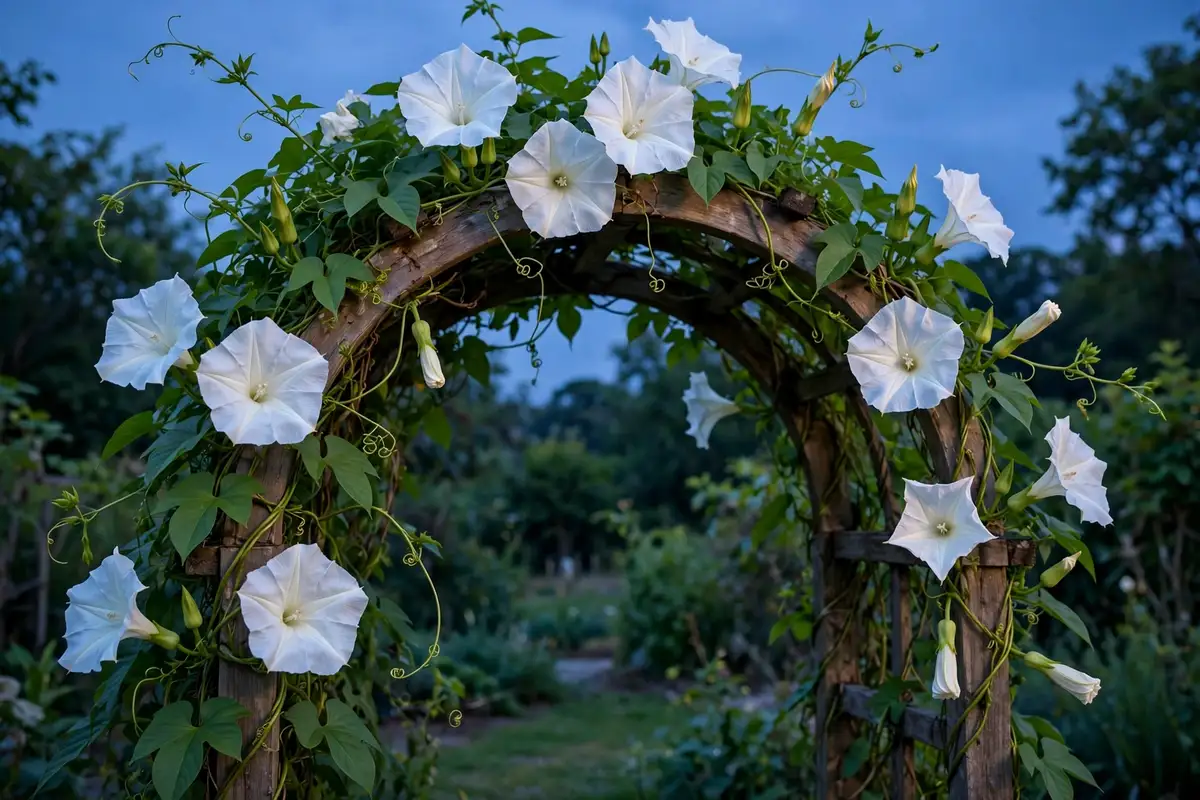
Most flowers close up when the sun goes down. The moon flower does the opposite. As dusk settles and the garden turns grey, its tightly furled white buds begin to stir, and within minutes they have unwound into wide, luminous trumpets — each one six inches across, glowing in the last light and smelling faintly of lemons and orange blossom. By midnight the vine is a constellation. By morning, every flower has folded away.
A moon flower asks you to garden at a different hour: to take your evening drink outside, sit near the fence, and watch a flower open in real time. This guide covers what a moon flower is, the six plants that share the name, what the flower means, and how to grow the true moonflower vine — including the warm-soil secret that decides whether yours flowers in August or sulks until October.
Quick Answer
A moon flower is a night-blooming white flower — most properly the moonflower vine, Ipomoea alba, a tropical relative of the morning glory whose large, fragrant white trumpets open at dusk and close by morning. It grows 10 to 15 feet in a season as an annual in most climates (a perennial in USDA zones 9 to 11), needs full sun, warm soil and a trellis, and flowers from midsummer until frost. The name moon flower is also used for a few other night bloomers, including the datura, the night-blooming cereus, evening primrose and night phlox. Moonflower seeds and all parts of datura are toxic if eaten, so plant them away from children and pets.
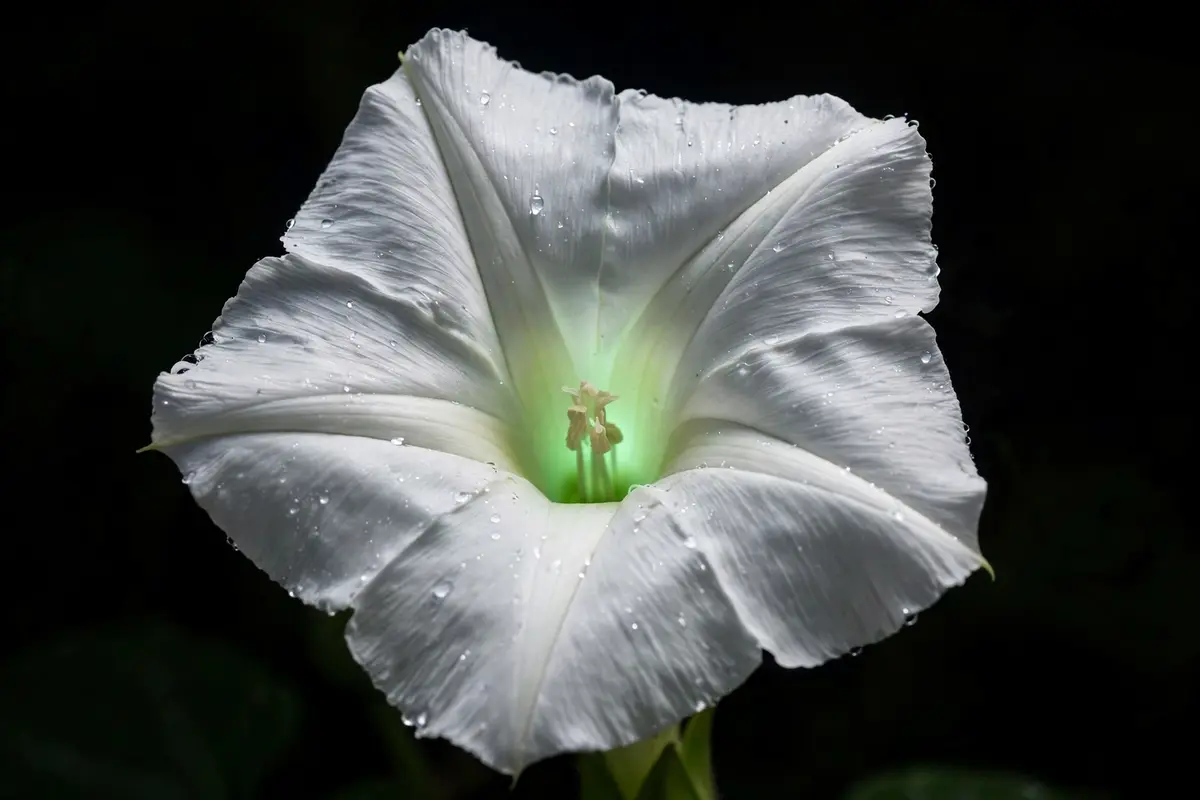
Table of Contents
- What Is a Moon Flower?
- Types of Moon Flower and 6 Night-Blooming Plants
- Moon Flower Meaning and Symbolism
- What a Moon Flower Symbolises at Night
- How to Grow Moonflowers
- Common Mistakes When Growing Moonflowers
- Designing a Moon Garden
- Frequently Asked Questions
What Is a Moon Flower?
The true moon flower is the moonflower, Ipomoea alba, in the bindweed family Convolvulaceae — the same family as the sweet potato and the morning glory, to which it is closely related. It is native to tropical America, from Florida and Mexico down to Argentina, where it scrambles over shrubs and fences in warm, frost-free country. You can read more on the Ipomoea alba page on Wikipedia.
The flower is built for the night shift. Its buds are long, twisted spirals that spend the day shut tight, and at dusk they unwind with a speed you can actually watch — on a warm evening a bud can open in under a minute, one of the few flowers that visibly moves. The open flower is a white trumpet 5 to 6 inches across with a pale green star down its throat, and it releases a sweet, lemony fragrance after dark. That perfume, and the white petals that catch moonlight, exist for one audience: night-flying hawk-moths, which hover at the flowers like small hummingbirds and pollinate them as they feed. Each flower lasts a single night. By sunrise it has wilted, but a healthy vine opens fresh buds every evening for months.
Because several unrelated plants share the same trick, “moon flower” has become a name for night bloomers in general, and gardeners use it loosely. The six plants in the next section are the ones most often meant. All of them share the same design rules — white or pale petals that shine in low light, and scent released after dark — because all of them are courting moths instead of bees.
Moon Flower Quick Facts
- Botanical name: Ipomoea alba (the true moonflower).
- Family: Convolvulaceae, the bindweed and morning glory family.
- Life cycle: perennial in USDA zones 9 to 11; grown as a fast annual everywhere else.
- Height: 10 to 15 feet in one season on a trellis, fence or arch.
- Bloom time: midsummer to first frost; each flower opens at dusk and lasts one night.
- Sun: full sun, at least six hours; warm soil above 18°C (65°F) to germinate.
- Good to know: the seeds are large, hard-coated and toxic if eaten — soak overnight before sowing.
Types of Moon Flower and 6 Night-Blooming Plants
Six plants answer to the name moon flower, and they are not interchangeable — one is a vine, one is a cactus, and one is seriously poisonous. The table tells them apart at a glance. For the full list of flower names, see our flower names A to Z guide.
| Plant | Botanical name | Type | Flower | Watch out for |
|---|---|---|---|---|
| Moonflower vine | Ipomoea alba | Twining vine, 10–15 ft | White trumpets, 5–6 in, fragrant | Seeds toxic; needs warm soil |
| Night-blooming cereus | Epiphyllum oxypetalum | Cactus, houseplant | Huge white flowers, one night only | Rare flowering nights |
| Datura (angel’s trumpet flower) | Datura inoxia | Bushy annual, 3–5 ft | White trumpets opening at dusk | All parts highly poisonous |
| Evening primrose | Oenothera biennis | Biennial, 3–5 ft | Yellow cups opening at dusk | Self-seeds freely |
| Night phlox | Zaluzianskya capensis | Small annual, 1 ft | White stars, honey scent at night | Needs cool nights to thrive |
| Tuberose | Agave amica (Polianthes) | Bulb, 2–3 ft spikes | White spikes, perfume all evening | Bulbs need winter protection |
1. Moonflower Vine (Ipomoea alba)
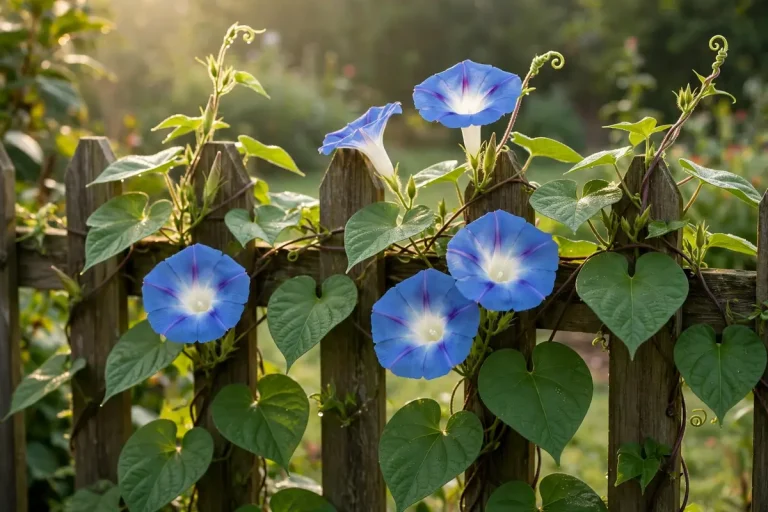
This is the moon flower of this guide, and the one seed catalogues mean: a vigorous tropical vine with heart-shaped leaves and satin-white trumpets that unfurl at dusk. It is the night-time twin of the morning glory, and the two can share one trellis — blue and purple trumpets for your morning coffee, white ones for your evening drink. It needs heat to hurry: in a warm summer it races to 15 feet and flowers from July; in a cool one it may not bloom until September, which is why the growing section below stresses an early, warm start.
2. Night-Blooming Cereus (Epiphyllum oxypetalum)
The night-blooming cereus, also called queen of the night, is a jungle cactus with flat, leaf-like stems and the most dramatic flowers in this list: white blooms up to a foot across that open after dark, perfume the whole house, and collapse by morning — sometimes on only a few nights a year. Gardeners in Asia hold viewing parties for it. It is grown as a houseplant in cold climates and outdoors in frost-free ones, and it is the moon flower to choose if you want an event rather than a season.
3. Datura (Datura inoxia)
Datura is the moon flower to treat with respect. It is a bushy, grey-leaved annual with big white trumpets that open at dusk and smell sweetly — and every part of it, especially the seeds, is dangerously poisonous to people and animals. It appears in old moon-garden books and still turns up in seed lists under “moonflower”, which is exactly why it belongs in this list: so you can tell it apart from the vine. Grow it only where children and pets cannot reach it, or choose the ipomoea instead.
4. Evening Primrose (Oenothera biennis)
The evening primrose breaks the white rule: its flowers are clear yellow. They share the moon flower’s timing, though — the buds are famous for popping open at dusk so quickly that you can watch the petals move, and the flowers glow in twilight like small lamps. It is a biennial wildflower of North America, happy in poor soil and dry banks, and it self-seeds generously. Bees work it at dawn before the flowers close, and goldfinches eat the seeds all winter.
5. Night Phlox (Zaluzianskya capensis)
Night phlox is the small, modest moon flower: a South African annual a foot tall whose white, maroon-backed flowers stay rolled shut all day and open at nightfall, releasing a honey-and-vanilla scent far stronger than its size suggests. Sow it along a path edge or in a pot by the door, where you will actually pass it in the evening. It does its best where nights are cool, and often fades in hot, humid summers.
6. Tuberose (Agave amica)
The tuberose is the perfumer’s moon flower: spikes of waxy white flowers that release one of the richest scents in the garden from late afternoon onwards. It is a tender bulb from Mexico, planted in spring and lifted or mulched in autumn in cold gardens, flowering in late summer. A single spike in a vase will scent a room for a week — the cut-flower trade’s version of the moon garden.
Moon Flower Meaning and Symbolism
A flower that blooms only in darkness was never going to collect ordinary meanings. In the language of flowers, the moon flower stands for mystery, dreams and the hidden side of things — feelings that are real but not on display, love that grows quietly, hope that survives the dark. Where the morning glory means a brief, bright affection, its night twin means the opposite kind of devotion: patient, private, and renewed every evening.
The moon flower is also tied to intuition and feminine energy in modern flower symbolism, through its link with the moon itself — cycles, rhythm, and things that follow their own timing rather than the crowd’s. Garden writers of the Victorian era planted “moon gardens” of white, night-scented flowers for evening strolls, and the moonflower vine was their centrepiece wherever the climate allowed it. In its native tropical America the plant has a longer, practical history: it was grown by Indigenous peoples, and its milky sap was reportedly used in early rubber-making in Mexico, long before it became an ornamental.
Giving moon flowers — or a moonflower plant — sends a particular message: that you value someone’s quiet, private side, or that your feelings do not need an audience. It is a good flower for a night owl, a dreamer, or anyone whose best hours begin after sunset.
What a Moon Flower Symbolises at Night
Because the moon flower opens in the dark, its colour story is short and strong: it is always white, and white at night means purity, peace and quiet hope — the colour that stays visible when every other colour has gone. Moon gardeners build whole borders on that fact, mixing moonflowers with other white flowers and silver-leaved plants so the planting glows after dusk instead of disappearing. A white flower at midnight is also a small lesson the plant world teaches for free: beauty does not need daylight, or an audience, to be worth opening for.
How to Grow Moonflowers
Moonflowers are easy in warmth and stubborn in cold — nearly every failure with them is a temperature failure. Gardeners on r/gardening on Reddit swap the same advice every spring, and it is all below: start early, sow warm, and give the vine something tall to climb.
Starting the Seed
Moonflower seeds are large, hard and slow to wake. Nick the coat with a file or nail clippers, then soak the seeds in warm water for 24 hours — they should swell visibly. Sow indoors six to eight weeks before the last frost in individual pots (the roots dislike disturbance), or outdoors once the soil has warmed past 18°C (65°F). In cold soil the seed simply rots, which is mistake number one in the next section. Germination takes one to three weeks in warmth.
Planting Out and Support
Plant out only after all frost danger has passed and nights are reliably mild. Choose the sunniest spot you have — a south-facing fence, arch or pergola is perfect — and set the plants 6 to 12 inches apart at the base of their support. Moonflowers twine like their morning glory cousins and need no tying; guide the first stems to the strings and they will climb on their own, 10 to 15 feet by late summer.
Soil, Water and Feeding
Any average, well-drained soil suits moonflowers; like morning glories, they flower better in soil that is not too rich, and a mountain of leaves with no buds is the classic sign of overfeeding. Water regularly while the vine establishes and during dry spells, keeping the soil evenly moist at flowering time. A monthly light feed is plenty; stop if the foliage gets lush and the buds stop coming.
Getting Flowers by Midsummer
The race with a moonflower is against the calendar: the vine must climb, mature and set buds before the evenings cool. Starting indoors is the single biggest lever in cool climates, followed by the warmest wall in the garden and a dark mulch to hold soil heat. Do not pinch the tips — flowering comes on mature growth, and pinching delays it. In zones 9 to 11 the plant is a short-lived perennial and will return from the base in spring; everywhere else, save seed in autumn for next year’s start.
Growing in Pots
A moonflower grows happily in a large pot — at least 14 inches across — with a wigwam of canes or a small trellis, on a sunny patio where you sit in the evening. Pot-grown vines need watering most days in summer, but they reward you by placing the night perfume exactly where you are sitting, which is the entire point of the plant.
Common Mistakes When Growing Moonflowers
The first mistake is sowing in cold soil: moonflower seed planted before the soil warms rots instead of sprouting, so wait, or start indoors. The second is planting in shade: a moonflower vine in shade climbs bravely and flowers barely at all, because the buds need the heat stored up from a day of full sun. The third is overfeeding, which gives you a splendid green curtain and no evening show — hold back the fertiliser.
The fourth mistake is expecting flowers too early and giving up: even a well-grown vine usually starts in midsummer, and in a cool season the first trumpet may not open until late August. The fifth is confusing the moonflower vine with datura when buying seed, and planting a dangerously poisonous plant where children play — check the botanical name, Ipomoea alba, on the packet. And finally, do not site the vine where nobody goes after dark: a moonflower blooming unseen by a side gate is a concert played to an empty hall. Plant it by the patio, the path to the door, or under a bedroom window.
Designing a Moon Garden
A moon garden is a planting designed to be seen — and smelled — after dark, and the moonflower is its curtain-raiser. The recipe is simple: white and pale flowers, silver or variegated foliage, and night scent, placed where you actually spend evenings. Train moonflowers up an arch over the patio, and underplant with tuberose, night phlox and white cosmos; add silver foliage plants like dusty miller or lamb’s ears to catch what light there is. Many of the same plants carry the garden through autumn, which is why our fall flowers guide pairs well with this one for end-of-season planning.
Two practical notes make or break a moon garden. First, keep it near the house and near a light switch you control: a garden you must cross a dark lawn to reach will be visited twice a summer. Second, white flowers near outdoor lights attract the very moths the planting is designed for, so expect company — hawk-moths at the moonflowers are the floor show, and they are harmless, beautiful and worth the price of admission alone.
Frequently Asked Questions
Is a moon flower the same as a moonflower?
Yes — moon flower and moonflower are the same name, most properly used for Ipomoea alba, the night-blooming relative of the morning glory. The name is also loosely shared by other night bloomers such as the night-blooming cereus, datura, evening primrose and night phlox, which is why the botanical name matters when you buy seed or plants.
When do moon flowers bloom?
Moonflower vines bloom from midsummer until the first frost. Each individual flower opens at dusk — often within a minute or two, fast enough to watch — stays open through the night, and wilts by morning. A healthy vine in warm weather opens several new flowers every evening, so the display renews itself nightly for two to three months.
Are moon flowers poisonous?
The seeds of Ipomoea alba are toxic if eaten, like those of its morning glory relatives, and should be kept away from children and pets. The real danger in this group is datura, which is sometimes sold as moonflower: every part of datura is highly poisonous. Always check that your seed packet says Ipomoea alba, and if you have more questions, the questions about the moon flower on Quora cover most of them.
Why is my moonflower not blooming?
Almost always cold or shade. Moonflowers need a long, warm season: seed started late, a cool summer, or a shady wall will give you leaves and no flowers. Rich soil and heavy feeding make it worse. Start seed indoors next spring, give the vine your hottest, sunniest support, feed lightly, and be patient — late August is a normal first bloom in cool climates.
Is the moon flower a perennial?
In USDA zones 9 to 11, yes — Ipomoea alba survives winter and regrows as a short-lived perennial, though it also self-seeds. In colder climates it is grown as an annual and killed by the first frost. Seed is easy to save: let a few pods dry on the vine, collect the large brown seeds, and store them somewhere dry, labelled and out of reach of children.
Can I grow a moon flower indoors?
The vine is too vigorous for a windowsill, but the night-blooming cereus — the other great moon flower — is a classic houseplant, grown in a pot and carried to a bright spot for its rare flowering nights. For more flowers filed under the same letter of the alphabet, see our guide to flowers that start with M.
One Comment