
Morning Glory Flower: Types, Meaning, Symbolism and How to Grow Morning Glories
A morning glory does not wait for you to wake up properly. It opens at first light, while the dew is still on the leaves, and by the time the afternoon sun is strong, the flowers have already folded shut. Each bloom lasts a single day — and that is the whole point. A morning glory is a flower you have to be there for, in the morning, with your coffee, while it is at its best.
What it gives you in return for that one morning is hard to beat: a fast-growing vine that can cover a fence, an arch or a bare wall in a single summer, with dozens of trumpet-shaped flowers in blue, purple, pink and white, opening fresh every day for months. The morning glory flower is also the birth flower for September, shared with the aster, and one of the easiest annual climbers a gardener can grow: sow the seed after the last frost, give it sun and something to climb, and it does the rest. This guide covers the main types of morning glory flower, what each colour means, and how to grow them — including the one mistake that catches almost every new grower, feeding them too well, which gives you a wall of leaves and almost no flowers at all.
Quick Answer
A morning glory flower is a trumpet-shaped bloom on a fast-growing twining vine in the genus Ipomoea. The common morning glory, Ipomoea purpurea, and the tall morning glory, Ipomoea tricolor — including the famous sky-blue ‘Heavenly Blue’ — are annuals in most climates, growing 6 to 15 feet in one season and flowering from midsummer into autumn. Each flower opens in the morning and closes by afternoon, in blue, purple, pink, white or red. Plant morning glories in full sun and well-drained, not-too-rich soil, give them a trellis, fence or string to climb, and sow seed outdoors after the last frost. The morning glory is the September birth flower, shared with the aster. The seeds are toxic if eaten — they contain compounds related to LSD — so keep them away from children and pets, and do not let the vine self-seed freely in warm climates, where it can become invasive.
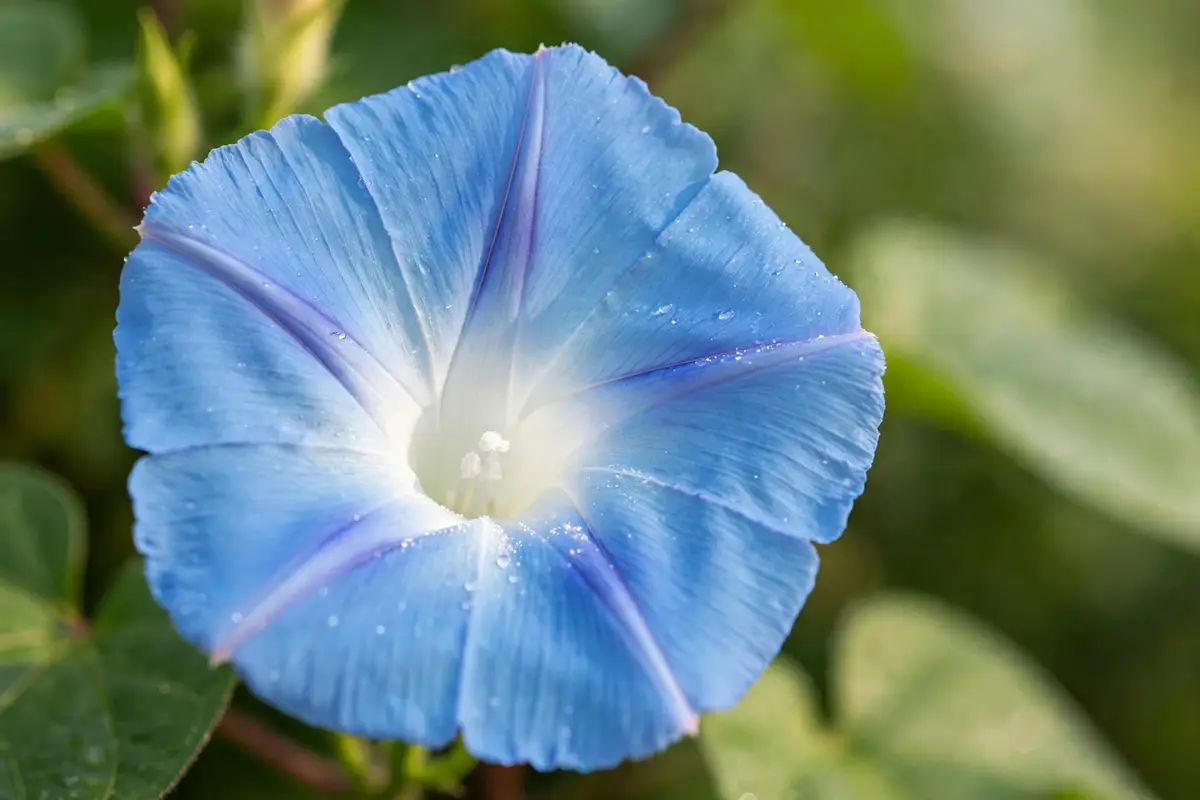
Table of Contents
- What Is a Morning Glory Flower?
- Types of Morning Glory and 6 Popular Varieties
- Morning Glory Flower Meaning and Symbolism
- What Each Morning Glory Colour Means
- How to Grow Morning Glories
- Common Mistakes When Growing Morning Glories
- Morning Glories in Gardens, on Fences and in Pots
- Frequently Asked Questions
What Is a Morning Glory Flower?
A morning glory belongs to the bindweed family, Convolvulaceae, which it shares with the sweet potato, the moonflower and the humble bindweed that gardeners spend their lives pulling out. The flower itself is a funnel, or trumpet: five petals joined into a single flared tube, usually 2 to 4 inches across, with a paler throat and a centre that is often white or yellow. Bees and hummingbirds work the open trumpets in the morning, which is why the flowers are shaped the way they are — wide enough for a bee to climb inside, deep enough to hold the nectar at the bottom. You can read more on the Ipomoea genus page on Wikipedia.
The name morning glory is not a poetic exaggeration; it is a description of the plant’s daily habit. The flowers open at dawn, or even before, as the light rises, and they close by late morning or early afternoon, especially on hot, bright days. On a cloudy day they may stay open longer, and in cool weather a flower can last into the evening, but as a rule each bloom gets one morning. The plant makes up for it with numbers: a healthy vine opens dozens of new flowers every day for months, so the display never really stops, it simply refreshes itself each morning.
The plant behind the flowers is a twining vine. It has no tendrils and no suckers; instead the whole stem winds itself around anything upright — a string, a cane, a fence wire, another plant — growing clockwise as it climbs. In a single summer a morning glory can reach 6 to 15 feet, depending on the type and the weather, and it will cover whatever support you give it, and then keep going. In cold climates it is grown as an annual and dies with the first frost. In warm, frost-free places, in USDA zones 9 to 11, some kinds survive the winter and come back as short-lived perennials, and in those places they can also self-seed so freely that they become a weed — a point worth remembering before you let a vine go to seed.
Types of Morning Glory and 6 Popular Varieties
Most garden morning glories are one of a few well-tried kinds, plus a handful of named cultivars bred for a clearer blue or a bigger flower. The table below gives a quick way to tell them apart, and the profiles that follow explain where each one grows best. For the full list of flower names, see our flower names A to Z guide.
| Variety | Botanical name | Height | Best spot | Flower colour |
|---|---|---|---|---|
| Common morning glory | Ipomoea purpurea | 6–10 ft | Fences, trellises, cottage gardens | Purple, pink, blue, white |
| ‘Heavenly Blue’ tall morning glory | Ipomoea tricolor ‘Heavenly Blue’ | 8–15 ft | Arches, tall fences, sunny walls | Sky blue with white throat |
| Japanese morning glory | Ipomoea nil | 6–10 ft | Pots, small trellises, balconies | Blue, purple, pink, red, white |
| Moonflower | Ipomoea alba | 10–15 ft | Evening gardens, pergolas, patios | White, fragrant, opens at night |
| Cypress vine / cardinal climber | Ipomoea quamoclit | 6–10 ft | Fences, hummingbird gardens | Scarlet red, small star flowers |
| ‘Grandpa Ott’ morning glory | Ipomoea purpurea ‘Grandpa Ott’ | 6–10 ft | Fences, arches, cottage gardens | Deep purple with pink star |
1. Common Morning Glory (Ipomoea purpurea)
The common morning glory is the one most people picture: a vigorous annual vine, 6 to 10 feet tall in a season, with heart-shaped leaves and trumpet flowers in purple, pink, blue and white, each about 2 to 3 inches across, opening every morning from midsummer until the first frost. It comes from Mexico and Central America, and it has been grown in gardens for so long that it has naturalised in warm parts of the world — which is both its charm and its warning, since it self-seeds freely wherever the winter is mild. Give it a fence or a trellis in full sun, sow it where it is to grow, and it will cover the support in a matter of weeks.
2. ‘Heavenly Blue’ Tall Morning Glory (Ipomoea tricolor ‘Heavenly Blue’)
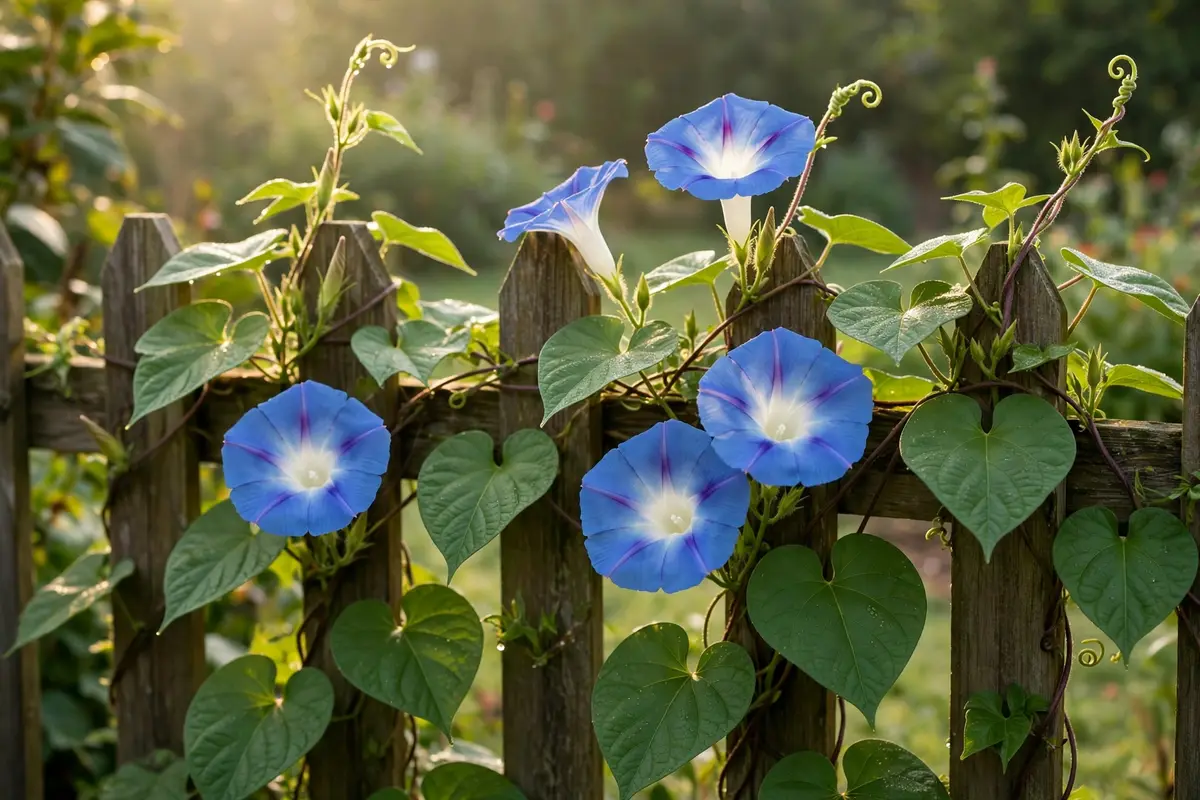
‘Heavenly Blue’ is the most famous morning glory of all, and the reason is the colour: a clear, pure sky blue that almost no other flower can match, with a white throat and a flower 4 to 5 inches across — bigger than the common kind. It grows 8 to 15 feet tall, with large heart-shaped leaves, and it flowers from midsummer into autumn, opening at dawn and closing by midday. It is a tall morning glory, Ipomoea tricolor, from Mexico, and it needs a tall support — an arch, a high fence, a sunny wall with strings — and a warm summer to flower well. In a cool summer it flowers late and less freely, so in cold climates start it indoors or choose a sheltered, south-facing spot.
3. Japanese Morning Glory (Ipomoea nil)
The Japanese morning glory, asagao in Japanese, is the one for gardeners who like variety and detail. It grows 6 to 10 feet tall, with flowers in blue, purple, pink, red and white, and centuries of breeding in Japan have produced forms with double flowers, fringed petals, speckled and striped patterns, and flowers that open in the shape of a star. It is smaller and a little less rampant than the common kind, which makes it the best morning glory for a pot or a balcony trellis, where its flowers can be seen up close. In Japan it has been grown and shown competitively since the Edo period, and a single prized plant can be worth a great deal — a reminder that this is a flower with a serious following, not just a quick fence cover.
4. Moonflower (Ipomoea alba)
The moonflower is the morning glory’s night-time twin. It is the same family and the same twining habit, growing 10 to 15 feet tall, but its flowers are white, 5 to 6 inches across, sweetly fragrant, and they open at dusk and close by morning — the exact opposite of the morning glory’s day. Planted together on the same trellis, the two give you flowers around the clock: blue trumpets in the morning, white trumpets in the evening. The moonflower needs a long, warm summer to flower well, so in cool climates start it indoors six weeks before the last frost and plant it in the sunniest, most sheltered spot you have.
5. Cypress Vine / Cardinal Climber (Ipomoea quamoclit)
The cypress vine is the delicate one of the family, and the best for hummingbirds. It grows 6 to 10 feet tall, but instead of the usual heart-shaped leaves it has fine, feathery, fern-like foliage, and instead of big trumpets it has small, star-shaped flowers, about an inch across, in scarlet red — the cardinal climber form — or in pink and white. The flowers open in the morning like the rest of the family, and hummingbirds visit them all day. It is lighter and airier than the big morning glories, so it suits a fence or a trellis where you want colour without a solid wall of leaves, and it is a good choice for a sunny spot that gets hot in the afternoon.
6. ‘Grandpa Ott’ Morning Glory (Ipomoea purpurea ‘Grandpa Ott’)
‘Grandpa Ott’ is the heirloom that gardeners pass on to each other. It is a form of the common morning glory, grown from seed saved by a gardener named Ott in the United States and shared through the Seed Savers Exchange, and it has become one of the most loved morning glories in the world. It grows 6 to 10 feet tall, with deep purple flowers, each with a pink, five-pointed star in the centre, opening every morning from summer into autumn. It is as vigorous and easy as the common kind, it self-seeds readily, and its dark purple is the colour that looks best against a pale fence or wall. If you want one morning glory and you want it to be beautiful, this is a safe choice.
Morning Glory Flower Meaning and Symbolism
No flower wears its meaning on its face quite like the morning glory. It blooms for a single morning and then it is gone, and that brief life is the whole of its message. In the Victorian language of flowers, the morning glory stood for affection — and, in some lists, for love in vain, or unrequited love: a feeling that is real and beautiful and does not last, or is not returned. It is a flower for a feeling that is strong in the morning and gone by the afternoon, and gardeners who know that meaning still give it with a little care about who receives it.
In the modern language of flowers, the meaning has softened into affection, love and the beauty of a new day. The morning glory is also the September birth flower, shared with the aster, and it is the flower given for an 11th wedding anniversary. Given to someone born in September, it says something the aster says too — love, patience and faith — but in a different voice: not the steady star that lasts all autumn, but the fresh bloom that opens with the day. The two September flowers belong together, and they are often planted together for that reason, the aster for autumn and the morning glory for the mornings of late summer.
In Japan, where the morning glory is called asagao, the flower has a longer and more serious history. It arrived from China in the Nara period, was first grown as a medicinal plant — its seeds were used as a laxative — and then became one of the most loved garden flowers in the country, bred into hundreds of forms and shown at summer exhibitions that still draw crowds. In Chinese tradition, the morning glory is linked with the legend of the Cowherd and the Weaver Girl, the lovers who meet only once a year, and the flower’s single morning is a reminder of how brief a meeting can be. In all three traditions — Victorian, Japanese and Chinese — the meaning comes back to the same thing: a beautiful thing that does not last, and is loved all the more for it.
What Each Morning Glory Colour Means
Blue is the colour most people think of first, and it carries the morning glory’s deepest meaning: trust, faithfulness, calm and the clear sky of a new day. Blue morning glories — above all ‘Heavenly Blue’ — are the ones given to someone you trust, and they are the colour most often chosen for a September birthday. Purple morning glories mean love, royalty, dignity and admiration, and they are the colour to give a sweetheart or a close friend. Pink morning glories mean love, affection and gentle feelings — the sort you give a friend, a sister or someone you are quietly fond of — and they look best against a dark fence, where their soft colour shows up clearly.
White morning glories, and the white moonflower that blooms at night, mean purity, innocence and sympathy, and they are the colour most often chosen for an evening garden or a quiet corner. Red morning glories — the scarlet cypress vine and the red Japanese kinds — mean passion, energy and intense love, and they are the strongest, most passionate colour in the family. A mixed planting of several colours reads as a whole message — love, trust, affection and a new day together — and it is the easiest way to grow them, since mixed seed is cheap and the vines will sort themselves out on the trellis. If you want more ideas for cool-coloured garden flowers, see our blue flowers guide, and if you are choosing by birth month, the morning glory is one of the two flowers in our September birth flower guide.
How to Grow Morning Glories
Morning glories are easy plants if you plant them in the right place and then, above all, leave them alone. The whole method fits in a few steps, and the vines will handle the rest themselves for the summer. Gardeners on r/gardening on Reddit often recommend them as one of the simplest annual climbers, and that reputation is earned — as long as you remember that rich soil and heavy feeding are the enemy, not the friend, of flowers.
When to Plant
Sow morning glory seed outdoors after the last frost, when the soil has warmed to at least 18°C (65°F), or start it indoors four to six weeks before the last frost and plant it out after the frost has passed. The seed has a hard coat, so soak it overnight in warm water, or nick the coat lightly with a file, before sowing — this speeds germination from two weeks to a few days. Sow where the vine is to grow if you can, since morning glories dislike being moved, and thin the seedlings to about 6 inches apart once they have a few true leaves. In warm climates you can sow a second batch in early summer for flowers into autumn.
Planting Depth and Spacing
Sow the seed about half an inch deep, in soil that drains freely, and space the plants 6 to 12 inches apart along the base of their support. The spacing matters less than it looks, because the vines will fill the gaps themselves, but plants that are too close together at the base compete for water and stay thin at the bottom. Put the support in place before you sow, or at the same time: a trellis, a fence, a wigwam of canes, or strings tied to a hook above. The vines start twining as soon as they are a few inches tall, and they will wind around anything within reach — including each other, and any plant growing nearby, so keep them away from shrubs you do not want smothered.
Light and Soil
Give morning glories full sun — at least six hours a day, and more if you can — and soil that is average to poor, well-drained and not heavily fed. This is the counter-intuitive part, and the one that matters most: in rich, fertile soil, or soil that has been given a lot of fertiliser, a morning glory grows a huge mass of leaves and very few flowers. In poor soil it flowers heavily, because the plant is trying to set seed. If your soil is rich, do not add compost or manure to the planting hole, and do not feed the plants at all during the summer. The soil should be roughly neutral, pH 6.0 to 7.0, and it should drain freely, since morning glories sitting in wet soil will rot at the base.
Watering and Feeding
Water during dry spells, especially while the vine is young and while the flower buds are forming, and keep the soil evenly moist rather than soaking it and then letting it dry out. Once the vine is established it is fairly drought-tolerant, and it will keep flowering with less water than most annuals. Water at the base of the plant, not over the leaves, and water in the morning so the leaves dry before night. Do not feed morning glories: no fertiliser, no liquid feed, no compost tea. If you have already fed them and they are all leaves, stop feeding at once, cut back the watering a little, and the plant will usually start flowering within a few weeks, once it feels less comfortable.
Training and Support
Morning glories need no tying in, only something to wind around. Guide the young stems towards the support when they are a few inches tall, and after that they will climb on their own, winding clockwise around the string or cane. If a stem wanders off and starts climbing a neighbouring plant, unwind it gently and point it back to the trellis before it gets a grip — once a morning glory has wound itself around a shrub, it is hard to remove without damaging both plants. At the end of the season, pull the whole vine down and compost it, or leave it standing for a few weeks so the seed pods can ripen if you want to save seed — but only if you are happy for it to self-seed, and only where it will not become a weed.
After Flowering and Saving Seed
After flowering, the faded trumpets fall and small, round seed pods form where the flowers were. Each pod holds four to six hard, dark seeds, and the pods turn brown and papery when they are ripe. If you want to save seed, collect the pods as they brown, dry them indoors for a week, and store the seed in a paper envelope in a cool, dry place — labelled, and out of reach of children and pets, since the seeds are toxic. If you do not want the plant to self-seed, deadhead the spent flowers or pull the vine down before the pods ripen, especially in warm climates where the seed will survive the winter and come up everywhere next spring. In cold climates the vine dies with the first frost, and you can pull it down and compost it without worrying about next year.
Common Mistakes When Growing Morning Glories
The first mistake is feeding them too well. A morning glory in rich soil, or given fertiliser, grows a wall of green leaves and almost no flowers, and the gardener blames the seed. Plant them in poor soil and feed them nothing. The second mistake is planting them in shade. A morning glory in shade grows long, weak stems, flowers little, and the flowers that do open stay open longer but look pale — find them the sunniest spot you have.
The third mistake is sowing too early, in cold soil. Morning glory seed sown in cold, wet soil rots before it germinates, so wait until the soil is warm, or start the seed indoors. The fourth mistake is giving them no support, or giving it too late. A morning glory with nothing to climb will crawl along the ground, tangle itself into a mat, and smother whatever it touches — put the trellis up first. The fifth mistake is letting them self-seed freely in a warm climate. In zones 9 to 11 the seed survives the winter, and a vine you loved this year can become a weed next year, climbing over everything in the garden. Finally, do not plant morning glories where children or pets can reach the seed pods: the seeds are toxic if eaten, and they should be treated with the same care as any poisonous plant in the garden.
Morning Glories in Gardens, on Fences and in Pots
In the garden, morning glories are at their best on a fence, a trellis, an arch or a pergola, where their height can be used and their flowers can be seen at eye level in the morning. Plant them in groups along the base of a fence for a solid wall of colour, or train a single vine up an arch over a path, so you walk under the flowers on a summer morning. They also suit a sunny wall, with strings tied to hooks, and they pair well with other summer flowers — the fall flowers guide, for example, covers the other plants that flower alongside morning glories in late summer and autumn. And if you are choosing flowers by letter for a summer display, you will find the morning glory in our flowers that start with M guide.
As a cut flower, the morning glory is honestly a poor choice, and it is better to say so than to pretend otherwise. A stem cut in the morning will close within an hour or two, and the flowers will not reopen, so a morning glory bouquet is a bouquet for the hour it is picked, not for the week. Grow morning glories where they flower, and enjoy them there, in the morning, with the dew still on them — that is what they are for. In a pot, a morning glory will grow well if the pot is large, at least 12 inches across, with a small trellis or a wigwam of canes in it, and if it is watered regularly, since pots dry out faster than the ground. On a balcony, a morning glory in a pot with a trellis is one of the easiest ways to get a wall of blue flowers in a single summer.
Frequently Asked Questions
Are morning glories perennial?
In most climates, no: morning glories are annuals, grown fresh from seed each spring, and they die with the first frost. In warm, frost-free places, in USDA zones 9 to 11, some kinds survive the winter and come back as short-lived perennials, and they also self-seed freely there. In cold climates, treat them as annuals, sow fresh seed each spring, and pull the vines down after the first frost.
When do morning glories bloom?
Most morning glories bloom from midsummer into autumn, usually from July until the first frost, with the first flowers appearing about 8 to 12 weeks after sowing. Each flower opens in the morning and closes by afternoon, but a healthy vine opens dozens of new flowers every day, so the display lasts for months. In a cool summer, or if the seed was sown late, flowering may not start until August.
Are morning glory seeds toxic?
Yes. Morning glory seeds contain lysergic acid amide (LSA), a compound related to LSD, and they are toxic if eaten — they can cause nausea, vomiting, diarrhoea, confusion and hallucinations. The ASPCA lists morning glory (Ipomoea species) as toxic to dogs, cats and horses, and the seeds are the most dangerous part. Keep seed packets and seed pods out of reach of children and pets, and call a doctor or a vet at once if any seed has been eaten.
Is morning glory the September birth flower?
Yes. The morning glory is the traditional September birth flower, shared with the aster. It was chosen for the month because it flowers in early autumn and because its meanings — affection, love and the beauty of a new day — suit the season. It is also the flower for an 11th wedding anniversary, and it is often planted with the aster, the other September birth flower, for a September garden.
Why is my morning glory not blooming?
Almost always because the soil is too rich, the plant has been fed, or it is not getting enough sun. Morning glories flower best in poor soil and full sun; in rich soil they grow leaves and no flowers. Stop feeding, do not add compost, make sure the plant gets at least six hours of direct sun, and be patient — a vine sown late, or in a cool summer, may not flower until August, and you can read more in the questions about the morning glory flower on Quora.
Are morning glories invasive?
They can be, in warm climates. In USDA zones 9 to 11, morning glories self-seed freely, survive the winter, and can smother other plants, and in some places they are listed as invasive. In cold climates they are not invasive, because the frost kills the vine and the seed does not reliably survive the winter. To be safe anywhere, deadhead the spent flowers before the seed pods ripen, pull the vine down at the end of the season, and do not let it seed into wild ground.

One Comment