24 Best Perennials for Full Sun: Names, Pictures and Growing Tips
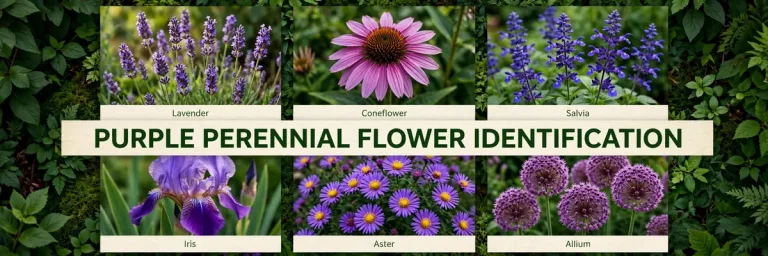
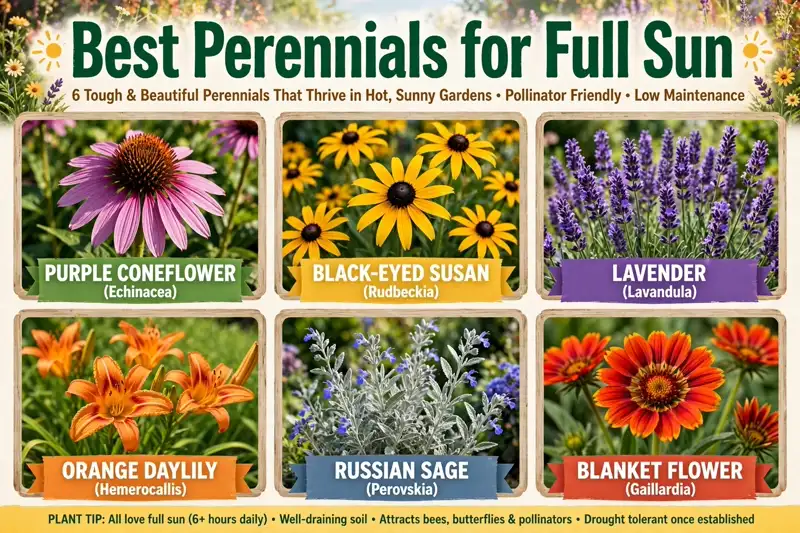
A blazing-hot border is one of the hardest places in a garden to keep colorful — yet it is exactly where the toughest, most floriferous perennials do their best work. The plants on this list do not merely tolerate six or more hours of direct sun: they demand it. Give them a south-facing bed, decent drainage, and an inch of water a week, and they will reward you with months of bloom, fragrance, and pollinator traffic, year after year. Below are 24 proven full-sun perennials — coneflowers, black-eyed Susans, daylilies, lavender, Russian sage, and 19 more — each with its botanical name, bloom season, hardiness zones, and the growing details that separate a good border from a great one. If you lean toward purple tones, our purple annual flowers guide pairs beautifully with many of the perennials below.
Every entry includes the plant’s scientific name so you can buy the right plant and not a lookalike, plus two comparison tables covering bloom season, height, zones, water, and soil. You will also find sections on what “full sun” really means, how to prep the soil, and how to water sun perennials through their first summer — followed by answers to the most common questions gardeners ask about sun-loving perennials.
Quick Answer
The best perennials for full sun include Purple Coneflower (Echinacea purpurea), Black-Eyed Susan (Rudbeckia), Daylily (Hemerocallis), Lavender (Lavandula angustifolia), Russian Sage (Salvia yangii), Meadow Sage, Yarrow, Blanket Flower, Coreopsis, Showy Stonecrop, Penstemon, Butterfly Weed, Red Hot Poker, Shasta Daisy, Blazing Star, Catmint, Bee Balm, Garden Phlox, Sea Holly, Globe Thistle, Lamb’s Ear, Ornamental Onion, Perennial Sunflower, and New England Aster. Full sun means at least 6 hours of direct sunlight daily; plant these in well-drained soil (zones 3–9 for most) and water deeply once a week while they establish.
Table of Contents
- What Counts as Full Sun?
- 24 Full-Sun Perennials at a Glance
- Water, Soil & Standout Traits
- Preparing Soil for Sun-Loving Perennials
- How to Water Full-Sun Perennials
- 24 Best Perennials for Full Sun: The Complete List
- Growing Tips for Sun Perennials
- Which Sun Perennials Will You Plant?
- Frequently Asked Questions
- References
What Counts as Full Sun?
On a plant tag, “full sun” means at least 6 hours of direct, unfiltered sunlight per day — and most of the perennials below bloom heaviest with 8 hours or more. Not all hours are equal, though. Six hours of morning sun is gentler than six hours of afternoon sun: western exposure is the hottest, driest microclimate in most yards, and it is where Mediterranean plants like lavender and Russian sage earn their keep while moisture-lovers such as bee balm and phlox may flag by August without extra water.
To measure your sun, note which beds stay sunny from late morning to late afternoon on a clear day. “Full sun” excludes bright shade, dappled light under trees, and sun broken up by long shadow bands — those are part-shade conditions, and shade-tolerant plants belong there instead. If your sunniest spot gets only 4–5 hours, choose the more adaptable entries on this list (daylilies, catmint, coneflowers, and yarrow tolerate part sun) rather than forcing a sun-worshipper like lavender into a dim corner. When in doubt, give the plant the brightest spot you have: extra light rarely harms a true sun perennial, but too little sun makes them leggy, floppy, and shy to bloom.
24 Full-Sun Perennials at a Glance
Use this table to compare all 24 full-sun perennials side by side — botanical names, bloom seasons, mature heights, and USDA hardiness zones.
| Plant name | Scientific name | Bloom season | Height | USDA zones |
|---|---|---|---|---|
| Purple Coneflower | Echinacea purpurea | Summer to fall | 2–4 ft | 3–8 |
| Black-Eyed Susan | Rudbeckia fulgida var. sullivantii | Summer to fall | 2–3 ft | 3–9 |
| Daylily | Hemerocallis spp. | Early summer to fall | 1–3 ft | 3–9 |
| English Lavender | Lavandula angustifolia | Early to midsummer | 2–3 ft | 5–9 |
| Russian Sage | Salvia yangii | Midsummer to fall | 3–5 ft | 4–9 |
| Meadow Sage | Salvia nemorosa / S. × sylvestris | Late spring to summer | 1.5–3 ft | 4–8 |
| Common Yarrow | Achillea millefolium | Summer | 2–3 ft | 3–9 |
| Blanket Flower | Gaillardia × grandiflora | Summer to frost | 1–2.5 ft | 3–10 |
| Threadleaf Coreopsis | Coreopsis verticillata | Early summer to fall | 1.5–2.5 ft | 3–9 |
| Showy Stonecrop | Hylotelephium spectabile | Late summer to fall | 1.5–2 ft | 3–9 |
| Foxglove Beardtongue | Penstemon digitalis | Early summer | 2–3 ft | 3–8 |
| Butterfly Weed | Asclepias tuberosa | Summer | 1–2.5 ft | 3–9 |
| Red Hot Poker | Kniphofia uvaria | Summer | 2–4 ft | 5–9 |
| Shasta Daisy | Leucanthemum × superbum | Early summer to fall | 2–3 ft | 5–9 |
| Dense Blazing Star | Liatris spicata | Mid to late summer | 2–4 ft | 3–8 |
| Catmint | Nepeta × faassenii | Late spring to fall | 1–3 ft | 3–8 |
| Bee Balm | Monarda didyma | Mid to late summer | 2–4 ft | 4–9 |
| Garden Phlox | Phlox paniculata | Mid summer to fall | 2–4 ft | 4–8 |
| Sea Holly | Eryngium planum | Mid summer to fall | 2–3 ft | 5–9 |
| Globe Thistle | Echinops ritro | Mid to late summer | 3–4 ft | 3–8 |
| Lamb’s Ear | Stachys byzantina | Foliage; early summer blooms | 0.5–1.5 ft | 4–8 |
| Ornamental Onion | Allium ‘Purple Sensation’ | Late spring | 2–3 ft | 4–9 |
| Perennial Sunflower | Helianthus × laetiflorus | Late summer to fall | 5–8 ft | 4–9 |
| New England Aster | Symphyotrichum novae-angliae | Late summer to fall | 3–6 ft | 4–8 |
Water, Soil & Standout Traits
This second table focuses on practical care: how thirsty each plant is, the soil it prefers, and the trait that makes it worth growing.
| Plant name | Water needs | Soil preference | Standout trait |
|---|---|---|---|
| Purple Coneflower | Low-medium once established | Average, well drained | Long bloom; goldfinch seedheads |
| Black-Eyed Susan | Medium; tolerates some drought | Average, well drained | Mass color; self-sows politely |
| Daylily | Medium; more water = more flowers | Adaptable, humus-rich best | Bulletproof; thousands of cultivars |
| English Lavender | Low; dislikes wet feet | Lean, alkaline, sharp drainage | Fragrance; evergreen silver foliage |
| Russian Sage | Low once established | Lean to average, well drained | Airy blue haze; heat-proof |
| Meadow Sage | Low-medium | Average, well drained | Reblooms if sheared after first flush |
| Common Yarrow | Low; drought tolerant | Poor to average, well drained | Flat flower landing pads for insects |
| Blanket Flower | Low; resents wet winters | Poor to average, well drained | Blooms nonstop to frost |
| Threadleaf Coreopsis | Low-medium | Average, well drained | Fine texture; clouds of small blooms |
| Showy Stonecrop | Low | Average to poor, well drained | Fall blooms + winter seedheads |
| Foxglove Beardtongue | Medium | Average, tolerates clay | Native; tubular hummingbird flowers |
| Butterfly Weed | Low once established | Poor to average, well drained | Monarch host plant; taproot — do not move |
| Red Hot Poker | Medium | Rich, well drained; mulch in cold zones | Exotic torch-like flower spikes |
| Shasta Daisy | Medium | Average, well drained | Classic white daisies; great cut flower |
| Dense Blazing Star | Medium; tolerates wet soil | Average, moisture-retentive ok | Vertical spikes; butterfly magnet |
| Catmint | Low-medium | Average, well drained | Months of blue; shear for rebloom |
| Bee Balm | Medium-high; dislikes drought | Rich, moist, well drained | Top hummingbird plant; fragrant foliage |
| Garden Phlox | Medium; needs steady moisture | Rich, humus-rich, well drained | Towering fragrant summer panicles |
| Sea Holly | Low | Poor to average, sandy ok | Metallic blue thistle-like blooms |
| Globe Thistle | Low-medium | Average, well drained | Steel-blue spheres; superb dried flower |
| Lamb’s Ear | Low; rots in wet soil | Poor to average, sharp drainage | Velvety silver foliage contrast |
| Ornamental Onion | Low-medium | Average, well drained | Spring purple globes; deer resistant |
| Perennial Sunflower | Medium; drought tolerant established | Average, adaptable | Fall color; feeds late-season pollinators |
| New England Aster | Medium | Average, well drained | Late-season nectar; native powerhouse |
Preparing Soil for Sun-Loving Perennials
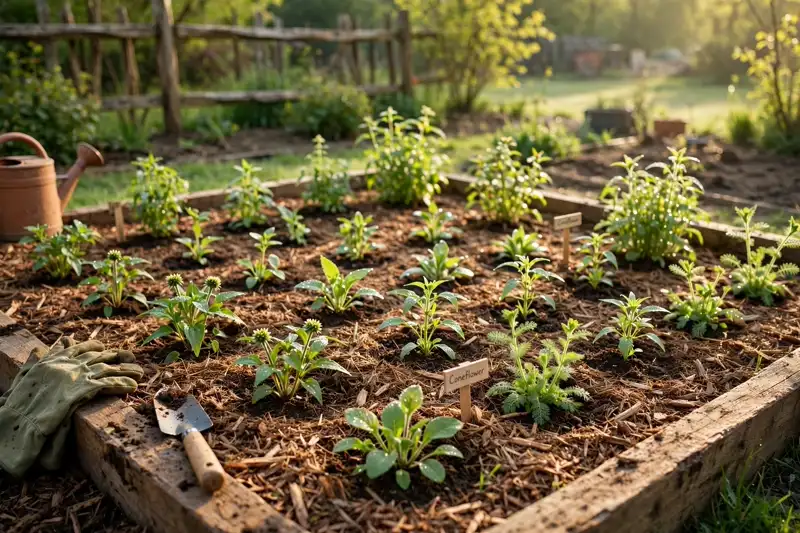
Sun and soil are a package deal: a south-facing bed bakes fast, so drainage and organic matter matter more here than anywhere else. Start by digging 10–12 inches deep and working in 2–3 inches of compost — not to make the soil rich, but to give young roots a friable zone while they establish. Most sun perennials thrive in slightly lean soil; over-fertilizing at planting produces lush foliage that flops over and invites disease. The Mediterranean entries (lavender, Russian sage, sea holly, blanket flower) genuinely prefer poor, gritty ground — if your soil is heavy clay, plant them on a low mound or in a raised bed with coarse sand or fine gravel mixed in.
Test your pH while you are at it: lavender and many sun perennials prefer neutral to slightly alkaline soil (pH 6.5–7.5), while bee balm and phlox are fine slightly acidic. A soil test every few years beats guessing with amendments. Mulch new plantings with 2–3 inches of shredded bark or straw to hold moisture through the first summer, but keep mulch a few inches back from the crowns — sun perennials planted in the “volcano mulch” style rot at the stem. Skip the landscape fabric: it starves roots of air and water exactly when heat-stressed plants need both most.
How to Water Full-Sun Perennials
The rule for the first growing season is simple: water deeply and infrequently. A thorough soaking that wets the root zone 6–8 inches deep, once a week, trains roots downward where soil stays cooler and moister. Daily sprinkles do the opposite — they keep roots shallow, exactly where the sun’s heat stresses them most. New transplants need water even if the species is drought-tolerant once established; “drought-tolerant” describes a mature plant with a deep root system, not a gallon-pot plant in its first July.
Water early in the morning so foliage dries quickly — this matters for mildew-prone entries like bee balm and garden phlox. Soaker hoses or drip irrigation beat overhead sprinklers for the same reason, and they put water at the roots instead of evaporating off hot leaves. Signs you are underwatering: wilting that persists into the cool of evening, browning leaf margins, and buds that drop before opening. Signs you are overwatering: yellowing lower leaves and mushy crowns, especially on lavender, lamb’s ear, and sedums. After the first year, most plants on this list need supplemental water only during extended dry spells — but “extended” in a hot summer can mean every week, so check soil moisture with your finger rather than the calendar.
24 Best Perennials for Full Sun: The Complete List
Here is the full rundown — every entry with its botanical name, why it thrives in full sun, bloom time, zones, and hands-on growing advice.
1. Purple Coneflower (Echinacea purpurea)
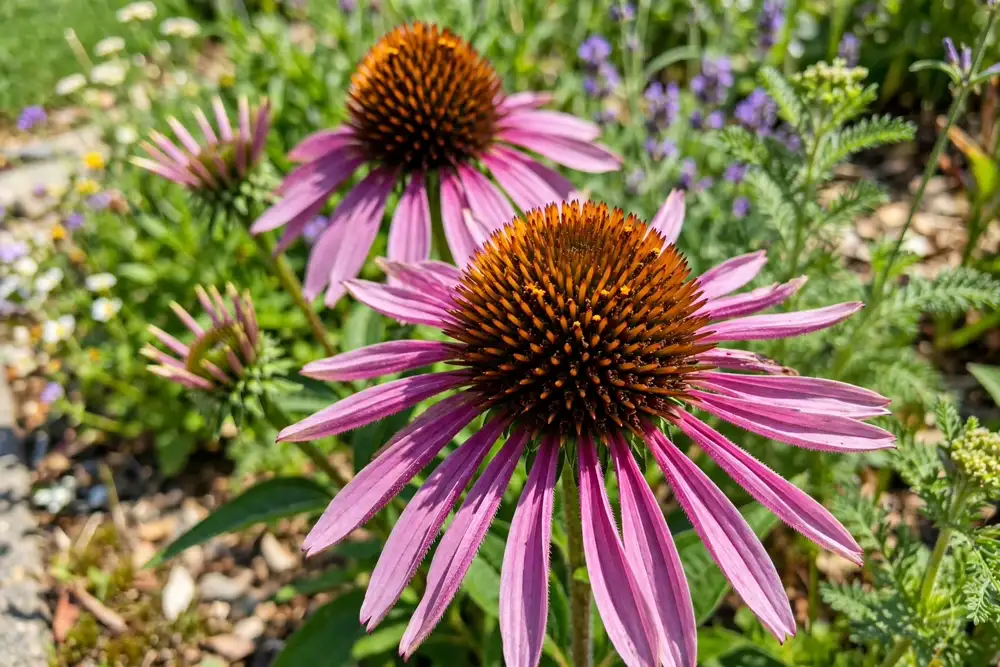
The purple coneflower is the anchor plant of the American sun garden: a central-US native that evolved under prairie sun and shrugs off heat, drought, and neglect once established. Daisy-like purple petals droop from a spiny orange cone, blooming from midsummer into fall and drawing butterflies, bees, and later goldfinches, which strip the seedheads all winter. Few perennials give you three seasons of interest — flowers, seedheads, winter architecture — with so little input. Zones 3–8, typically 2–4 feet tall.
Plant in average, well-drained soil; coneflowers tolerate clay better than most sun perennials but still hate standing water. Deadhead the first flush to extend bloom, but leave the last flowers standing for the birds and winter interest — the seedheads are as ornamental as the blooms. Divide clumps every 3–4 years to keep them vigorous, and resist over-fertilizing: rich soil makes them floppy. If you are browsing by letter, echinacea also leads our guide to plants that start with E. For a verified botanical profile, see the NC State Extension coneflower page.
2. Black-Eyed Susan (Rudbeckia fulgida var. sullivantii)
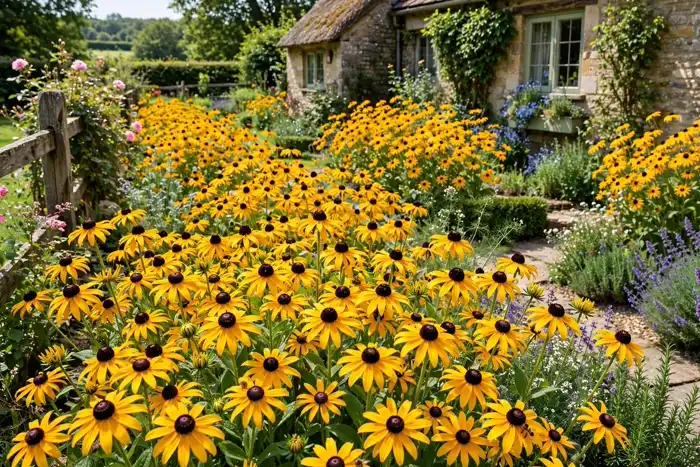
Few flowers deliver more color per square foot than the black-eyed Susan, especially the famous cultivar ‘Goldsturm’ — golden petals around a dark chocolate cone, blooming in solid sheets from July into September. It is a workhorse for mass plantings, meadow edges, and cottage borders, and like coneflower it is a central-US native built for sunny, competitive conditions. The flowers are superb cut flowers, and spent heads feed seed-eating birds. Zones 3–9, 2–3 feet tall.
Give it average, well-drained soil and full sun; it tolerates light drought but blooms longest with consistent moisture. It self-sows modestly — a virtue if you want drifts, a nuisance in tight formal beds, so deadhead before seeds set if you want it to stay put. ‘Goldsturm’ spreads by rhizomes into generous clumps; divide every 3–4 years in spring. The NC State Extension black-eyed Susan profile covers varieties and culture in detail.
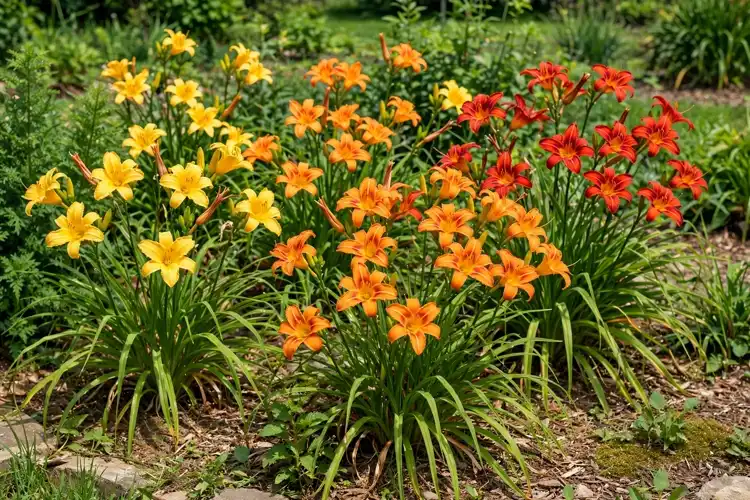
3. Daylily (Hemerocallis spp.)
The daylily is arguably the most forgiving perennial ever sold: it survives neglect, poor soil, heat, and cold (zones 3–9), and modern reblooming cultivars flower from June into fall. Each trumpet lasts a single day — hence the name — but a mature clump opens dozens of buds in sequence, so the display never stops. With tens of thousands of registered cultivars in every color but true blue, there is a daylily for every sun border. Most grow 1–3 feet tall.
Plant in full sun for maximum flowers (they tolerate part shade but bloom less) in average soil enriched with compost. More water means more blooms, so mulch and water during dry spells. Remove spent flower stalks at the base and snap off faded blooms to keep clumps tidy. Divide congested clumps every 3–5 years in early spring or after bloom. The Old Farmer’s Almanac daylily growing guide is a solid reference for cultivars and care.
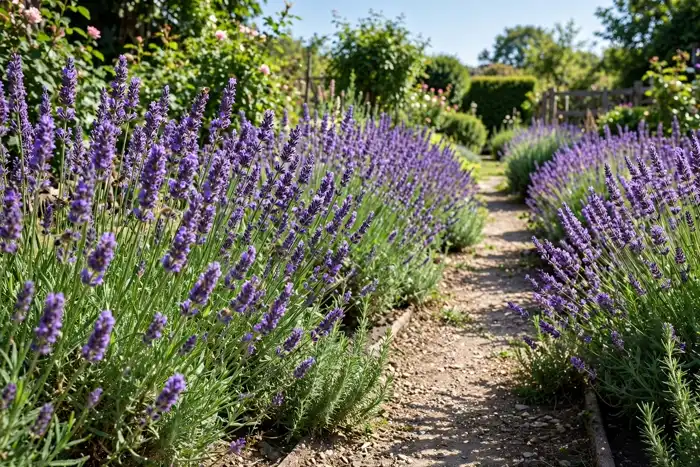
4. English Lavender (Lavandula angustifolia)
English lavender is the Mediterranean sun plant par excellence — silver-gray evergreen foliage, intensely fragrant purple flower spikes in early summer, and a constitution that demands heat and sharp drainage. It anchors herb gardens, lines paths, and perfumes entire borders, and dried bundles keep their scent for months. Zones 5–9, 2–3 feet tall. Note that Spanish and French lavenders (L. stoechas, L. × intermedia) are less cold-hardy; angustifolia cultivars like ‘Hidcote’ and ‘Munstead’ are the reliable choices for cold winters.
The number-one killer of lavender is wet soil in winter, not cold. Plant on a mound or slope in lean, alkaline, gravelly soil — never in rich, soggy beds. Full, blazing sun is non-negotiable. Shear flower stems back by a third right after the first bloom to encourage a second flush, and trim lightly in spring, never cutting into old wood (lavender rarely resprouts from bare stems). The RHS lavender growing guide covers pruning and variety selection.
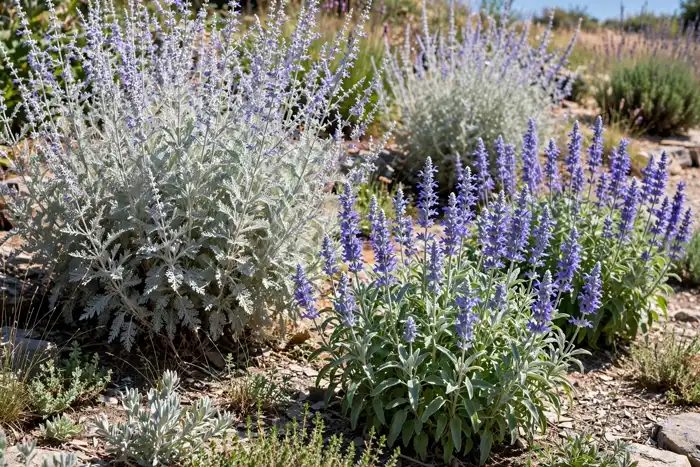
5. Russian Sage (Salvia yangii)
Botanists moved this Central Asian native from Perovskia into Salvia in 2017, but gardeners still call it Russian sage — a 3–5 foot cloud of silvery stems and lavender-blue flowers that blooms from midsummer into fall. It is the plant for the hottest, driest spot you own: reflected heat off a south wall, a hellstrip by the driveway, a slope that bakes all afternoon. The airy, see-through habit makes it the perfect “veil” plant in front of bolder flowers. Zones 4–9.
Plant in lean, well-drained soil and full sun; rich soil and shade make it flop. Cut the whole plant back to 6–8 inches in early spring before new growth starts — it blooms on new wood, so spring pruning is safe and essential. Once established it needs almost no water and no fertilizer. If it sprawls, the cause is almost always too much fertility or too little sun, not the plant’s fault.
6. Meadow Sage (Salvia nemorosa and S. × sylvestris)
Where Russian sage is airy, meadow sage is dense and upright — spikes of violet-blue, pink, or white flowers rising from aromatic foliage in late spring, with the famous cultivar ‘May Night’ (‘Mainacht’) setting the standard. It is one of the best early-season sun perennials, bridging the gap between spring bulbs and summer daisies, and it reblooms reliably if you shear it after the first flush. Zones 4–8, 1.5–3 feet tall depending on cultivar.
Full sun and average, well-drained soil are all it asks. Cut the first flower spikes back by half as soon as they fade and you will usually get a strong second show in late summer. Divide every 3–4 years to keep centers from going woody. Unlike culinary sage (Salvia officinalis), meadow sages are grown for flowers, not the kitchen — buy them from the perennial bench, not the herb rack.
7. Common Yarrow (Achillea millefolium)
Yarrow’s flat-topped flower clusters are landing pads for every beneficial insect in the neighborhood — hoverflies, ladybugs, parasitic wasps, butterflies — while its ferny, aromatic foliage tolerates drought, poor soil, and foot traffic near paths. Native across the Northern Hemisphere, it blooms all summer in white, yellow, pink, and red (cultivars like ‘Moonshine’ and ‘Paprika’ outperform the wild type in gardens). Zones 3–9, 2–3 feet tall.
The catch: yarrow spreads, sometimes aggressively, by rhizomes and self-seeding. Give it lean soil — rich ground makes it floppy and even more vigorous — and deadhead to control seeding. It is also a beautiful cut and dried flower; it holds color well. Yarrow is one of our favorite Y-entries in the flowers that start with Y collection if you are browsing alphabetically.
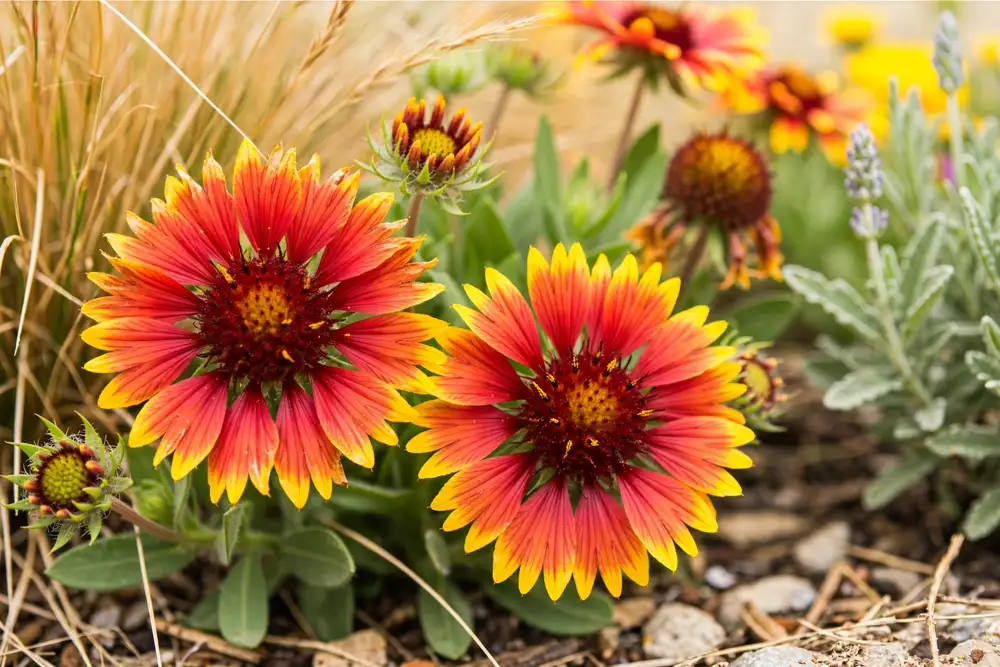
8. Blanket Flower (Gaillardia × grandiflora)
Blanket flower blooms longer than almost anything on this list — red-and-gold daisies from June straight to hard frost if you deadhead, on compact 1–2.5 foot mounds that never need staking. A North American native hybrid, it thrives in the poor, hot, dry soils where fancier perennials sulk, making it the answer for parking strips, sandy slopes, and the front of the border. Zones 3–10.
Lean, well-drained soil and full sun are mandatory; the one thing blanket flower will not forgive is a wet winter crown. Shear the whole plant back by a third in midsummer when bloom pauses, and it will roar back for fall. Treat it as a short-lived perennial — plan to divide or replace every 3–4 years. Deadheading is the single biggest factor in season-long bloom, so make it a weekly habit.
9. Threadleaf Coreopsis (Coreopsis verticillata)
Threadleaf coreopsis earns its place with texture: needle-fine foliage and clouds of small golden daisies that bloom from early summer into fall, especially the classic cultivars ‘Moonbeam’ (pale yellow) and ‘Zagreb’ (deep gold). It is a well-behaved spreader that fills gaps in the border, softens the edges of bolder plants, and never needs staking. Zones 3–9, 1.5–2.5 feet tall.
Full sun and average, well-drained soil; it tolerates drought and poor soil once established. Shear plants back by a third in late summer for a fresh flush of bloom and foliage — threadleaf coreopsis responds to a haircut better than almost any perennial. Divide every 2–3 years to keep clumps floriferous. Taller coreopsis species can flop, but the threadleaf types stay upright.
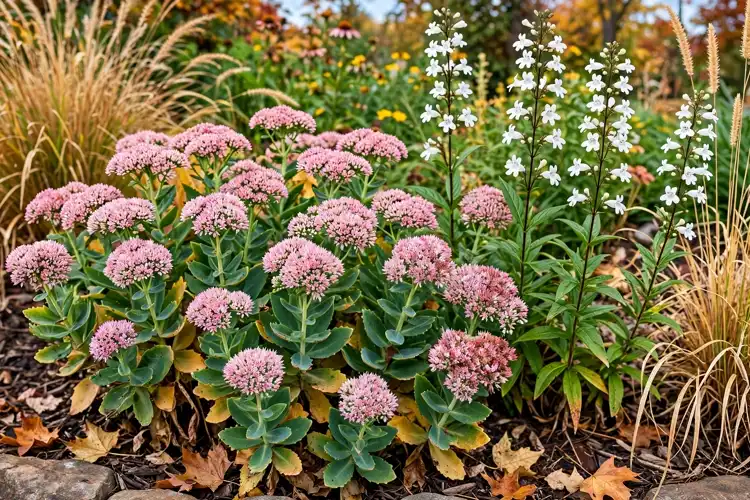
10. Showy Stonecrop (Hylotelephium spectabile)
Showy stonecrop — still widely sold as Sedum spectabile — is the fall workhorse of the sun border. Succulent blue-green rosettes hold flat pink flower heads (‘Autumn Joy’ is the classic) that deepen to copper as the season cools, then stand as architectural seedheads through winter. Blooming from late summer into fall, it picks up exactly when summer perennials fade. Zones 3–9, 1.5–2 feet tall.
This is a true succulent: it wants full sun and well-drained soil and will rot in wet ground. It needs almost no water and no fertilizer — in fact, rich soil makes the stems flop. Leave the seedheads standing for winter interest and cut them down in early spring. Divide in spring every few years; divisions root so readily you can expand a whole border from one plant.
11. Foxglove Beardtongue (Penstemon digitalis)
Penstemons are the western-US answer to foxgloves, and the foxglove beardtongue is the most garden-reliable of them: white tubular flowers with a purple throat on 2–3 foot stems in early summer, followed by attractive seed capsules. The cultivar ‘Husker Red’ adds burgundy foliage that looks good from spring to fall. A true North American native (zones 3–8), it feeds hummingbirds and long-tongued bees when little else is blooming.
Full sun and average soil, and it is one of the few penstemons that tolerates clay. Good drainage still matters — wet winter soil shortens its life. Leave the seedheads for winter interest and self-sowing, then cut back in spring. Penstemons are naturally short-lived (3–5 years is normal); let them seed around and you will always have replacements.
12. Butterfly Weed (Asclepias tuberosa)
Butterfly weed is the showiest milkweed: brilliant orange flower clusters in summer on 1–2.5 foot plants, and the single most important host plant for monarch butterfly caterpillars. Unlike common milkweed it does not spread aggressively, and its deep taproot makes it supremely drought-tolerant once established — it evolved in dry prairies and sandy fields across eastern North America. Zones 3–9.
That taproot comes with a rule: plant it once and never move it. Buy young container plants or sow seed in place; transplanting mature plants usually kills them. Full sun and well-drained to poor soil — it genuinely prefers it lean. Be patient in spring: butterfly weed emerges late, often weeks after everything else. Mark its spot so you don’t dig it up by mistake.
13. Red Hot Poker (Kniphofia uvaria)
Red hot poker looks like it wandered in from another continent — and it did: this South African native sends up 2–4 foot torches of red, orange, and yellow tubular flowers in summer that hummingbirds find irresistible. In a border of daisies and spikes it is the exclamation point, and modern compact cultivars fit smaller gardens. Zones 5–9.
It needs full sun and rich, well-drained soil with consistent moisture during bloom — the one plant on this list that appreciates feeding. In zone 5, mulch the crown heavily in late fall and leave the foliage tied up over winter for insulation; cut it back in spring. Red hot poker leads our flowers that start with K guide if you want more K-blooms. Divide congested clumps in spring every 3–4 years.
14. Shasta Daisy (Leucanthemum × superbum)
The Shasta daisy is the classic white daisy of summer borders — cheerful, crisp, and endlessly useful for cutting. This garden hybrid (bred by Luther Burbank from several species) blooms from early summer into fall with deadheading, standing 2–3 feet tall on sturdy stems that rarely need staking. Zones 5–9. Cultivars like ‘Becky’ are notably vigorous and long-blooming.
Full sun and average, well-drained soil; Shastas dislike wet winters and heavy clay. Deadhead religiously — spent flowers are the enemy of rebloom. Divide every 2–3 years in spring or fall, because clumps decline in the center with age. They pair beautifully with the blue spikes of salvias and the gold of coreopsis for the classic red-white-and-blue border.
15. Dense Blazing Star (Liatris spicata)
Blazing star does something no other flower does: its bottlebrush spikes bloom from the top down, opening in sequence from midsummer on 2–4 foot stems. The purple spikes are butterfly magnets — monarchs in particular mob them — and the corms are native to moist prairies of the central and eastern US. White forms exist, but the purple is the classic. Zones 3–8.
Unlike most sun perennials, blazing star tolerates (even likes) moist soil, though it still needs full sun. Plant corms 2–4 inches deep in spring; established clumps are very long-lived and rarely need dividing. Leave the seedheads for goldfinches and winter interest. If your soil is very dry, water during bud formation for the tallest, fullest spikes.
16. Catmint (Nepeta × faassenii)
Catmint is the blue haze of the summer border: billows of lavender-blue flowers over aromatic gray-green foliage from late spring onward, and the cultivar ‘Walker’s Low’ (a 2007 Perennial Plant of the Year) blooms for months. Bees adore it, deer ignore it, and it weaves beautifully around roses and daylilies. Zones 3–8, 1–3 feet depending on cultivar.
Full sun, average well-drained soil, and one hard shear after the first flush — cut plants back by half and they rebloom within weeks. True catnip (Nepeta cataria) drives cats wild and self-sows aggressively; the ornamental hybrid faassenii is sterile, better-behaved, and the one you want. Divide every 3–4 years to rejuvenate tired centers.
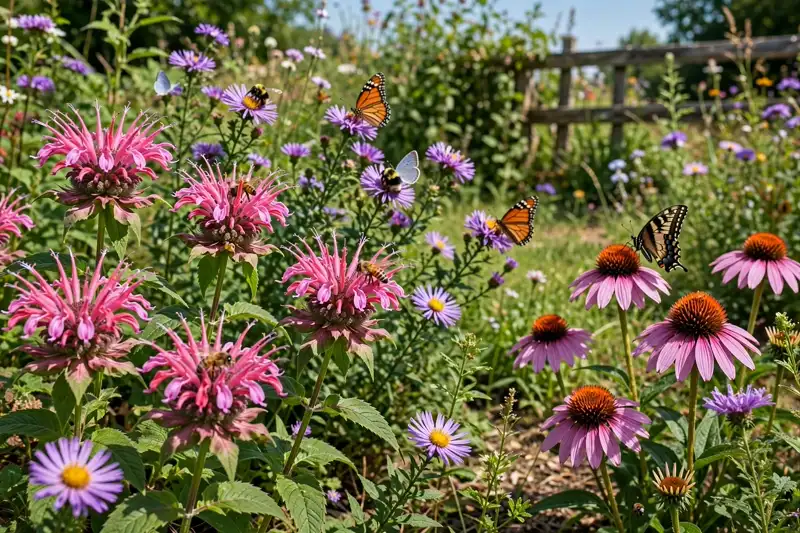
17. Bee Balm (Monarda didyma)
Bee balm is the hummingbird headquarters of the sun garden: shaggy scarlet, pink, or purple flower heads in midsummer, visited constantly by hummingbirds, butterflies, and bees. An eastern-US native in the mint family, it also brings fragrant foliage — Oswego tea was brewed from it — and a bold, cottage-garden presence at 2–4 feet. Zones 4–9.
This is one sun perennial that genuinely wants moisture: rich, humus-rich soil and consistent water keep it happy and reduce its one weakness, powdery mildew. Give plants good air circulation, water at the base, and choose mildew-resistant cultivars like ‘Jacob Cline’ or ‘Raspberry Wine’. Divide every 2–3 years to keep clumps vigorous. The NC State Extension bee balm profile details varieties and care.
18. Garden Phlox (Phlox paniculata)
Garden phlox delivers the sweetest scent of the high-summer border: big fragrant panicles of pink, white, lavender, or red on 2–4 foot stems from midsummer into fall. An eastern-US native, it is a backbone plant for the back of the border, and modern mildew-resistant cultivars (‘David’, ‘Jeana’, the Flame series) have solved its historic weakness. Zones 4–8.
Phlox is hungry and thirsty by sun-perennial standards: rich soil, steady moisture, and mulch. Water at the base — overhead watering invites mildew — and thin stems in spring for air flow. Deadhead to prevent self-seeding of inferior seedlings. Because its genus name starts with P, phlox is a natural fit for our guide to plants that start with P. Divide every 3–4 years in spring.
19. Sea Holly (Eryngium planum)
Sea holly looks forged rather than grown: steel-blue, thistle-like flower heads on wiry branched stems, blooming midsummer into fall with an almost metallic sheen. Despite the name it is not a true holly and not from the sea — it is a Eurasian native that thrives in poor, sandy, dry soils where little else will flower. Superb as a dried flower; cut stems hold their blue for months. Zones 5–9, 2–3 feet tall.
Full sun, lean soil, and sharp drainage — sea holly resents rich, wet ground and winter wet. Once established it is extremely drought-tolerant and almost never needs dividing; in fact, it dislikes being moved thanks to its taproot. Leave flower heads standing through winter for structure, and wear gloves: the bracts are genuinely spiny.
20. Globe Thistle (Echinops ritro)
Globe thistle’s perfectly round steel-blue flower heads on 3–4 foot stems are among the most architectural shapes in the sun garden — striking fresh, and equally prized dried for winter arrangements. Blooming mid to late summer, it draws bees in droves and pairs dramatically with grasses and the soft mounds of catmint. Zones 3–8.
Give it full sun and average, well-drained soil; it tolerates drought and poor soil. Deadhead after bloom if you want to limit its enthusiastic self-seeding. The deep taproot makes established plants hard to move, so site it thoughtfully. Cut stems for drying just as the blue color fully develops.
21. Lamb’s Ear (Stachys byzantina)
Sometimes a garden needs a plant grown for touch: lamb’s ear’s thick, woolly, silver leaves are irresistibly soft and make the finest foliage contrast in the sun border, setting off every flower color around them. The low rosettes stay under a foot (flower spikes reach 1.5 feet in early summer), spreading into weed-smothering mats. Zones 4–8.
Full sun keeps the foliage silver and compact; shade turns it green and floppy. Sharp drainage is essential — the fuzzy leaves trap moisture and rot in humid, wet conditions, so space plants for air flow and avoid overhead watering. Many gardeners cut the flower spikes for a tidier look; the cultivar ‘Silver Carpet’ rarely blooms at all. Divide congested mats in spring.
22. Ornamental Onion (Allium ‘Purple Sensation’)
Ornamental onions bridge spring and summer: 2–3 foot stems topped with perfect purple globes in late spring, exactly when the border needs height. ‘Purple Sensation’ is the classic — inexpensive, reliable, deer- and rodent-proof (the onion scent deters them), and the seedheads stay ornamental for weeks after the color fades. Zones 4–9.
Plant bulbs 4–6 inches deep in fall in full sun and well-drained soil; alliums rot in winter-wet ground. Let the foliage die back naturally — it feeds next year’s bulb — and disguise the yellowing leaves behind emerging perennials like daylilies. They naturalize gently and need dividing only every 4–5 years.
23. Perennial Sunflower (Helianthus × laetiflorus)
For the back of a big border, nothing beats the perennial sunflower: 5–8 foot towers of lemon-yellow daisies from late summer into fall, feeding bees and butterflies when nectar is scarce and standing up to heat that exhausts lesser plants. ‘Lemon Queen’ is the refined choice — soft yellow, long-blooming, and less aggressive than the species. Zones 4–9.
Full sun and average soil; it is remarkably adaptable and drought-tolerant once established. Give it room — this is not a plant for small beds — and cut stems back by a third in early summer if you want shorter, bushier plants. Divide every 3–4 years to control spread and reinvigorate clumps.
24. New England Aster (Symphyotrichum novae-angliae)
New England aster closes the season: clouds of violet-purple daisies from late summer into fall, precisely when migrating monarchs need fuel. This eastern-North-American native is one of the most valuable late-season pollinator plants you can grow, and modern compact cultivars (‘Purple Dome’, ‘Alma Pötschke’) stay tidy at 3–6 feet. Zones 4–8.
Full sun and average, well-drained soil. Pinch or shear stems back by half in early summer for bushier plants with more flowers — unpinched asters can flop. Good air circulation and watering at the base keep foliage diseases in check. Leave the seedheads for winter birds; finches work them for weeks.
Growing Tips for Sun Perennials
Plant in groups of three or five. Single specimens of most sun perennials look lost; odd-numbered drifts create the mass of color these plants are famous for. Space according to the mature width on the tag, not the size of the pot — coneflowers and black-eyed Susans planted a foot apart will knit into a solid drift in two seasons.
Deadhead the repeat bloomers, leave the seedheads. Blanket flower, coreopsis, Shasta daisy, and meadow sage bloom far longer with weekly deadheading. Coneflowers, black-eyed Susans, sedums, and asters earn a second act as bird food and winter architecture — leave their heads standing until spring cleanup.
Stake only when you must, shear instead. Floppy growth usually means too much shade, water, or fertilizer — fix the cause first. For asters, tall sedums, and bolting salvias, a midseason shear (cut back by a third in early summer) produces shorter, sturdier, more floriferous plants with no stakes required.
Divide on schedule. Daylilies, black-eyed Susans, bee balm, phlox, and Shasta daisies all decline in the center after 3–4 years; spring division rejuvenates them and gives you free plants. Taprooted species — butterfly weed, sea holly, globe thistle — should never be divided or moved once established.
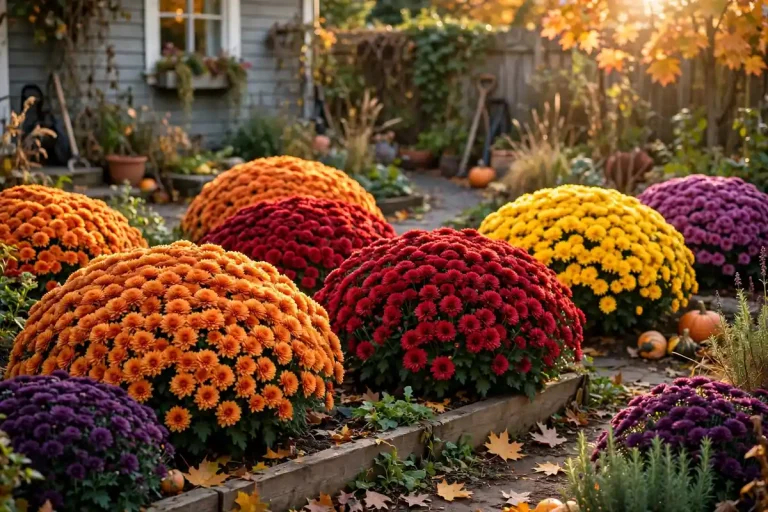
Plan the fall handoff. Sun perennials peak in summer; as they fade, fall containers take over the color. Our mum care guide shows how to keep chrysanthemums blooming for weeks, extending your garden’s season well past the last aster.
Which Sun Perennials Will You Plant?
Twenty-four plants, one requirement: sun. If you are starting from scratch, you cannot go wrong with the backbone trio — purple coneflower, black-eyed Susan, and daylily — plus lavender for fragrance and Russian sage for late-season haze. Add butterfly weed and New England aster for the pollinators, a stonecrop for fall, and an ornamental onion for spring, and you have interest from May to frost.
Match every plant to your zone and your soil before you buy, plant in drifts, water deeply that first summer, and then step back — these are the plants that reward a gardener’s restraint. Pick five that fit your conditions, get them in the ground this season, and let the sun do the rest. Happy planting!
Frequently Asked Questions
What is the easiest perennial to grow in full sun?
Daylilies, black-eyed Susans, and purple coneflowers are the most forgiving full-sun perennials — they tolerate a wide range of soils, survive neglect, and bloom reliably with minimal care. Catmint and yarrow are close behind. Start with these if you are new to sun gardening.
How many hours of sun do “full sun” perennials really need?
At least 6 hours of direct sun daily, and 8+ hours for the heaviest bloom. Afternoon sun is more intense than morning sun. Plants like lavender, Russian sage, and blanket flower genuinely want the hottest spot you have; daylilies, catmint, and coneflowers will still perform with 5–6 hours.
Which full-sun perennials bloom the longest?
Blanket flower blooms from June to frost with deadheading, and threadleaf coreopsis, catmint, and meadow sage all rebloom for months if sheared after the first flush. Daylily rebloomers and black-eyed Susans give 8–12 weeks of color. For continuous bloom, plant a sequence: ornamental onion (spring), salvias and yarrow (early summer), coneflowers and daylilies (midsummer), sedum and asters (fall).
Do full-sun perennials need a lot of water?
Only in their first year. Established lavender, Russian sage, yarrow, blanket flower, sedum, sea holly, and butterfly weed are genuinely drought-tolerant. Bee balm, garden phlox, and blazing star are the exceptions — they want consistently moist soil. Water all new transplants deeply once a week through their first summer regardless of species.
What should I plant in a hot, dry spot where nothing survives?
Russian sage, lavender, yarrow, blanket flower, sea holly, globe thistle, and butterfly weed all evolved for hot, dry, lean conditions. Improve drainage (not fertility), mulch lightly, and water deeply the first season — after that, these plants handle heat that kills fussier perennials.
When is the best time to plant sun perennials?
Spring after the last frost is ideal — plants establish roots before summer heat. Early fall (6+ weeks before hard frost) is the second-best window, especially in hot climates where fall planting avoids the worst heat. Avoid planting in midsummer unless you can water diligently.
References
- NC State Extension — Echinacea purpurea (Purple Coneflower)
- NC State Extension — Rudbeckia fulgida (Black-Eyed Susan)
- The Old Farmer’s Almanac — Growing Daylilies
- Royal Horticultural Society — Lavender Growing Guide
- NC State Extension — Lavandula angustifolia (English Lavender)
- NC State Extension — Monarda didyma (Bee Balm)