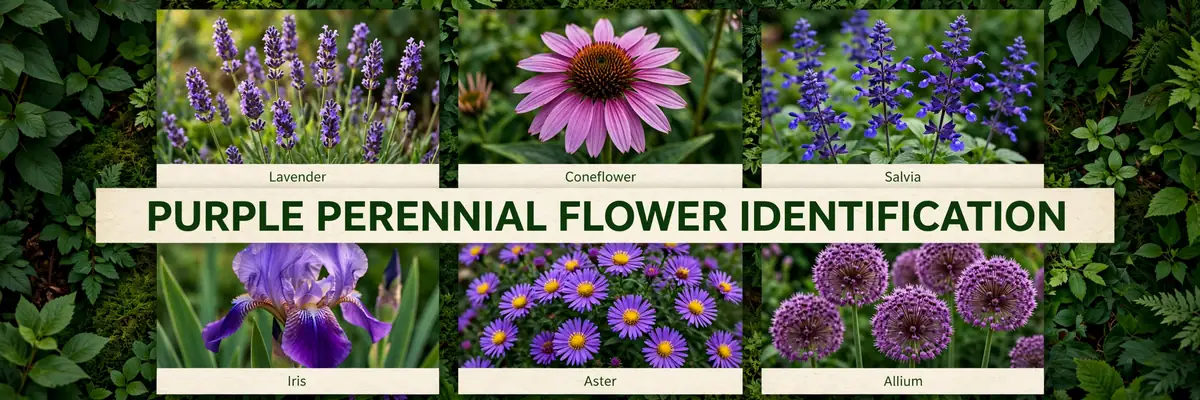
Purple Perennial Flower Identification: How to Identify 19 Purple Perennials by Shape, Leaves, and Bloom Time
You have a mystery purple flower blooming in your garden — or maybe in a neighbor’s border, on a nursery bench, or along a trail — and you want its name. Purple is one of the most common flower colors in the perennial world, which is exactly why it is so hard to pin down: lavender, Russian sage, salvia, catmint, coneflower, aster, and half a dozen others can all read as “tall purple spikes” or “purple daisies” at a glance. The good news is that you rarely need to guess. Flower shape, leaf type, bloom season, height, and scent narrow nearly every purple perennial down to one answer in under a minute, once you know what to look at.
This purple perennial flower identification guide teaches you that 5-point method, then puts it to work across 19 of the most common purple perennials grown in home gardens — each with the exact visual clues that separate it from its lookalikes. Two comparison tables let you cross-check shape, leaves, bloom time, and height at a glance, and a season-by-season cheat sheet helps when all you remember is when it bloomed. Work through the steps below and that mystery flower will have a name before you finish your walk around the block.
Quick Answer
To identify a purple perennial flower, check five things in order: flower shape (spike, daisy, bell, pompon, flat cluster, or dome), leaf type (narrow and silvery? palmate? grass-like?), bloom season (spring, early summer, midsummer, or fall), height and habit, and shade of purple plus scent. Tall purple spikes blooming top-down are blazing star; spikes with a strong herbal scent and silver needle leaves are lavender; drooping purple daisies with a spiny center are purple coneflower; flat purple daisies blooming in fall are asters; and perfect purple spheres on bare stalks with an onion smell are ornamental alliums.
Table of Contents
- How to Identify a Purple Perennial: The 5-Point Method
- Purple Perennial Visual ID Table
- 19 Purple Perennials: ID Profiles With Lookalike Tips
- Purple Lookalikes: Spot the Differences
- Quick ID Cheat Sheet by Bloom Season
- Common Purple Perennial Identification Mistakes
- Frequently Asked Questions
- References
How to Identify a Purple Perennial: The 5-Point Method
Professional botanists identify plants with keys that work through dozens of tiny traits, but for garden perennials you only need five observations, taken in this order. Each step eliminates whole groups of candidates, so by step three you are usually choosing between two or three plants instead of nineteen. If you are working with a plant you also want to grow, the same traits double as a buying checklist — most of these are classic full sun perennials, so confirm your bed gets at least six hours of direct light before you shop.
Step 1: Flower Shape — The Fastest Filter
Flower shape eliminates the most candidates at once. Nearly every purple perennial falls into one of these shapes:
Spikes — small flowers packed along an upright stem. This is the biggest group: lavender, salvia, catmint, Russian sage, veronica, blazing star, delphinium, lupine, and butterfly bush (whose panicles are branched spikes). If your flower is a spike, move to Step 2; leaf and scent differences split this group cleanly.
Daisies — ray petals radiating around a central disc. Only two common purple perennials use this form: purple coneflower (drooping petals, spiny raised cone) and New England aster (flat, many narrow petals, yellow disc). Bloom season separates them instantly — coneflower is summer, aster is fall.
Bells — cup- or bell-shaped flowers: balloon flower and Carpathian bellflower. Check the buds: balloon flower buds inflate like tiny balloons before opening, which no bellflower does.
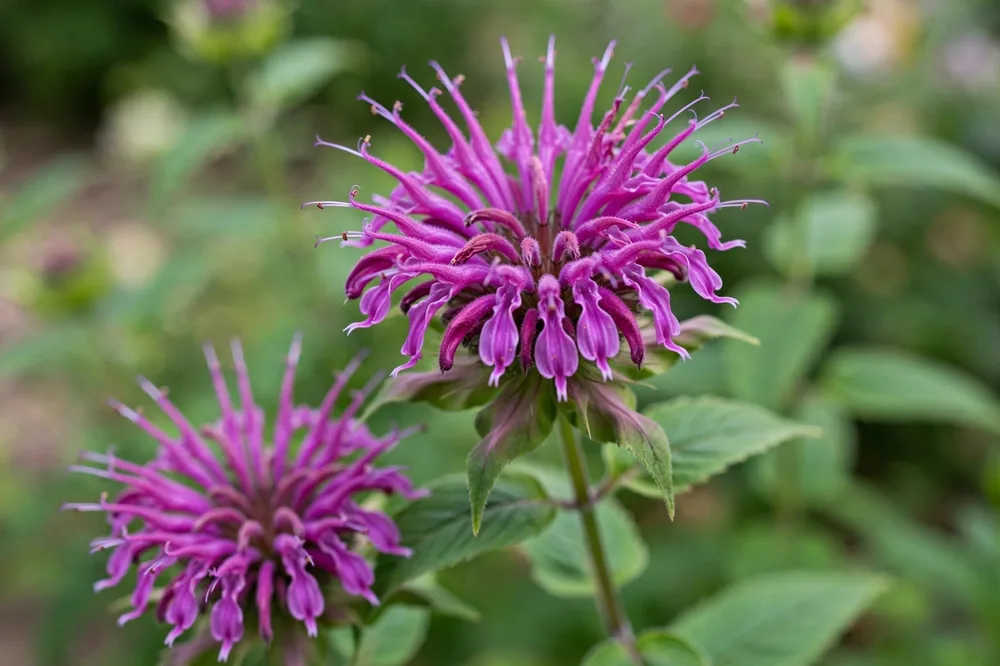
Pompons and spheres — rounded heads of many tiny florets. Bee balm makes shaggy, tousled pompons on leafy stems; globe allium makes geometrically perfect spheres on bare stalks.
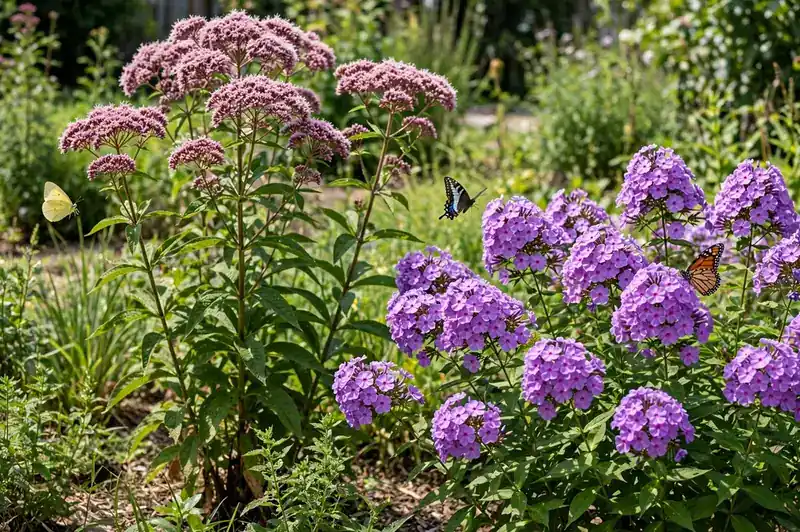
Flat clusters (umbels) — many small flowers forming a flat or domed tabletop: Joe Pye weed is the classic example.
Domes — mounded clusters of individual 5-petaled florets: garden phlox.
Irises — the unmistakable iris architecture of three upright petals (standards) and three drooping ones (falls): Siberian iris.
Saucers — open, bowl-shaped single flowers: hardy geranium ‘Rozanne’.
Step 2: Leaf Characteristics
When two flowers share a shape, leaves break the tie. Rub and look:
Narrow, silvery, needle-like on a woody base means lavender. Finely cut, silvery-gray and feathery on stiff pale stems means Russian sage. Oblong, wrinkled, gray-green and aromatic means salvia; scalloped, heart-shaped, gray-green with a minty scent means catmint or bee balm (both are mint relatives — check for square stems, a mint-family signature). Palmate leaves — leaflets radiating from one point like fingers — belong to lupine and to almost nothing else purple. Deeply divided but not palmate leaves on a tall spike point to delphinium. Narrow, grass-like foliage means blazing star or Siberian iris (iris leaves are stiffer and more upright). Opposite, lance-shaped leaves with domed flower clusters mean garden phlox; whorled leaves (several per node, like spokes) with flat mauve clusters mean Joe Pye weed. Rough, hairy, sandpapery leaves with daisy flowers mean purple coneflower. And if crushing any part of the plant smells of onion, you have an allium — no other purple perennial does that.
Step 3: Bloom Season as an ID Clue
Season is the most underused identification clue. A tall purple spike in May is a completely different set of plants than a tall purple spike in September:
Spring (April–June): lupine, Siberian iris, globe allium, early bellflower, late-spring salvia and catmint.
Early summer (June–July): delphinium, lavender (starting), hardy geranium ‘Rozanne’, balloon flower.
Midsummer (July–August): purple coneflower, bee balm, garden phlox, veronica, lavender at peak.
Late summer–fall (August–October): blazing star, Russian sage, butterfly bush, Joe Pye weed, New England aster.
When a nursery tag is long gone, bloom time plus shape is often enough: a purple daisy blooming in September is an aster, not a coneflower, no matter how similar the photo looks.
Step 4: Height and Growth Habit
Measure or estimate. Ground-hugging mounds under 12 inches (Carpathian bellflower, hardy geranium) are a different world from 4–7-foot back-of-border towers (delphinium, Joe Pye weed, butterfly bush — the last of which is a woody shrub, not a herbaceous perennial, another instant eliminator). Mid-border plants in the 18–36-inch range — lavender, salvia, catmint, coneflower, veronica, phlox — are where most confusion lives, which is why steps 1–3 matter most there. Also note habit: does it form a tidy clump (salvia, veronica), sprawl (catmint, geranium), or stand stiffly upright (coneflower, liatris)?
Step 5: Shade of Purple and Scent
Use color last, because it varies with cultivar and camera — but as a final check it helps. True lavender-blue belongs to lavender and Russian sage; deep violet-blue to salvia ‘May Night’ and veronica; soft blue-violet to catmint; rosy purple with a copper cone to coneflower; rich royal purple to asters and alliums; mauve-pink to Joe Pye weed; magenta-purple to bee balm. Then crush a leaf: sweet-herbal (lavender), minty (bee balm, catmint), oniony (allium), honey-sweet flowers (butterfly bush, phlox), or no scent at all (coneflower, aster, liatris). Scent confirms what shape and leaves suggest.
Purple Perennial Visual ID Table
Scan this table to narrow any purple perennial to a short list. Match flower shape first, then leaves and bloom time — the combination is nearly always unique.
| Flower | Flower shape | Leaf type | Bloom time | Height | Zones |
|---|---|---|---|---|---|
| English Lavender | Dense short spike | Silvery needle-like, fragrant | Jun–Aug | 18–24 in | 5–9 |
| Russian Sage | Airy branched panicle | Finely cut silvery-gray | Jul–Sep | 3–4 ft | 4–9 |
| Salvia ‘May Night’ | Dense upright spike | Oblong wrinkled gray-green, aromatic | May–Jun | 18–24 in | 4–9 |
| Catmint | Loose sprawling spike | Scalloped heart-shaped gray-green, minty | May–Sep | 24–30 in | 3–8 |
| Butterfly Bush | Cone-shaped panicle | Lance-shaped, white undersides | Jul–Sep | 5–8 ft (shrub) | 5–9 |
| Purple Coneflower | Daisy, drooping petals | Rough hairy ovate | Jun–Aug | 24–36 in | 3–8 |
| New England Aster | Flat daisy, many petals | Hairy, clasping stem leaves | Aug–Oct | 3–5 ft | 4–8 |
| Bee Balm | Shaggy pompon | Oval toothed, minty; square stems | Jul–Aug | 30–48 in | 4–9 |
| Balloon Flower | Bell from inflated bud | Oval blue-green; white sap | Jun–Aug | 18–30 in | 3–8 |
| Carpathian Bellflower | Open cup/bell | Heart-shaped basal leaves | Jun–Aug | 8–12 in | 3–8 |
| Spike Speedwell | Dense bottlebrush spike | Glossy toothed dark green | Jun–Aug | 12–24 in | 3–8 |
| Blazing Star | Fuzzy spike, blooms top-down | Grass-like narrow | Jul–Aug | 2–4 ft | 3–8 |
| Lupine | Tall pea-flower spire | Palmate (finger-like leaflets) | May–Jun | 3–4 ft | 4–8 |
| Delphinium | Tall spire, spurred florets | Deeply divided, not palmate | Jun–Jul | 4–6 ft | 3–7 |
| Siberian Iris | Iris: 3 upright + 3 drooping petals | Stiff narrow grass-like | May–Jun | 2–4 ft | 3–8 |
| Hardy Geranium ‘Rozanne’ | Open saucer | Deeply cut maple-like | May–Oct | 12–18 in | 5–8 |
| Globe Allium | Perfect sphere on bare stalk | Strap-like basal, yellows early; onion scent | May–Jun | 30–36 in | 4–8 |
| Joe Pye Weed | Flat-topped dome cluster | Whorled (several per node) | Jul–Sep | 4–7 ft | 4–8 |
| Garden Phlox | Mounded dome of 5-petaled florets | Opposite lance-shaped | Jul–Sep | 2–4 ft | 4–8 |
19 Purple Perennials: ID Profiles With Lookalike Tips
Each profile below gives the botanical name (always confirm this on the nursery tag — common names are reused across different plants), the three or four visual traits that clinch the identification, the lookalike most often confused with it, and the growing tips that matter once you know what you have.
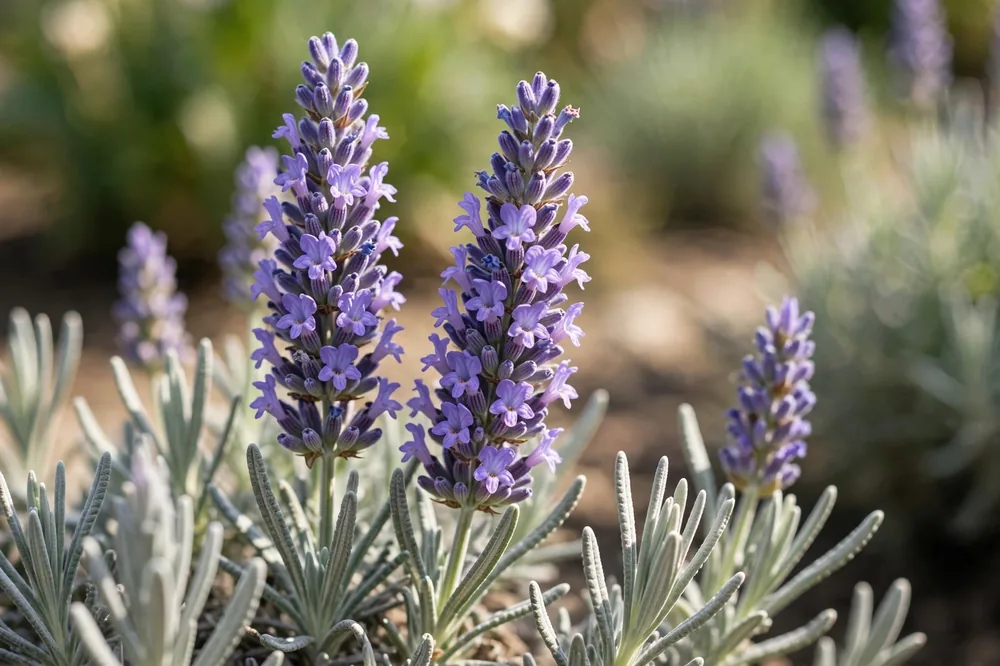
1. English Lavender (Lavandula angustifolia)
ID clues: Short, dense spikes of tiny tubular florets in true lavender-blue rise above narrow, silvery-gray, needle-like leaves on a woody base. Crush a leaf and the sweet-herbal perfume is unmistakable — no lookalike smells like lavender. Plants stay compact at 18–24 inches and bloom June through August in zones 5–9. Among flowers that start with L, lavender is the one gardeners ask about most, and the fragrance test settles it every time.
Lookalike: Russian sage (below) has much airier, taller flower panicles and only a faint scent. French and Spanish lavenders have showier “rabbit ear” bracts on top of each spike.
Growing tips: Full sun and sharp drainage are non-negotiable — wet winter soil kills more lavender than cold does. Plant in lean, slightly alkaline soil, never mulch heavily around the crown, and shear lightly after the first bloom for a possible second flush. Never cut back into bare wood; lavender does not regrow from old leafless stems.
2. Russian Sage (Salvia yangii, syn. Perovskia atriplicifolia)
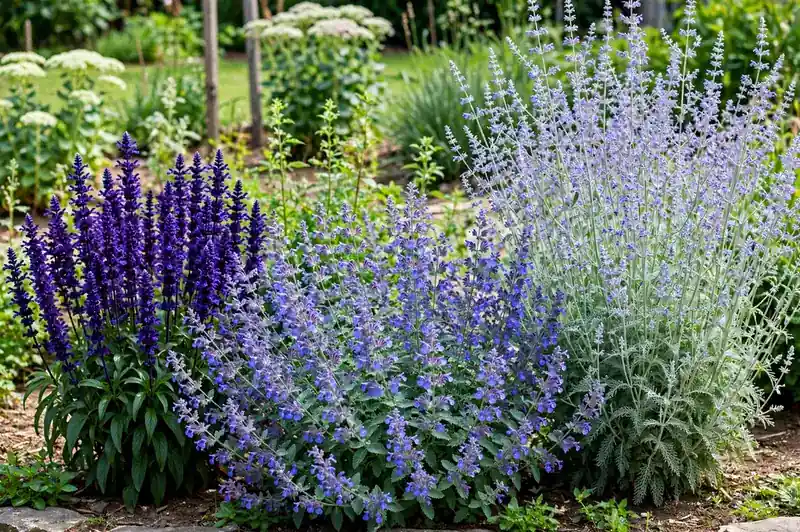
ID clues: Clouds of tiny lavender-blue flowers float in airy, branching panicles 12 inches or more long above stiff, almost white stems. The foliage is the giveaway: finely cut, silvery-gray, and feathery, with only a faint sage scent when crushed. At 3–4 feet tall blooming July through September (zones 4–9), it reads as a purple haze rather than a solid spike.
Lookalike: Lavender is denser, shorter, and far more fragrant; butterfly bush has cone-shaped, honey-scented panicles and solid green leaves.
Growing tips: Give it the hottest, leanest spot you have — rich soil and excess water make it flop. Cut all stems back hard in early spring (new growth flowers best) and skip fertilizer entirely. Excellent for xeric borders and one of the toughest full sun perennials once established.
3. Salvia ‘May Night’ (Salvia nemorosa ‘Mainacht’)
ID clues: Stiff, upright, densely packed spikes of deep violet-blue — the darkest “true purple” of the spike group — rise 18–24 inches over clumps of oblong, wrinkled, gray-green leaves that smell herbal-sagey when rubbed. Blooms May into June (zones 4–9) with a strong rebloom if sheared. The flower spikes are noticeably denser and more formal than catmint’s.
Lookalike: Spike speedwell has glossier, non-aromatic leaves and a tidier bottlebrush form; catmint is looser, grayer, and sprawls.
Growing tips: Deadhead or shear back by a third after the first flush and you will get flowers into fall. Deer and rabbits avoid it, it tolerates clay better than lavender, and divisions every 3–4 years keep clumps vigorous. One of the most reliable flowers that start with S for beginners.
4. Catmint (Nepeta × faassenii ‘Walker’s Low’)
ID clues: Billowy, branching spikes of soft blue-violet flowers over mounds of scalloped, heart-shaped, gray-green leaves. Crush the foliage for a minty-herbal scent, and check the stems — square in cross-section, the mint-family signature it shares with bee balm. The habit sprawls and softens edges rather than standing at attention, blooming May through September in zones 3–8 with shearing.
Lookalike: Catnip (Nepeta cataria) has white flowers and a weedier look; salvia ‘May Night’ is stiffer, darker, and more upright.
Growing tips: Shear back by half after the first bloom to prevent flopping and trigger rebloom. Extremely drought-tolerant once established and ignored by deer. Note: it attracts cats, who may roll in it — plant it where a flattened center will not bother you.
5. Butterfly Bush (Buddleia davidii)
ID clues: Long, cone-shaped panicles of tiny fragrant florets — purple cultivars like ‘Black Knight’ are a deep royal purple — carried on an arching woody shrub 5–8 feet tall, blooming July through September (zones 5–9). Two traits clinch it: the honey-sweet perfume and the constant butterfly traffic. Leaves are lance-shaped, dark green above and distinctly white-felted beneath.
Lookalike: Russian sage is herbaceous (dies back), has silvery cut foliage, and lacks the sweet scent; lilac blooms in spring on woodier stems.
Growing tips: Treat it like a perennial: cut all stems back to about 12 inches in early spring, since flowers form on new wood. Deadhead to extend bloom and reduce self-seeding — it is invasive in parts of the Pacific Northwest and Southeast, so check local guidance and consider sterile cultivars.
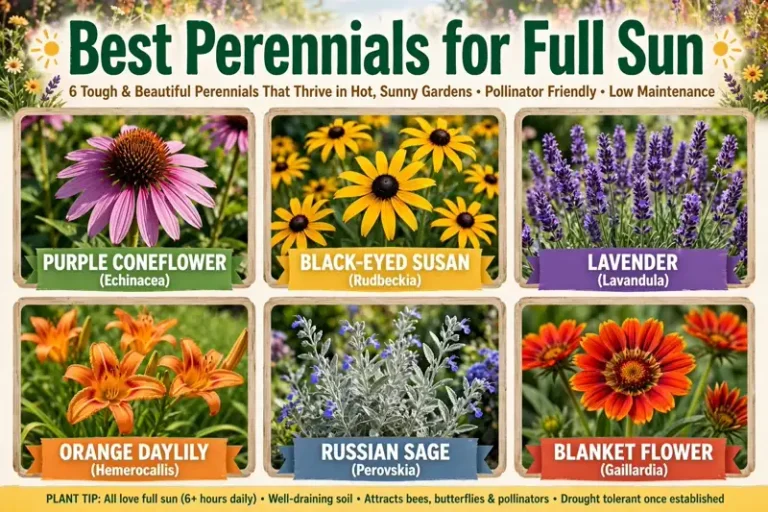
6. Purple Coneflower (Echinacea purpurea)
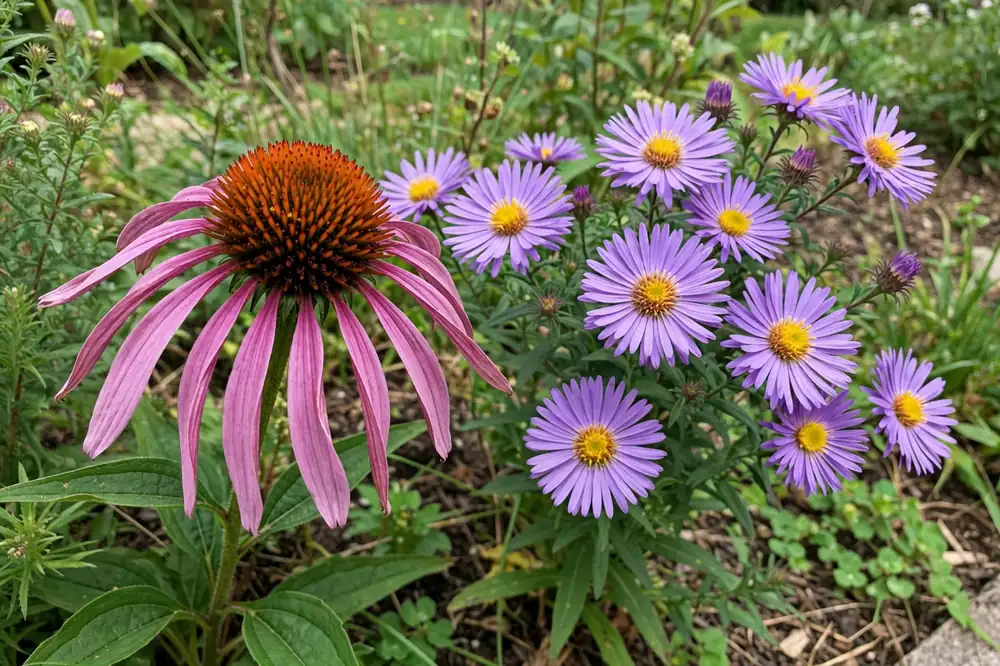
ID clues: The classic purple daisy: rosy-purple petals that droop downward from a prominent, spiny, copper-orange central cone. Stems and leaves are rough and hairy to the touch — run a finger along a leaf and it feels like sandpaper. Plants stand stiffly upright at 24–36 inches, blooming June through August in zones 3–8. Its botanical name also earns it a place among flowers that start with E, and it is one of the easiest flowers that start with C to confirm by touch alone.
Lookalike: New England aster (below) is a flatter daisy with far more petals and blooms in fall; black-eyed Susan is the yellow version of the same architecture.
Growing tips: Full sun, tolerates clay and drought once established. Deadhead for tidiness or leave the seed heads standing — goldfinches prize them through winter. Divide every 3–4 years; new hybrids come true only from division, not seed.
7. New England Aster (Symphyotrichum novae-angliae)
ID clues: Dozens of narrow, rich-purple ray petals around a golden-yellow disc, carried in profusion on hairy 3–5-foot stems. The leaves clasp the stem directly (no leaf stalk), another hairy-stemmed clue. The clincher is timing: it blooms August through October (zones 4–8), when coneflowers are finished and almost nothing else purple is flowering. Fall mums bloom at the same time, but our mum care guide notes their denser, many-petaled blooms and very different foliage.
Lookalike: Purple coneflower blooms in summer with drooping petals and a spiny cone; New York aster is similar but smoother-stemmed.
Growing tips: Pinch stem tips back until early July for bushier, shorter plants that do not flop. Give it full sun and good air circulation — powdery mildew is its main weakness. A vital late-season nectar source for migrating monarchs.
8. Bee Balm (Monarda didyma)
ID clues: Shaggy, tousled pompon heads — each a fireworks-burst of tubular magenta-purple florets — sit atop leafy stems 30–48 inches tall. Check two things: stems are distinctly square in cross-section, and crushed leaves smell of mint, oregano, or Earl Grey tea (it is in the mint family). Blooms July through August in zones 4–9. No other purple perennial combines the wild pompon form with that scent.
Lookalike: Purple coneflower is a true daisy with a spiny cone; globe allium makes perfect spheres on bare, onion-scented stalks.
Growing tips: Powdery mildew is the eternal battle — space plants generously, water at the base, and choose resistant cultivars like ‘Purple Rooster’ or wild bergamot (M. fistulosa). Deadhead to extend bloom; divide crowded clumps every 3 years. A hummingbird magnet.
9. Balloon Flower (Platycodon grandiflorus)
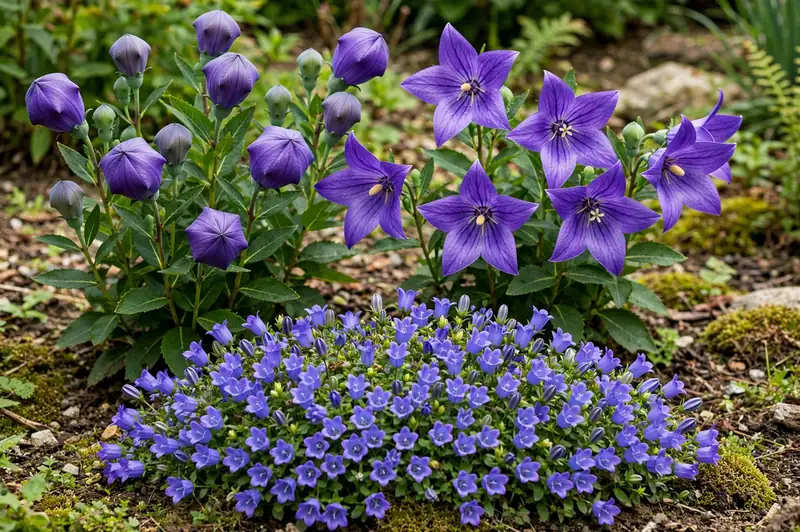
ID clues: The buds are the identification: they swell into perfect little purple balloons before popping open into wide, five-petaled bells. Nothing else in the garden does this. Flowers are violet-blue to purple on 18–30-inch stems with oval, blue-green leaves; snap a stem and white milky sap appears. Blooms June through August in zones 3–8.
Lookalike: Carpathian bellflower (below) has similar bells but normal buds and a low, mounding habit.
Growing tips: It resents transplanting because of a long taproot — choose its spot once. It is also slow to emerge in spring, so mark the location to avoid digging it up by mistake. Otherwise undemanding: full sun to part shade, average soil, long-lived.
10. Carpathian Bellflower (Campanula carpatica)
ID clues: Cheerful open cups of violet-blue to purple bells on low, tidy mounds just 8–12 inches tall, with heart-shaped basal leaves. The buds are ordinary pointed buds — the absence of balloon buds is itself the field mark separating it from balloon flower. Blooms June through August in zones 3–8, often reblooming if sheared.
Lookalike: Balloon flower is taller with inflated buds and milky sap; clustered bellflower (C. glomerata) packs its bells into tight upright clusters.
Growing tips: A superb edging and rock-garden plant that tolerates part shade. Shear after the first flush for rebloom, and let a few flowers self-sow for free replacements. Dislikes hot, humid nights — give it afternoon shade in warm climates.
11. Spike Speedwell (Veronica spicata)
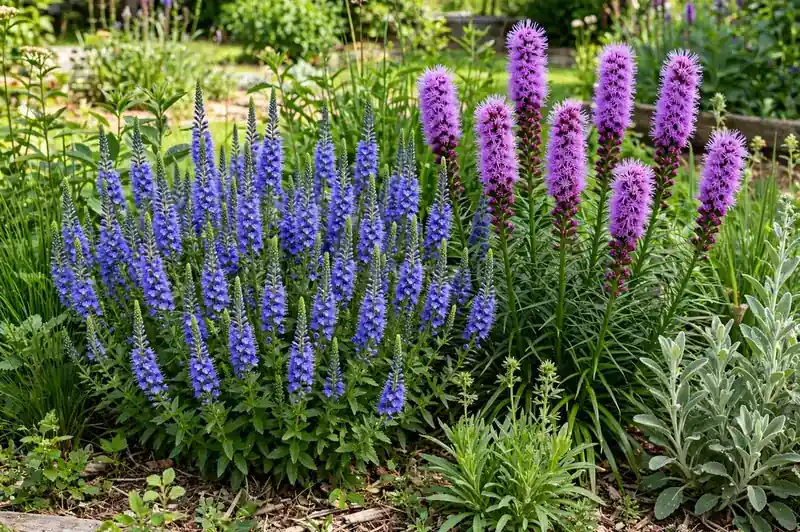
ID clues: Dense, upright, bottlebrush spikes of deep violet-blue florets over tidy clumps of glossy, dark-green, toothed leaves. The spikes are smoother and more uniform than salvia’s, and the leaves are the clincher — glossy and unscented, unlike any salvia or catmint. Blooms June through August at 12–24 inches in zones 3–8. Find more of its relatives in our guide to flowers that start with V.
Lookalike: Salvia ‘May Night’ has aromatic, wrinkled gray-green leaves; blazing star blooms top-down and has grassy foliage.
Growing tips: Deadhead spent spikes to the next bud for months of rebloom. Prefers consistently moist, well-drained soil — it sulks in drought where salvia thrives. Divide every 3–4 years to keep the center from dying out.
12. Blazing Star (Liatris spicata)
ID clues: Fuzzy purple spikes 2–4 feet tall with the single most distinctive blooming pattern in the perennial border: the florets open from the TOP of the spike downward, while nearly every other spike flower opens bottom-up. Foliage is narrow and grass-like, mostly basal. Blooms July through August in zones 3–8.
Lookalike: Spike speedwell and salvia both bloom bottom-up with broader leaves; delphinium has much larger individual florets with spurs.
Growing tips: Full sun and lean soil — it tolerates poor, sandy ground beautifully but rots in wet winter soil, so drainage matters more than fertility. Grows from corms planted in spring. Outstanding cut flower with a 2-week vase life; butterflies adore it.
13. Lupine (Lupinus polyphyllus)
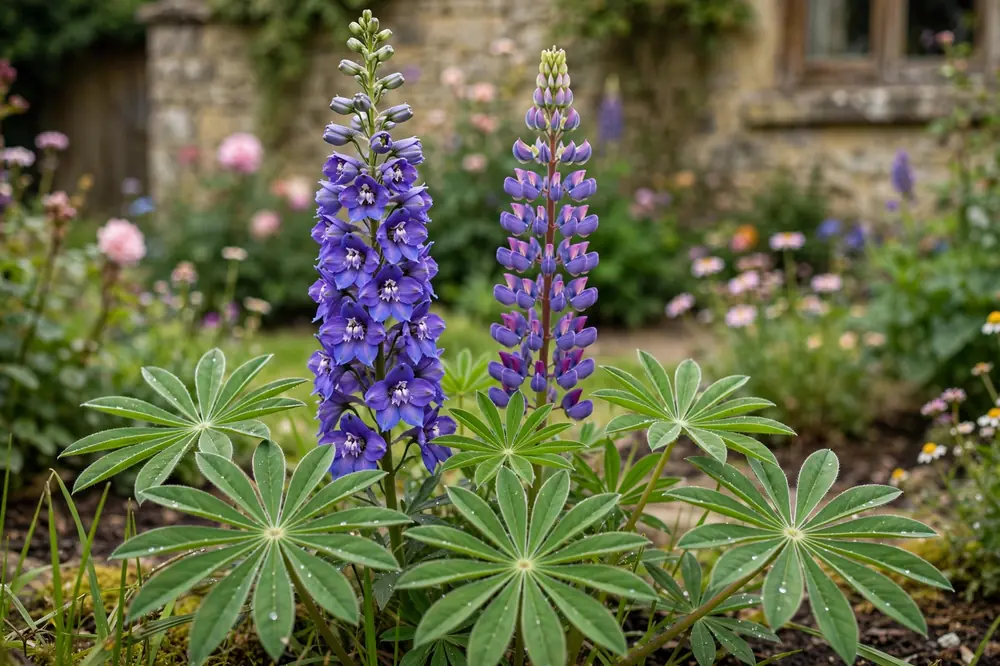
ID clues: Tall spires of pea-shaped purple flowers in May and June, but you can identify lupine without a single bloom: the leaves are palmate — 7 to 11 soft leaflets radiating from a central point like fingers on a hand — and almost no other garden plant shares them. Plants reach 3–4 feet in zones 4–8.
Lookalike: Delphinium (below) has similar spires but deeply lobed, non-palmate leaves and spurred individual flowers; foxglove is a biennial with tubular bells.
Growing tips: A cool-summer perennial that sulks in heat — it thrives in the Pacific Northwest and Northeast but is short-lived in hot climates. Give it full sun, neutral to slightly acidic soil, and let it self-sow for continuity. As a legume it fixes nitrogen, improving the soil for its neighbors.
14. Delphinium (Delphinium elatum hybrids)
ID clues: Majestic 4–6-foot spires of cupped florets, each with a backward-pointing spur at the back (gently pull one floret off and look behind it). Leaves are large and deeply divided but never palmate like lupine’s. Blooms June into July in zones 3–7, in shades from violet to deep purple, often with a contrasting “bee” (center) in white or black.
Lookalike: Lupine has pea-flowers without spurs and palmate leaves; blazing star blooms top-down with tiny fuzzy florets.
Growing tips: The diva of the border: rich, well-drained soil, consistent moisture, and staking are mandatory. Cut flowered spikes to the ground after bloom for a smaller second flush. Note that all parts are toxic if ingested — plant away from curious pets and toddlers.
15. Siberian Iris (Iris sibirica)
ID clues: The iris flower architecture is unmistakable: three upright petals (standards) and three drooping ones (falls), in violet-purple, carried on slender stems above stiff, narrow, grass-like foliage that stays upright all season. Blooms May into June at 2–4 feet in zones 3–8. Unlike bearded iris, there is no fuzzy “beard” and the leaves are much narrower.
Lookalike: Japanese iris has larger, flatter flowers and prefers wetter soil; bearded iris has wide, fan-like leaves and rhizomes at the surface.
Growing tips: One of the few purple perennials that tolerates — even enjoys — moist soil, making it ideal for rain gardens and pond edges. Divide in late summer (it resents spring division). Leave the foliage standing for winter interest; cut back in early spring.
16. Hardy Geranium ‘Rozanne’ (Geranium × ‘Rozanne’)
ID clues: Violet-blue saucer flowers with white centers and dark radiating veins, blooming nonstop from May to October on sprawling 12–18-inch mounds. The deeply cut, almost maple-like leaves are the vegetative clue. Do not confuse it with annual “geraniums” (pelargoniums) — true hardy geraniums have single open saucers, not pompon heads. Zones 5–8.
Lookalike: Other cranesbill geraniums have smaller or pinker flowers; mallow has similar saucers but hollyhock-like tall growth.
Growing tips: Shear the whole plant back by a third in midsummer if it sprawls — it rebounds with fresh bloom. No deadheading needed. One of the longest-blooming perennials ever bred; excellent for weaving through roses and shrubs.
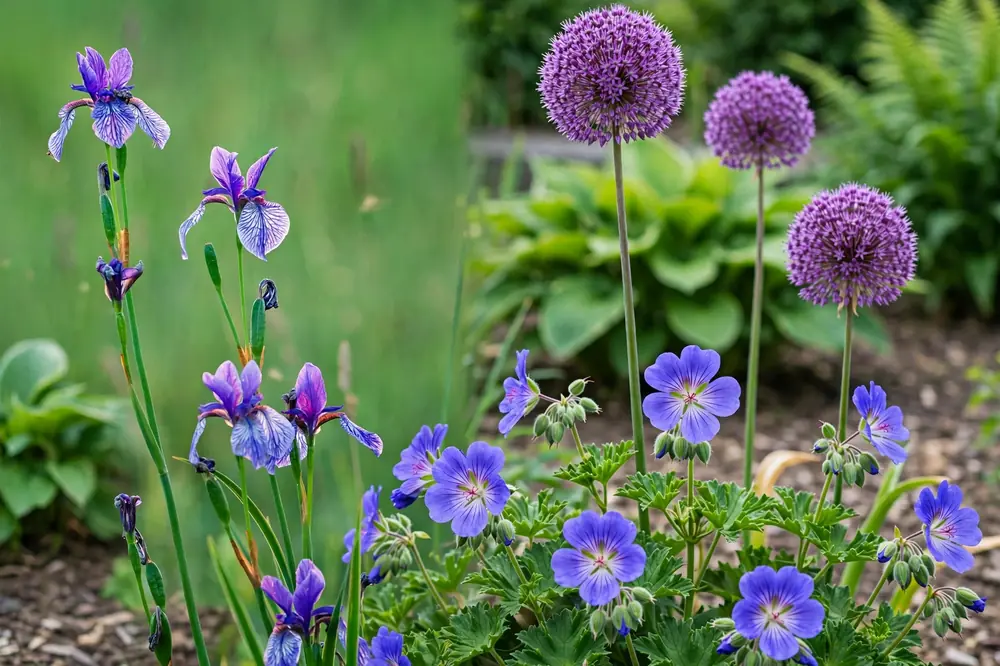
17. Globe Allium (Allium ‘Globemaster’)
ID clues: A geometrically perfect purple sphere, 8–10 inches across, floating on a tall leafless stalk 30–36 inches high. The basal strap-like leaves yellow and wither just as the flower opens — a normal and expected part of the show. The definitive test: crush any green part and it smells unmistakably of onion. Blooms May into June in zones 4–8.
Lookalike: Bee balm makes shaggy pompons on leafy, mint-scented stems; drumstick allium (A. sphaerocephalon) makes much smaller egg-sized heads later in summer.
Growing tips: Plant bulbs in fall, 6–8 inches deep, in sharply drained soil — wet winter soil rots them. Do not cut the yellowing foliage until it pulls away freely; the bulb needs it. The dried seed heads are architectural enough to leave standing for months.
18. Joe Pye Weed (Eutrochium purpureum)
ID clues: Huge flat-topped domes of tiny mauve-purple florets crowning 4–7-foot stems in late summer (July–September, zones 4–8). Look at the leaf nodes: leaves grow in whorls of 3–6 around the stem like spokes on a wheel — a rare arrangement that confirms the ID instantly. Crush a flower head for a faint vanilla scent, and watch for the butterfly crowds.
Lookalike: Garden phlox (below) has domed clusters too, but opposite leaves and fragrant 5-petaled florets; ironweed has darker purple flowers and alternate leaves.
Growing tips: Unlike most on this list, it loves moisture — perfect for low spots and rain gardens. For shorter plants, cut stems back by a third in June. It self-sows enthusiastically; deadhead if you want to contain it. Native-plant gardens prize it as a late-season pollinator powerhouse.
19. Garden Phlox (Phlox paniculata)
ID clues: Fragrant, mounded domes of individual five-petaled florets in purple, lavender, and magenta, blooming July through September on 2–4-foot stems with opposite, lance-shaped leaves. The sweet perfume — strongest in the evening — plus the 5-petal count are the field marks. Blooms carry on for weeks in zones 4–8.
Lookalike: Dame’s rocket (Hesperis matronalis) is the classic impostor: its flowers look similar but have only FOUR petals, alternate leaves, and it is a short-lived biennial, not a true perennial. Bee balm has square stems and minty scent.
Growing tips: Powdery mildew is the main enemy — give it full sun, good air circulation, and water at the base. Deadhead for rebloom and divide every 3–4 years to keep clumps vigorous. Do not confuse it with creeping phlox, a spring groundcover.
Purple Lookalikes: Spot the Differences
These are the pairs gardeners confuse most often. Each has one decisive field test — run it and the argument is over.
| The pair | Plant A | Plant B | The decisive test |
|---|---|---|---|
| Lavender vs Russian Sage | Dense 2–3 in spikes, intensely fragrant, silver needle leaves, 2 ft | Airy 12 in+ panicles, faint scent, feathery cut leaves, 4 ft | Crush a leaf: strong sweet-herbal perfume = lavender |
| Salvia ‘May Night’ vs Catmint | Stiff upright deep-violet spikes, wrinkled aromatic leaves, tidy clump | Soft sprawling blue-violet spikes, scalloped gray leaves, minty scent | Habit: at-attention formal clump = salvia; billowy sprawler = catmint |
| Balloon Flower vs Bellflower | Buds inflate like balloons before opening; white sap; 18–30 in | Open cups from ordinary buds; no sap; low 8–12 in mound | Find an unopened bud: inflated balloon = balloon flower |
| Delphinium vs Lupine | Each floret has a rear spur; leaves deeply lobed but not palmate | Pea-shaped florets, no spur; palmate finger-like leaves | Pull off one floret and look behind it: spur = delphinium |
| Blazing Star vs Spike Speedwell | Blooms top-down; fuzzy florets; grassy basal leaves | Blooms bottom-up; dense smooth spikes; glossy toothed leaves | Check which end of the spike opened first: top = blazing star |
| Purple Coneflower vs New England Aster | Drooping petals, spiny raised cone; blooms summer | Flat daisy, many narrow petals, yellow disc; blooms fall | Season + center: spiny cone in July = coneflower; flat yellow disc in September = aster |
| Garden Phlox vs Dame’s Rocket | 5 petals per floret; opposite leaves; true perennial; fragrant | 4 petals per flower; alternate leaves; short-lived biennial | Count the petals: 5 = phlox, 4 = dame’s rocket |
| Bee Balm vs Globe Allium | Shaggy pompons on leafy square stems; minty scent | Perfect spheres on bare stalks; onion scent; basal leaves yellow early | Crush foliage: mint = bee balm; onion = allium |
Quick ID Cheat Sheet by Bloom Season
If all you remember is when it bloomed, start here — then confirm with shape and leaves from the table above.
Spring bloomers (April–June)
Lupine (pea spires, palmate leaves), Siberian iris (iris form, grassy leaves), globe allium (purple spheres, onion scent), Carpathian bellflower (low cups), and late-spring salvia ‘May Night’ and catmint getting started. A tall purple spike in May is almost always lupine or delphinium just beginning.
Early summer (June–July)
Delphinium (towering spurred spires), English lavender (fragrant spikes, silver leaves), balloon flower (balloon buds), hardy geranium ‘Rozanne’ (violet saucers, months of bloom), and spike speedwell. This is peak spike season — use the leaf and scent tests to sort lavender, salvia, and veronica.
Midsummer (July–August)
Purple coneflower (drooping daisies, spiny cones), bee balm (shaggy pompons, mint scent), garden phlox (fragrant domes), blazing star (top-down spikes), and Russian sage and butterfly bush beginning. If it is a purple daisy in July, it is a coneflower; asters have not started yet.
Late summer to fall (August–October)
New England aster (flat purple daisies), Joe Pye weed (mauve flat-topped domes, whorled leaves), Russian sage and butterfly bush at peak, and reblooming catmint and salvia. A purple daisy blooming in September or October is an aster — full stop.
Common Purple Perennial Identification Mistakes
Mistake 1: Calling annuals perennials. The most common error of all. Petunias, verbena, and heliotrope all come in purple and look perennial-ish in a summer border, but they die with frost while true perennials return from the roots. Gardeners constantly confuse them with purple annual flowers — check for a woody base or overwintering crown, and when in doubt, look up the tag or wait for spring: perennials resprout, annuals do not.
Mistake 2: “Lavender” for anything purple and fragrant. Russian sage, catmint, and even lilac all get called lavender. Real lavender (Lavandula angustifolia) has needle-like silver leaves and the strongest perfume of the group — if the leaves are broad or the scent is faint, it is not lavender.
Mistake 3: Counting on color alone. “Purple” covers lavender-blue, violet, mauve, magenta, and lilac, and the same cultivar photographs differently in sun versus shade. Always confirm with shape, leaves, and season before deciding.
Mistake 4: Assuming the nursery tag is right. Mislabeling is rampant, especially with salvias, veronicas, and asters. Use this guide’s field tests — petal counts, spur checks, scent tests — to verify, not the plastic tag.
Mistake 5: Forgetting that bloom time is data. A “purple daisy” photo without a date is half an identification. Coneflower versus aster, spring salvia versus fall aster — season resolves dozens of these disputes instantly, so always note when you saw it bloom.
Frequently Asked Questions
How do I identify a purple flower in my garden?
Work through five traits in order: flower shape (spike, daisy, bell, pompon, flat cluster, or dome), leaf type, bloom season, height and habit, and shade of purple plus scent. Shape alone eliminates most candidates — for example, only coneflower and aster make purple daisies, and bloom season (summer versus fall) separates those two immediately. The comparison tables above walk you through the whole process.
What is the tall purple perennial with spikes?
It depends on the season. In May–June it is likely lupine (palmate leaves) or delphinium (spurred florets, 4–6 ft). In midsummer, blazing star (blooms top-down) or veronica. In late summer, Russian sage (airy silvery panicles) or butterfly bush (cone-shaped, honey-scented, woody shrub). Check the leaves and bloom direction to narrow it down.
How can I tell lavender from Russian sage?
Three differences: lavender has dense, short spikes and intensely fragrant, needle-like silver leaves on a compact 2-foot plant; Russian sage has loose, airy panicles over a foot long, only faintly scented feathery foliage, and reaches 3–4 feet. Crush a leaf — if the sweet-herbal perfume is unmistakable, it is lavender.
Which purple perennials bloom in the fall?
New England aster is the star fall bloomer (September–October), joined by late Joe Pye weed, Russian sage, butterfly bush, and reblooming catmint and salvia. If your mystery flower is a purple daisy blooming after Labor Day, it is an aster.
Is my purple flower a perennial or an annual?
True perennials return from the same roots each spring and often develop a woody base or persistent crown; annuals like petunias and most verbena die completely with frost. If the plant came back on its own this spring without replanting, it is a perennial (or a self-sown annual — check whether seedlings, not the original crown, returned).
Why didn’t my purple perennial come back this spring?
The usual culprits are wrong hardiness zone (lavender and butterfly bush are the most common victims), wet winter soil rotting the crown (lavender, blazing star corms, allium bulbs), or cutting back too hard in fall — many perennials need their top growth left for winter protection. Check your USDA zone against the plant’s rating in the table above before replanting.
References
- Missouri Botanical Garden Plant Finder — searchable database of perennials by flower color, bloom time, height, and zone; the standard reference for confirming an identification.
- RHS Plant Search — the Royal Horticultural Society’s plant database with detailed growing and identification notes.
- Old Farmer’s Almanac: Plant Hardiness Zones — find your USDA zone to check whether a purple perennial will survive your winters.
- Gardening Know How: Planting a Lavender Garden — variety selection, spacing, and care for lavender plantings.
- RHS: How to Grow Lavender — planting, pruning, and soil guidance for English lavender.