Skeleton Flower: The Flower That Turns Transparent in Rain
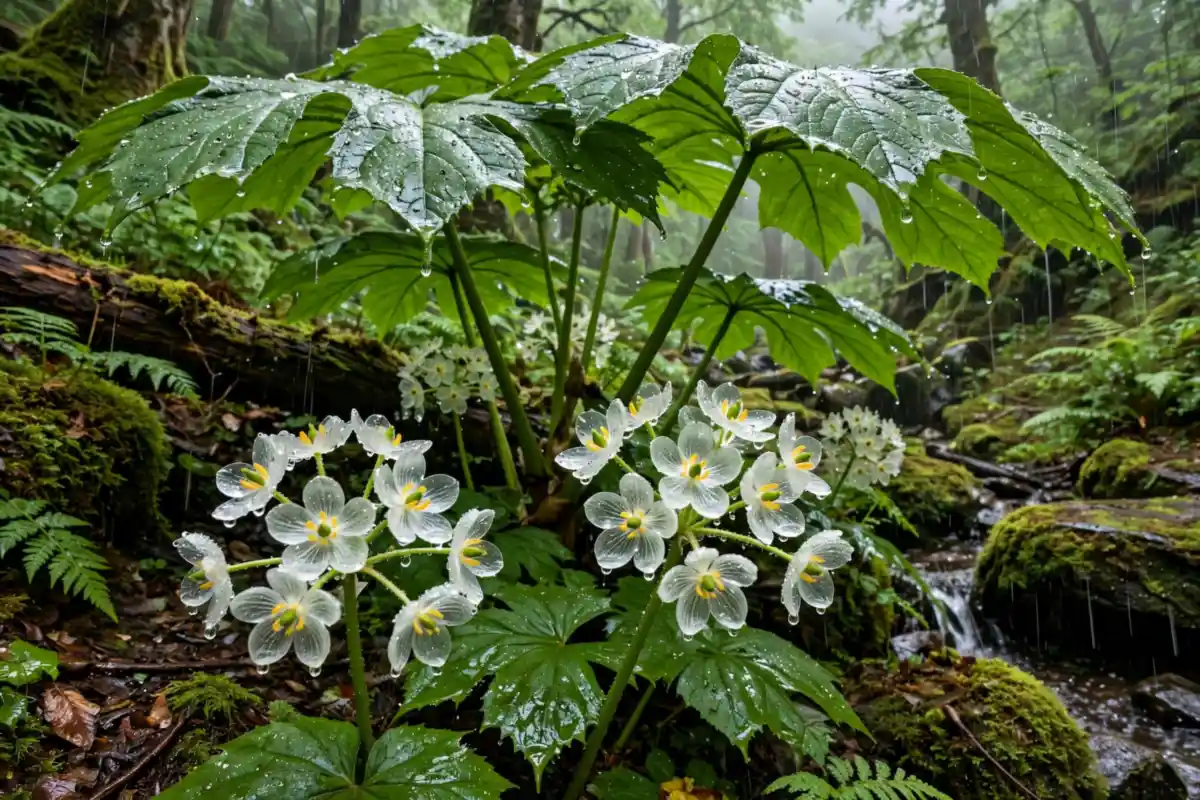
Rain does something to this flower that sounds like folklore and is pure physics: the white petals go clear as glass. Water fills the air pockets inside the petal tissue, the scattering that makes it look white disappears, and the skeleton flower stands in the forest drizzle wearing nothing but its own veins — then, as it dries, the white returns. No pigment changes, no magic. Just a mountain flower in northern Japan whose beauty works in two weathers.
This guide covers the skeleton flower properly (the six faces of Diphylleia grayi, from white bloom to glass rain-state to cobalt berries), what it means — purity, transparency and things briefly revealed — the science of the vanishing act, and the OTHER white “skeleton”, the ghost plant, which borrows the name by a different route.
Quick Answer
The skeleton flower is Diphylleia grayi, a woodland perennial in the barberry family Berberidaceae from the cool mountains of Japan, China and the Russian Far East, whose white petals turn transparent when wet and white again as they dry. It grows 12 to 16 inches tall under two huge umbrella leaves, in USDA zones 4 to 8, needing cool shade and soil that never dries. In floriography the skeleton flower means purity, honesty and fleeting beauty — affection that hides nothing. It is a connoisseur’s woodland plant: slow, scarce, and unforgettable in the rain.
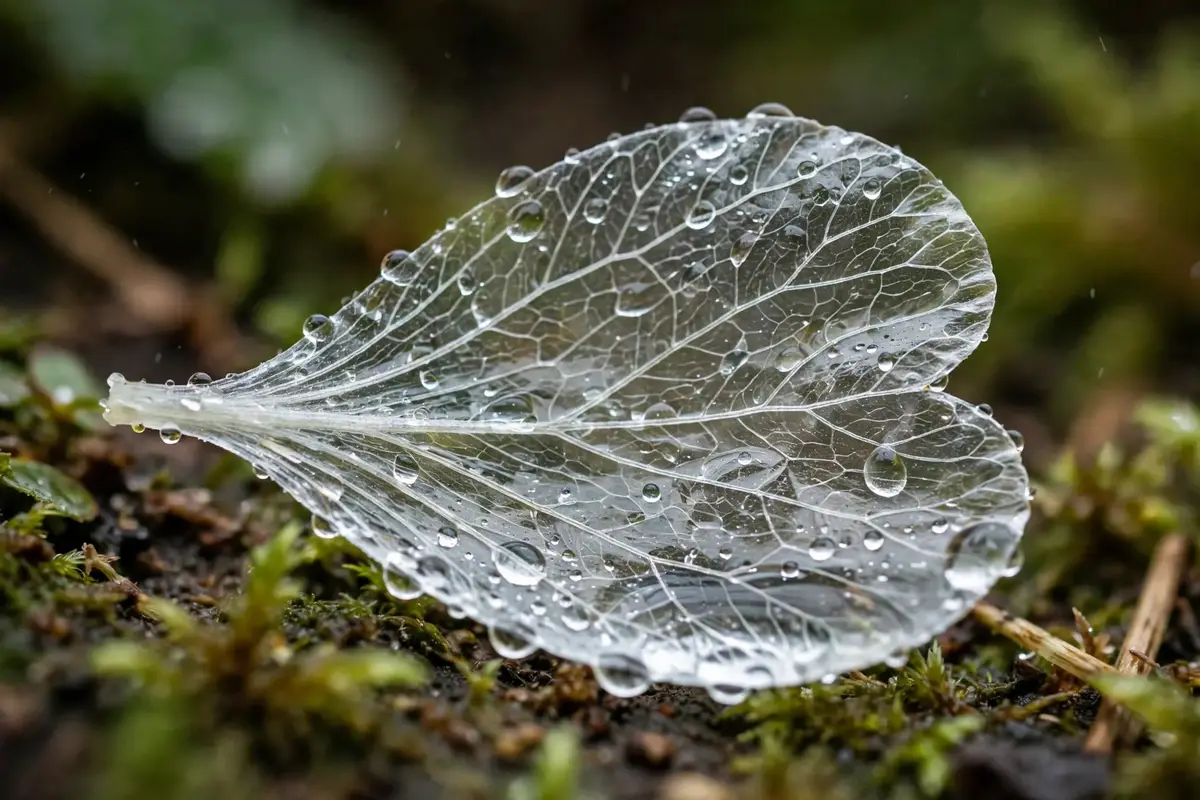
Table of Contents
- What Is a Skeleton Flower?
- The Six Faces of Diphylleia and 6 Things Worth Knowing
- Skeleton Flower Meaning and Symbolism
- Skeleton Flower Colours and Their Meanings
- How to Grow Skeleton Flowers
- Common Mistakes When Growing Skeleton Flowers
- Skeleton Flower vs Ghost Plant: Two White Ghosts
- Frequently Asked Questions
What Is a Skeleton Flower?
Diphylleia grayi — named for the American botanist Asa Gray — is a plant of high, wet forests: it grows where mountain streams keep the air humid and the summers cool, in Hokkaido and northern Honshu (Japanese gardeners call it sankayou), in China (D. sinensis is its close cousin) and on Sakhalin. The plant is built like an umbrella stand: a rhizome sends up, each spring, exactly two enormous lobed leaves — up to 2 feet across — and, once mature, a cluster of white six-petalled flowers above them in late spring, followed by berries of an unreal cobalt blue on red stalks. You can read more on the Diphylleia grayi page on Wikipedia.
The transparency is the famous part, and the physics is elegant: a dry diphylleia petal is full of microscopic air spaces that scatter light, which is what “white” means here. Rain soaks in, water replaces air, the petal’s contents now bend light almost uniformly — and the petal goes clear, showing its vein skeleton. It is the same reason wet paper turns translucent. The flower does not die or dissolve; left to dry, it whites out again, unharmed, ready for the next shower. Why the plant evolved this is genuinely unsettled — protection of pollen in rain and pollinator signalling in wet weather are the leading guesses.
Skeleton Flower Quick Facts
- Botanical name: Diphylleia grayi (cousin: D. sinensis).
- Family: Berberidaceae, the barberry family.
- Hardiness: zones 4 to 8; demands cool summers.
- Height: 12 to 16 inches; leaves to 2 feet across.
- Bloom time: late spring to early summer; blue berries in late summer.
- Light and soil: full to part shade; rich, humus-heavy soil that NEVER dries out.
- Good to know: petals turn glass-clear only when wet, and recover on drying; slow to establish; rarely offered for sale — a plant to order in autumn and plant with patience.
The Six Faces of Diphylleia and 6 Things Worth Knowing
One species, six acts. The table lists them; the profiles follow. For the full list of flower names, see our flower names A to Z guide.
| Face | What | When | Where to look |
|---|---|---|---|
| 1. The white bloom | Opaque white petals | Late spring, dry weather | Above the umbrella leaves |
| 2. The glass state | Transparent petals, veins showing | During and after rain | The same flowers, soaked |
| 3. The umbrella leaves | Two giant lobed leaves | All season | The plant’s whole presence |
| 4. The cobalt berries | Blue fruit on red stalks | Late summer–autumn | Where the flowers stood |
| 5. The Chinese cousin | Diphylleia sinensis | Spring | Mountains of central China |
| 6. The namesake ghost | Monotropa uniflora | Summer | Deep forest floors (vs section) |
1. The White Bloom — Act One
Unremarkable at a glance, and that is the point: a cluster of clean white, six-petalled flowers, an inch or so across, carried above the foliage like a small announcement. Dry, the skeleton flower could pass for a modest woodland white — one of dozens. Its fame is conditional on weather, which is exactly what makes seeing it feel like being let in on something.
2. The Glass State — the Vanishing Act
Rain arrives; the petals drink; the white drains out of them as the air in the tissue floods, until each flower is a clear, veined ghost of itself — the skeleton the name describes. Photographs of this stage (nearly all taken in Japanese mountain parks after showers) made the plant internet-famous. Dry hours restore the white, completely. A flower that performs — and resets — with the weather.
3. The Umbrella Leaves — the Plant’s Real Presence
Long before it flowers, a diphylleia is architecture: two vast, lobed, umbrella leaves on a single stem, sheltering the ground beneath like a parasol pitched for frogs. In a shade garden the foliage alone earns the plant its place — bold texture where hostas usually do the job, with a wilder, higher-altitude air. Slugs, regrettably, admire them too.
4. The Cobalt Berries — the Second Show
Pollinated flowers give way to berries of a saturated, almost metallic cobalt blue, held on contrasting coral-red stalks — a colour combination so unlikely it looks dyed. They last into autumn as the leaves yellow. (Admire, don’t eat: the family is not a food family, and the berries are for birds and photographers.) Gardeners who grow diphylleia often end up valuing this act above the glass trick — it lasts weeks, not hours.
5. The Chinese Cousin — Diphylleia sinensis
The same umbrella-and-glass design from the mountains of central China: slightly smaller overall, equally moisture-bound, equally slow. Most plants sold in the West as diphylleia are grayi (Japanese/Russian) — the two are near enough that care is identical, and the rain trick works for both. Seed lists occasionally offer sinensis; woodland collectors grow them side by side to argue about the berries.
6. The Namesake Ghost — Monotropa
The sixth “face” is not diphylleia at all: the ghost plant, Monotropa uniflora, a bone-white, chlorophyll-free forest plant also called skeleton flower and corpse plant in parts of North America. It shares the ghostly register, not the trick — monotropa is white always, in every weather. The full comparison closes this guide; in the Japanese mountains, the skeleton name belongs to diphylleia alone.
Skeleton Flower Meaning and Symbolism
A flower that literally hides nothing has gathered meanings to match: purity, transparency, honesty — and, in the language the internet age has given it, affection that conceals nothing, love with no air pockets. In Japan, where the sankayou grows wild, it carries the mountain-flower register of humility and ephemerality: beauty that depends on the weather and forgives it. The modern flower-language gloss given most often is “affection” and “happiness that returns” — because the white always comes back when the rain stops, the skeleton flower has become a small emblem of things that endure their transparent moments.
Nobody sends a cut bunch (the plant is far too rare and the flowers too brief); the skeleton flower is a meaning you plant rather than give — in the shade garden it works like the other honesty emblems in our white flowers guide, except this one proves its honesty physically, in front of you, every time it rains.
Skeleton Flower Colours and Their Meanings
- White (dry) — purity: the flower at rest, modest and opaque.
- Clear (wet) — transparency and honesty: the famous state, veins revealed.
- Cobalt blue (berries) — wonder: the late-summer second act.
- Green umbrellas — shelter: foliage that roofs the forest floor.
How to Grow Skeleton Flowers
Start with the honest gate: this plant needs what its mountains give — cool summers, constant moisture, shade — and declines, slowly and then completely, where summers are hot or soil dries. Gardeners on r/gardening on Reddit who succeed share one formula: “plant it where the ferns are already happy, mulch it like a forest floor, and don’t expect anything the first year — or much the second.”
Site, Soil and Planting
Choose the coolest, shadiest, dampest corner you own — north-facing slopes, stream edges, the north side of buildings in cold regions. The soil should be rich in leaf mould and humus, acidic to neutral, and reliably moist year-round: this is a plant for the bog garden’s shady end, not the border’s dry shade. Buy dormant rhizomes or pot-grown plants in autumn (the usual offering), plant shallowly with the crown just under the soil, water in deeply, and mulch 3 inches with leaf mould to imitate the forest floor it evolved on.
Patience and Aftercare
Diphylleia wakes late, grows slowly, and may not flower for two or three years while the rhizome builds — judge it in year three, not month three. Never let it dry in summer: in dry spells, water deeply and repeatedly or the leaves scorch at the edges and the rhizome weakens. Keep the mulch topped up, guard the spring shoots from slugs, and leave the plant entirely alone once planted — it resents division and relocation the way most slow woodlanders do. In containers it can work (big pot, shade, constant watering), but the ground, in the right climate, is where it becomes a colony.
Common Mistakes When Growing Skeleton Flowers
Mistake one is climate optimism: in hot-summer regions (roughly, where nights stay warm for months), diphylleia sulks and fades no matter the watering — it is a cold-mountain plant, full stop; choose a ghost plant alternative to admire in the woods instead. Mistake two is dry shade: shade alone is not enough, the soil must stay moist — most failures are drought in disguise.
Mistake three is impatience: digging it up “to check”, dividing it early, or binning a dormant rhizome that was simply asleep until late spring. Mistake four is sun “for the flowers” — an hour of midday sun on a dry day scorches the great leaves irreversibly for the season. And mistake five is expecting the glass trick on demand: the petals clear only when thoroughly wetted and return to white as they dry — mist your plant with the hose and you will see a hint of it; a mountain rain does the full performance.
Skeleton Flower vs Ghost Plant: Two White Ghosts
The shared nickname crosses oceans and strategies. Skeleton flower (Diphylleia grayi): a green, photosynthetic woodland perennial of Asian mountains with umbrella leaves; white flowers that turn CLEAR IN THE RAIN and back; cobalt berries; possible (if demanding) in cool gardens. Ghost plant (Monotropa uniflora): a North American–Asian forest plant with NO chlorophyll at all, bone-white stem, leaf and flower in every weather, feeding not on sunlight but on fungi that tap tree roots — a parasite’s client, impossible to transplant or garden with, to be admired where it stands and left alone. One ghost performs with the weather; the other is a ghost full-time. Both earn their names; only one of them can live in your garden.
Frequently Asked Questions
Why does the skeleton flower turn transparent?
Physics, not pigment: dry petals are full of tiny air pockets that scatter light and read as white. Water replaces the air when the petals soak, the tissue stops scattering and goes clear, showing its veins — the same effect as wet paper going translucent. The flower is unharmed and turns white again as it dries. If your question is not answered here, the questions about the skeleton flower on Quora cover most of the rest.
Can you buy skeleton flower plants?
Sometimes — specialist woodland and alpine nurseries list dormant rhizomes or small pots, usually in autumn, and seed appears occasionally (it needs cold stratification and fresh sowing). Stock is genuinely scarce: this is a slow plant that nurseries cannot hurry. Order when you see it listed rather than planning around it.
Is the skeleton flower the same as the ghost plant?
No — they share nicknames (skeleton flower, corpse plant) across regions. The true skeleton flower of the rain trick is Diphylleia grayi; the ghost plant is Monotropa uniflora, permanently white and chlorophyll-free. The comparison section above separates them fully.
Where does the skeleton flower grow wild?
In cool, wet mountain forests: northern Japan (Hokkaido, northern Honshu) as sankayou, the Russian Far East including Sakhalin, and — for the cousin D. sinensis — the mountains of central China. Always in shade, always near moisture, always where summers stay cool.
Is the skeleton flower poisonous?
It is not a food plant: the barberry family contains alkaloid-bearing species (berberine and kin), and the berries should be admired, not eaten, by people or pets. No dramatic toxicity record attaches to diphylleia itself, but the standing rule for ornamental woodlanders applies — look, photograph, don’t taste.
How long does the transparency last?
As long as the petals stay wet — through a rain shower and the dripping hours after — then the white returns gradually as they dry. A thoroughly soaked flower can stay glassy for the better part of a wet day. For more flowers under the same letter, see our guide to flowers that start with S.