Trumpet Flower: Meaning, Types and How to Grow Them
One points down from heaven, the other up from the earth — and gardeners have mixed them up for centuries. The angel’s trumpet hangs its great scented bells toward the ground; the devil’s trumpet aims its flowers at the sky. Add the orange trumpet vine swallowing fences whole and the yellow bells of the desert Southwest, and “trumpet flower” turns out to be not one plant but a whole brass section, each instrument tuned differently.
This guide covers the six trumpet flowers worth knowing (both famous trumpets of Brugmansia and Datura, the vine, the yellow bells, the Cape honeysuckle and the crossvine), what trumpets mean — fame, glory and announcements — and the up-versus-down test that never fails. One honest warning runs through it: the two most famous trumpets are seriously poisonous, and the guide treats that as part of their story, not a footnote.
Quick Answer
“Trumpet flower” names several unrelated plants whose blooms are flared tubes: angel’s trumpet (Brugmansia, hanging flowers), devil’s trumpet (Datura, upward flowers), trumpet vine (Campsis radicans), yellow trumpetbush (Tecoma stans), Cape honeysuckle (Tecomaria capensis) and crossvine (Bignonia capreolata). Most grow as shrubs or vines in USDA zones 7 to 11 (trumpet vine and crossvine are hardier, to zone 4–5), flower through the warm months in full sun, and several feed hummingbirds. Trumpet flowers mean fame, glory and joyful announcements. Brugmansia and Datura are toxic in all parts — plant them with respect and away from children and pets.
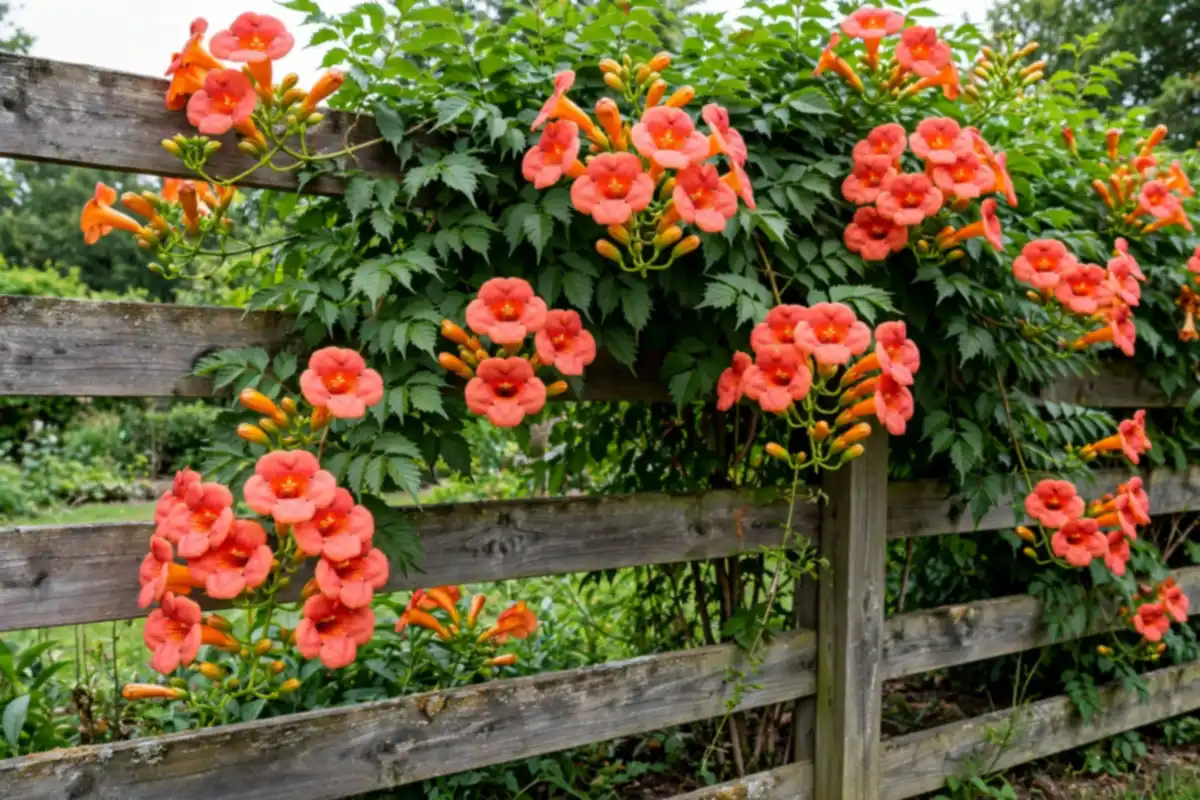
Table of Contents
- What Is a Trumpet Flower?
- Types of Trumpet Flower and 6 Kinds Worth Knowing
- Trumpet Flower Meaning and Symbolism
- Trumpet Flower Colours and Their Meanings
- How to Grow Trumpet Flowers
- Common Mistakes When Growing Trumpet Flowers
- Angel’s Trumpet vs Devil’s Trumpet: Down vs Up
- Frequently Asked Questions
What Is a Trumpet Flower?
The trumpet shape is pollination engineering: a long tube stores nectar at its base where only long tongues — hummingbirds by day, hawkmoths by night — can reach, and the flare at the mouth is both landing sign and advertising hoarding. That is why the shape evolved independently in the nightshade family (Brugmansia, Datura) and the bignonia family (Campsis, Tecoma, Tecomaria, Bignonia). Of these, two became legends: Brugmansia, the angel’s trumpet, a small Andean tree whose 8-to-12-inch pendulous bells pour out perfume after dusk for night moths; and Datura, the devil’s trumpet, an annual or short-lived plant of disturbed ground whose upright trumpets follow the same night shift. Both carry tropane alkaloids — scopolamine and kin — and have been sacred, medicinal and dangerous in human cultures for millennia. You can read more on the Brugmansia page on Wikipedia.
The bignonia trumpets took the daylight shift: orange, red and yellow tubes built for hummingbirds, which hover at the flare and carry pollen on their foreheads. The trumpet vine does this so vigorously it has become a byword for beautiful trouble — a native vine that will cover a barn, a fence or, given time, a house, and feeds hummingbirds for three months doing it. Between the night angels and the day vines, the trumpet clan covers nearly every warm garden job except modesty.
Trumpet Flower Quick Facts
- Botanical names: Brugmansia spp. (angel’s), Datura spp. (devil’s), Campsis radicans, Tecoma stans, Tecomaria capensis, Bignonia capreolata.
- Families: Solanaceae (Brugmansia, Datura); Bignoniaceae (the vines and shrubs).
- Hardiness: zones 7 to 11 for most; trumpet vine zones 4–9, crossvine 5–9; Datura grown as an annual.
- Size: shrubs 6–15 ft; vines 20–40 ft; Datura 2–5 ft.
- Bloom time: summer to frost (Brugmansia in flushes; Tecoma nearly continuous in heat).
- Sun and soil: full sun; rich, moist, drained soil for Brugmansia; almost anything for the vines.
- Good to know: WARNING — Brugmansia and Datura are poisonous in all parts; keep away from children and pets, and wear gloves when pruning.
Types of Trumpet Flower and 6 Kinds Worth Knowing
The two night legends, three hummingbird vines and shrubs, and the evergreen crossvine. The table separates them; the profiles follow. For the full list of flower names, see our flower names A to Z guide.
| Type | Flowers point | Form | Hardiness | Best use |
|---|---|---|---|---|
| Angel’s trumpet (Brugmansia) | DOWN | Small tree/shrub | Zones 9–11 (pots elsewhere) | Evening-scented patio tree |
| Devil’s trumpet (Datura) | UP | Annual/short perennial | Annual everywhere | Moon gardens, drama |
| Trumpet vine (Campsis) | Outward | Vigorous vine | Zones 4–9 | Fences, barns, hummingbirds |
| Yellow trumpetbush (Tecoma stans) | Up/outward | Shrub | Zones 8–11 | Desert and hot gardens |
| Cape honeysuckle (Tecomaria) | Outward, curved | Scrambling shrub | Zones 9–11 | Winter flowers, hedges |
| Crossvine (Bignonia) | Outward | Evergreen vine | Zones 5–9 | Walls, spring colour |
1. Angel’s Trumpet (Brugmansia) — the Perfumed Tree
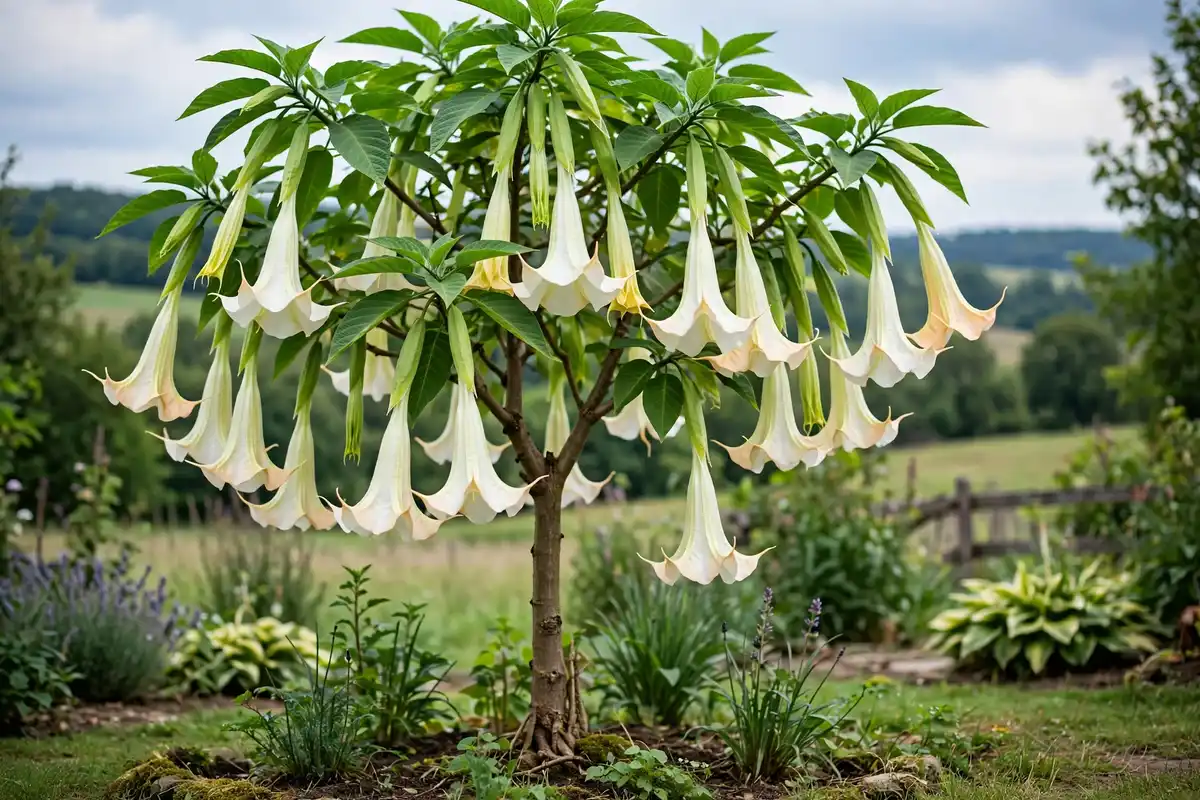
The aristocrat: a woody small tree from the Andes carrying dozens of huge hanging trumpets in white, peach, pink or gold, each releasing its perfume as the light fades — an evening event, every evening, all summer. Extinct in the wild (it survives only in cultivation, kept by people for centuries), it is grown in pots in cold climates and overwintered frost-free, then plunged back into the sun to flower again. Feed and water it like the hungry plant it is, and stand under it at dusk once: the scent explains its following.
2. Devil’s Trumpet (Datura) — the Upward Rebel
Everything the angel does, inverted: flowers point up, the plant is an herbaceous annual raised fresh from seed each spring, and the seed pods are spiky balls (the angel’s are smooth). White Datura metel doubles (‘Ballerina’ series) look like crinolines; purple-edged singles glow at dusk in the moon garden. Sacred in Hindu tradition (the flower of Shiva) and infamous in folklore, datura demands the same respect as its cousin: beautiful, untouchable, unforgettable.
3. Trumpet Vine (Campsis radicans) — the Beautiful Bully
A native North American vine of overwhelming energy: clusters of orange-red trumpets from June to September, hummingbirds in permanent attendance, and roots that colonise by sucker and self-clinging pads. Plant it on a barn, a dead tree, a chain-link fence you want gone — somewhere its strength is an asset — and never against house siding or a small trellis. ‘Flava’ (yellow) and ‘Madame Galen’ (the hybrid, slightly better behaved) are the named choices.
4. Yellow Trumpetbush (Tecoma stans) — the Desert Bell
Clusters of clear-yellow bells from late spring through autumn on a heat-loving shrub — the official flower of the US Virgin Islands and a backbone plant of Arizona and Texas gardens, where it shrugs off 100°F afternoons that wilt everything else. Butterflies and hummingbirds work it daily. In zone 8 it dies to the ground and returns; further north it makes a fast, flowering annual from seed sown early.
5. Cape Honeysuckle (Tecomaria capensis) — the Winter-Flowering Scrambler
Not a honeysuckle and not quite a vine: a scrambling South African shrub whose curved orange-red trumpets open mainly in the cool season — autumn into spring — when hummingbirds (and in its homeland, sunbirds) need them most. Trained on a fence it makes an evergreen screen in zones 9–11; in a pot it travels. The yellow form ‘Lutea’ is for collectors of the unexpected.
6. Crossvine (Bignonia capreolata) — the Evergreen Native
The polite trumpet vine: an evergreen (or nearly) North American climber whose spring clusters of orange-throated trumpets arrive with the first hummingbirds, climbing by tendrils with adhesive discs — no suckering thuggery, and it will even flower in light shade. The leaflets show a cross in their veining, hence the name. ‘Tangerine Beauty’ is the cultivar to ask for; for a wall that must look good in February, this is the trumpet.
Trumpet Flower Meaning and Symbolism
A trumpet is an announcement, and the flower keeps the instrument’s meanings: fame, glory, honour and joyful news proclaimed aloud. In floriography the trumpet flowers were given for distinction and renown — the bloom you send when someone has won something. The two night trumpets carry their own charged symbolism underneath: the angel (Brugmansia) for divine messages and spiritual awakening, entwined in Andean tradition with visions and healing; the devil (Datura) for mystery, dreams and the beauty that must not be touched — also Shiva’s sacred flower in India, offered at temples. Send the bignonia trumpets for celebration and congratulation; the night pair are flowers to grow, not to give — their meaning is the warning on the label.
The trumpet vine’s orange fire does its own work in the garden, covering ugly structures with the same energy the trumpets in our sunflower varieties bring to a fence line — loud, warm and impossible to ignore.
Trumpet Flower Colours and Their Meanings
- Orange-red — fame and celebration: trumpet vine, crossvine, Cape honeysuckle.
- White — divine messages, the moon garden: night-scented angel’s and devil’s trumpets.
- Yellow — joy proclaimed: Tecoma’s bells, the colour of announcements.
- Peach, pink and gold — honour with warmth: the cultivated Brugmansia palette.
- Purple-edged — mystery: the metel daturas, beauty at arm’s length.
How to Grow Trumpet Flowers
Match the plant to the job and the zone, then give sun and stand back. Gardeners on r/gardening on Reddit repeat two trumpet rules: “brugmansia is a hungry, thirsty diva — feed it or it sulks” and “trumpet vine: plant it like you mean forever, because it is.”
The Shrubs: Brugmansia and Tecoma
Brugmansia wants the richest life in the garden: full sun, deep fertile soil, water whenever it flags, and feed every week or two in growth — its flushes of giant flowers are built from sheer intake. In pots (the cold-climate method), use the largest container you can move, overwinter the plant frost-free and barely watered, cut it back hard in spring, and expect flowers by midsummer. Tecoma stans is the opposite temperament: sun, lean soil, drought once rooted; water deeply but rarely, prune after the main flush, and in borderline zones mulch the crown for its winter return.
The Vines and the Annual
Trumpet vine and crossvine need structures worthy of them — masonry, stout posts, dead trees — and annual cutting-back to keep flowers (which form on new wood) low and plentiful; crossvine, flowering on old wood, is pruned right after its spring show instead. Contain trumpet vine’s suckers with a mower and honesty. Datura is the simple one: sow seed indoors in early spring, plant out after frost into any sunny soil, water moderately, and let the spiky pods ripen if you want next year’s plants — remembering always where the children and dogs play, and planting it where admiration happens at a distance.
Common Mistakes When Growing Trumpet Flowers
Mistake one is planting trumpet vine against the house: its pads mark siding, its roots travel under paths, and removal is a multi-year campaign. Give it a structure it may own. Mistake two is starving a brugmansia and wondering where the flowers are — few garden plants convert feed into bloom so directly, and a yellowed, bloomless angel is almost always just hungry.
Mistake three is ignoring the poison warning as folklore: Brugmansia and Datura contain potent tropane alkaloids in every part, seed included; site them away from play areas and vegetable beds, glove up for pruning, and never compost their trimmings where animals graze. Mistake four is overwintering brugmansia wet and warm, which rots it — cool, dark and nearly dry is the formula. And mistake five is pruning crossvine in late winter like its cousin: you cut off the spring flowers, which wait on last year’s wood.
Angel’s Trumpet vs Devil’s Trumpet: Down vs Up
The classic confusion, settled by one glance at direction. Angel’s trumpet (Brugmansia): flowers hang DOWN; the plant is a woody shrub or small tree that lives for years; seed pods are smooth and elongated; the perfume pours out at night; it is extinct in the wild and survives in gardens. Devil’s trumpet (Datura): flowers point UP; the plant is herbaceous, usually grown as an annual from seed each year; seed pods are spiky balls; equally night-scented; it seeds itself freely on disturbed ground. Down is the angel, up is the devil — and both are equally poisonous, so the mnemonic is for naming, not for handling. When in doubt, the pods and the woodiness decide it.
Frequently Asked Questions
Are trumpet flowers poisonous?
The nightshade pair, yes, seriously: all parts of Brugmansia and Datura contain tropane alkaloids and must never be eaten — plant away from children, pets and livestock, and wash hands after pruning. The bignonia trumpets (trumpet vine, Tecoma, Tecomaria, crossvine) are not in that danger class, though trumpet vine’s sap can irritate skin in sensitive people (“cow itch” is its folk warning) — gloves are a good habit with the whole section. If your question is not answered here, the questions about the trumpet flower on Quora cover most of the rest.
How can I tell angel’s trumpet from devil’s trumpet?
Direction first: angel’s (Brugmansia) flowers hang down from a woody, long-lived shrub; devil’s (Datura) flowers stand up on an herbaceous annual. Then the fruit: smooth elongated pods for the angel, spiky round balls for the devil. The full comparison is in the section above.
Do trumpet flowers attract hummingbirds?
The day-blooming bignonias are hummingbird headquarters — trumpet vine and crossvine are among the most-visited native flowers in North America, and Tecoma and Cape honeysuckle work the same shift in warm climates. The night pair feed hawkmoths instead, with white scented flowers built for dusk.
Is trumpet vine invasive?
It is native to eastern North America and aggressive within and beyond it: suckers, self-seeding and sheer growth can swamp small gardens and buildings. Plant it only where it can be contained by mowing and distance, or choose crossvine, the well-mannered relative, for walls near the house.
Can angel’s trumpet grow in a pot?
It is the standard cold-climate method: the biggest pot you can move, rich compost, generous feed and water in summer, then a frost-free, dim, nearly dry rest indoors through winter and a hard spring prune. Treated so, one plant gives years of evening perfume.
When do trumpet flowers bloom?
Through the warm months: crossvine opens the season in spring; trumpet vine and Tecoma run summer into autumn; brugmansia flowers in flushes from early summer to frost (heaviest in warm spells); datura blooms from midsummer until frost stops it. For more flowers under the same letter, see our guide to flowers that start with T.