Primrose Flower: Meaning, Types and How to Grow It
Before the roses, before almost anything, there is the primrose: pale gold stars opening in the cold mud of late winter, in the ditch banks and woodland edges where spring arrives first. Its name literally means “first rose” — not a rose at all, but the first flower that matters — and for country people across Europe it was the true starting gun of the year.
This guide covers the six primroses worth knowing (from the wild woodland species to the collector’s auricula in its clay pot), explains primrose’s meanings — young love and “I can’t live without you” — and clears up the evening primrose, a famous flower that is not a primrose at all.
Quick Answer
A primrose flower is the low, early-spring bloom of Primula, a genus in the primrose family Primulaceae — above all the common primrose, Primula vulgaris, whose pale-yellow flowers open singly on hairy stems from a rosette of crinkled leaves. It grows 4 to 6 inches tall in USDA zones 4 to 8, flowers from late winter through spring in cool, moist, partly shaded ground, and shares the February birth-flower title with the violet. Primrose means young love, first love, and “I can’t live without you”. The unrelated evening primrose (Oenothera) is a different plant entirely.
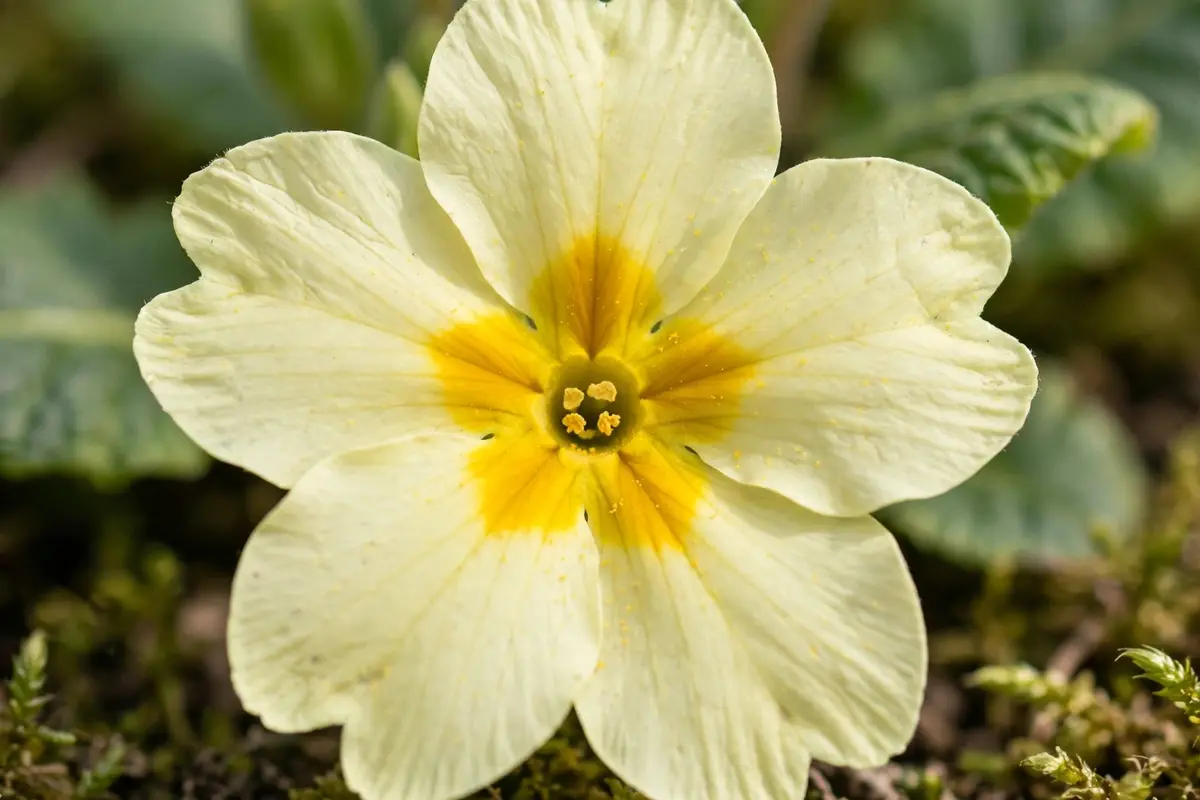
Table of Contents
- What Is a Primrose Flower?
- Types of Primrose and 6 Kinds Worth Knowing
- Primrose Flower Meaning and Symbolism
- Primrose Flower Colours and Their Meanings
- How to Grow Primroses
- Common Mistakes When Growing Primroses
- Primrose vs Evening Primrose: Not the Same Plant
- Frequently Asked Questions
What Is a Primrose Flower?
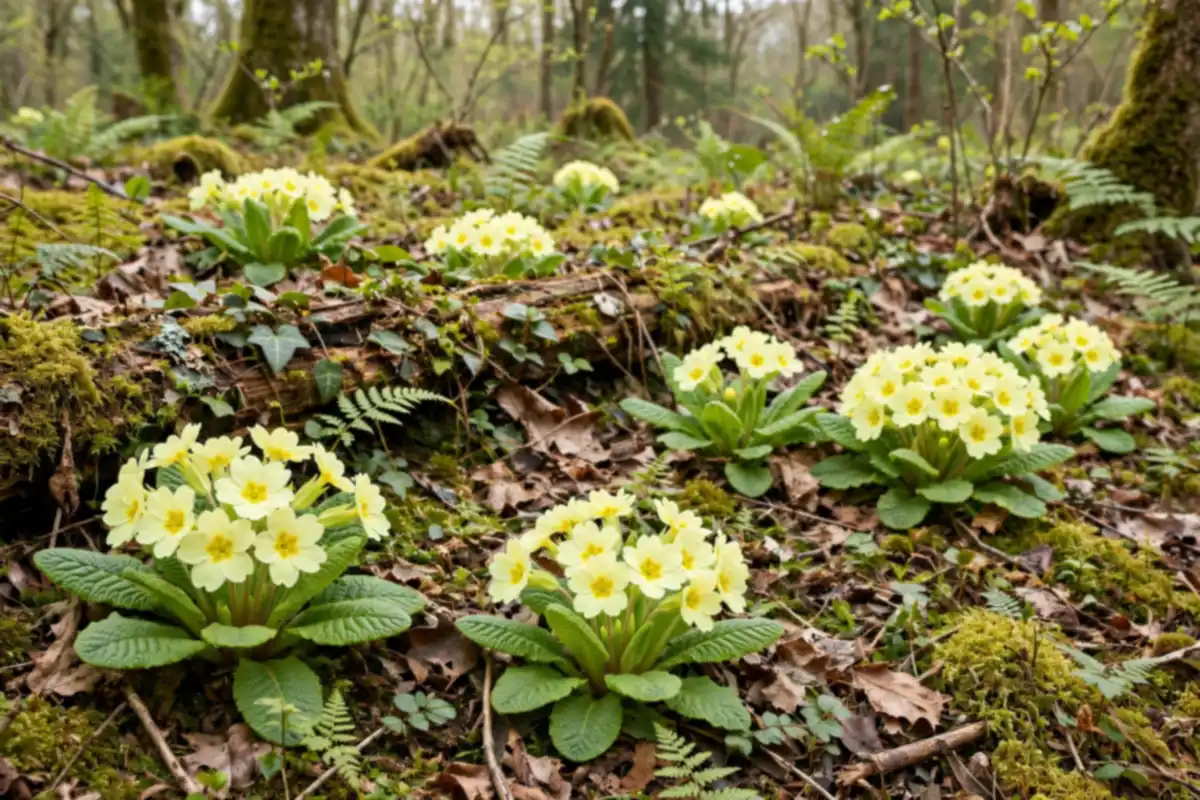
Primula is a genus of roughly 500 species in Primulaceae, centred on the mountains and cool woodlands of Europe and Asia. The name is Latin prima, “first” — the first rose of the year, flowering when roses are still bare sticks. The common primrose of hedgerows, Primula vulgaris, is a semi-evergreen perennial: a flat rosette of soft, crinkled, tongue-shaped leaves, from which each flower rises alone on its own slender hairy stalk, five notched petals around a golden eye. Wild plants are pale primrose-yellow almost to the point of cream; everything brighter in the garden centres is the work of breeders crossing vulgaris with its coloured cousins. You can read more on the Primula vulgaris page on Wikipedia.
The primrose carries a curious piece of evolutionary theatre in every flower: pin-eyed and thrum-eyed forms, two mirror-image arrangements of stigma and anthers that force cross-pollination between plants — a mechanism Darwin studied so closely he wrote that no other discovery in botany gave him as much pleasure. The flower is woven into European spring itself: Primrose Day (19 April) still marks Disraeli’s death with primroses laid at his statue, Shakespeare’s “primrose path” gave English its phrase for pleasant self-destruction, and the flower is the county emblem of Devon, whose banks run gold with it. One household caution: a relative, Primula obconica, carries the allergen primin and can give sensitive handlers a rash — the common garden primroses are far milder, but gloves are sensible if your skin objects.
Primrose Flower Quick Facts
- Botanical names: Primula vulgaris; P. × polyantha; P. veris (cowslip).
- Family: Primulaceae, the primrose family.
- Hardiness: zones 4 to 8 (varies by species).
- Height: 4 to 8 inches for the border kinds; candelabras to 3 feet.
- Bloom time: late winter to spring; drumsticks and candelabras into early summer.
- Sun and soil: partial shade; cool, moist, humus-rich soil.
- Good to know: February birth flower (with violet); divide clumps right after flowering; evening primrose is NOT a Primula.
Types of Primrose and 6 Kinds Worth Knowing
The woodland original, the bedding-plant hybrids, the meadow cowslip, and the collector’s treasure. The table separates them; the profiles follow. For the full list of flower names, see our flower names A to Z guide.
| Type | Flowers | Height | Habit | Best use |
|---|---|---|---|---|
| Common primrose (P. vulgaris) | Pale yellow, single stems | 4–6 in | Woodland rosette | Banks, woodland edges |
| Polyanthus (P. × polyantha) | All colours, clustered umbels | 6–9 in | Bedding hybrid | Spring bedding, pots |
| Cowslip (P. veris) | Deep yellow nodding bells | 6–10 in | Meadow perennial | Wildflower meadows, lawns |
| Oxlip (P. elatior) | Pale yellow, one-sided clusters | 8–12 in | Woodland rarity | Shade gardens |
| Drumstick primula (P. denticulata) | Purple/pink/white globes | 8–12 in | Early, bold | Damp borders, pondsides |
| Auricula (P. auricula) | Velvet, farina-dusted, show flowers | 6–8 in | Collector’s alpine | Pots, auricula theatres |
1. Common Primrose — the Woodland Original
Primula vulgaris itself: pale, luminous yellow flowers one to a stem over a neat rosette, flowering from late winter in the mild districts it loves — woodland rides, hedge banks, old orchards, churchyards. It is the primrose of poetry and of the February birth flower, and in a garden it wants to be left in cool leaf-mould shade to multiply quietly for decades. Buy plants, not seed (seed needs a cold spell and patience), plant in drifts, and divide the clumps as they thicken.
2. Polyanthus — the Bedding Rainbow
The garden-centre primrose: Primula × polyantha, the vulgaris × veris × coloured-species hybrid swarm, sold in winter and spring in every colour including blues and near-blacks, flowers held in clusters on stout stems above the rosette. Polyanthus are the backbone of spring bedding and window boxes — technically short-lived perennials, usually replanted yearly, and worth every penny for flowering through the last of the winter gloom.
3. Cowslip — the Meadow Sister
Primula veris swaps the woodland floor for the open meadow: a taller stem carrying a nodding one-sided cluster of deep-yellow, orange-spotted bells with a scent of apricots. Once common enough to pick by the basket for cowslip wine, it crashed with old meadows and is now replanted everywhere as a wildflower — in lawns left long, it self-seeds into drifts of spring gold. A plant of full sun and grass, where its primrose cousins would sulk.
4. Oxlip — the Rare Woodlander
Primula elatior is the connoisseur’s wild primrose: pale-yellow flowers in a one-sided cluster on a taller stem, confined in the wild to a few ancient East Anglian woods, and endlessly confused with the “false oxlip” hybrid between primrose and cowslip. In gardens it is a graceful shade plant that bridges its two famous relatives — and a small act of conservation wherever it is grown true.
5. Drumstick Primula — the Early Globe
Primula denticulata from the Himalayas does something none of the above attempt: perfect spheres of purple, lilac, pink or white flowers on stout stems, opening in early spring before the leaves have properly unfurled — drumsticks rising from bare mud. It loves damp soil, seeds itself generously beside ponds and in wet borders, and gives the primrose season its boldest piece of architecture.
6. Auricula — the Collector’s Jewel
Primula auricula, the mountain cowslip of the Alps, became the most collected flower of the 18th century: velvety petals in impossible colour combinations, dusted with white farina, displayed in tiered “auricula theatres” against black backgrounds. Show auriculas are still exhibited, named and traded like racehorses. They are pot plants — gritty soil, cold winter, rain kept off the crowns — and the primrose family’s aristocracy entire.
Primrose Flower Meaning and Symbolism
The primrose means young love — first love, specifically, with the blush still on it. In the Victorian language of flowers it carried the message “I can’t live without you”, the declaration of someone at the very start of love rather than its settled middle, and it was also given for youth, renewal and the optimism of beginnings: the first flower, for first feelings. The Celts set primroses on thresholds as an invitation and protection against fairies (a bunch on the doorstep kept the house lucky; primroses picked before sunrise on May Eve carried the year’s magic), and the flower’s February birth-flower role — shared in our February birth flower guide — ties it to the year’s own young love, Imbolc and first spring.
Give primroses (a pot of polyanthus is the living card) for new love, for February birthdays, for anyone starting something — new home, new job, new chapter. It is the least intimidating romantic flower there is: all promise, no pressure.
Primrose Flower Colours and Their Meanings
- Pale yellow — young love and first light: the wild colour, the February gold.
- Pink — tenderness and new affection: the gentlest of the polyanthus shades.
- Blue — rarity and devotion: breeder’s blues, the collector’s prize among bedding colours.
- White — purity and fresh starts: wedding-season primulas and spring christenings.
- Purple — dignity in small things: drumstick globes in the damp spring border.
How to Grow Primroses
Think like a woodland floor: cool roots, leaf mould, and never a summer bake. Gardeners on r/gardening on Reddit sum up the primrose rule in one line: “they’re not dying, they’re summer-dormant and sulking — give them shade, moisture and patience, and divide them when they flower less.”
Planting and Place
Plant in autumn or early spring in partial shade — under deciduous trees, on a north or east bank, in the cool skirts of shrubs — in humus-rich soil that stays moist but drains (add leaf mould or compost generously; primroses forgive poor soil less than dry soil). Space border kinds 6–9 inches apart in drifts rather than rows. In pots, use a soil-based compost with added grit and keep them somewhere cool; a polyanthus in a hot south-facing pot is a plant on a countdown.
Care, Dividing and Seed
Water through dry springs — a primrose that wilts repeatedly flowers poorly the next year — and deadhead bedding polyanthus to keep the clusters coming. The great renewal trick is division: lift established clumps every few years just after flowering, pull them into single rosettes, and replant at once, watered in; a divided primrose is a young primrose again, and this one habit keeps a planting alive for decades. For seed, sow fresh in summer (primula seed loses viability fast) and give it a cold winter outdoors — the fridge trick the larkspur growers use works here too. Watch for vine weevil in pots and aphids under the leaves; the plant’s real enemy remains summer drought.
Common Mistakes When Growing Primroses
Mistake one is sun and drought: a primrose in a hot, dry, south-facing bed will dwindle by July and vanish by the second year — it is a woodland plant rented to the border, not a bedding annual to be baked. Mistake two is never dividing: undivided clumps rise out of the soil on woody necks, flower less each spring, and die out in the centre within a few years.
Mistake three is buying polyanthus, enjoying one spring, and binning them as “dead” in summer when they are merely dormant and thirsty — plant them out in a shady corner instead and most return. Mistake four is sowing old seed indoors in warmth and concluding primroses are hard from seed: they need fresh seed and a winter’s chill. And mistake five is the name mistake again — buying an “evening primrose” and expecting this plant at all, which the next section untangles.
Primrose vs Evening Primrose: Not the Same Plant
The most durable confusion in the flower-name world. Primrose (Primula): Primulaceae family; a low rosette of crinkled leaves; flowers in late winter and spring, opening in daylight, in yellow, pink, blue, white and more; a plant of cool shade and moisture. Evening primrose (Oenothera): Onagraceae, the willowherb family — no relation at all; a tall (3–6 foot), upright plant whose big yellow cups open at dusk through summer, famous for its seed oil. They share nothing but four syllables and a yellow default. If it opens at night and stands waist-high, it is Oenothera; if it hugs the ground in February, it is Primula. Garden centres label both accurately — the confusion lives entirely in the shared name.
Frequently Asked Questions
Is the primrose a perennial?
Yes — the species are true perennials, and a divided, well-sited common primrose clump can live and spread for decades. The bedding polyanthus hybrids are short-lived perennials usually treated as annuals: plant them out after their pot spring and many will flower again for years. If your question is not answered here, the questions about the primrose flower on Quora cover most of the rest.
What does the primrose symbolise?
Young love and first love — the Victorian message was “I can’t live without you” — plus youth, renewal and beginnings. It is February’s birth flower (shared with the violet), which makes a pot of primroses the classic February birthday gift.
Is primrose the same as evening primrose?
No relation at all: primrose is Primula (primrose family, spring, ground-hugging), evening primrose is Oenothera (willowherb family, summer, tall, night-opening). See the comparison section above — the shared name is the whole of the connection.
When do primroses flower?
From late winter into spring for the vulgaris and polyanthus kinds — February to April in mild climates, a few weeks later in cold ones. Drumstick primulas follow in early spring, cowslips a little later, and candelabra primulas carry the genus into early summer in wet ground.
Are primroses poisonous?
Common primroses are not considered poisonous — the leaves and flowers have a long folk history in salads and wines (cowslip wine was a country staple). The household caution is skin, not stomach: some primula species, especially Primula obconica, carry the allergen primin and can cause contact dermatitis in sensitive people. Handle new primula types with gloves if your skin is reactive.
Can primroses grow in pots?
Beautifully — polyanthus and auriculas are among the classic pot plants. The rules: a cool position out of fierce sun, soil-based compost, steady moisture, and division or repotting when the rosettes crowd. Auriculas insist on more: gritty soil, winter shelter from rain, and their moment on the theatre shelf. For more flowers under the same letter, see our guide to flowers that start with P.