Heather Flower: Meaning, Types and How to Grow It
It turns whole hillsides purple in August, brews into ale older than Scotland, and a sprig of its white form is still tucked into bridal bouquets for luck. Heather is the moorland’s own flower — two plants, actually, wearing one name: the true heather that paints the late-summer hills, and the winter heather that flowers through snow. Both are tougher than almost anything else in the garden centre, and both demand exactly one thing.
This guide separates Calluna from Erica, covers the six kinds worth growing (including the famous bud-bloomers and the tree whose roots become briar pipes), explains heather’s meanings — admiration, solitude, protection and luck — and states the one soil rule that decides everything.
Quick Answer
A heather flower is one of two evergreen heath-family shrubs: true heather, Calluna vulgaris (also called ling), which covers moorland in purple-pink bells from late summer into autumn, or a winter/spring heather, Erica species, which flowers from late autumn through spring. Calluna grows 12 to 24 inches tall in USDA zones 4 to 7 and absolutely requires acid soil; the main garden Erica (E. carnea) tolerates lime. Heather means admiration, solitude and protection — and white heather means luck, Scotland’s most famous good-luck charm.
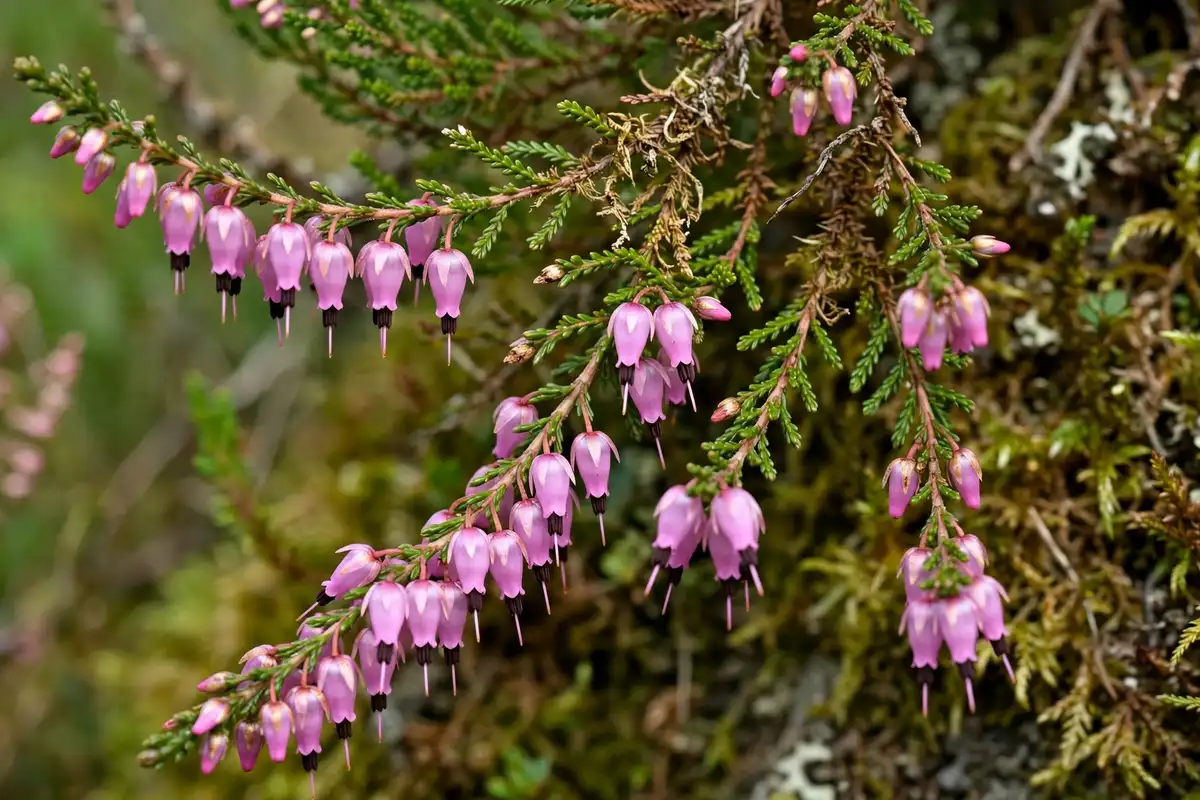
Table of Contents
- What Is a Heather Flower?
- Types of Heather and 6 Kinds Worth Knowing
- Heather Flower Meaning and Symbolism
- Heather Flower Colours and Their Meanings
- How to Grow Heather
- Common Mistakes When Growing Heather
- Calluna vs Erica: True Heather vs Winter Heather
- Frequently Asked Questions
What Is a Heather Flower?
Calluna vulgaris is a low evergreen shrub of the heath family, Ericaceae — the only species in its genus, once lumped with the Ericas until botanists noticed its flower’s unusual split calyx: four showy sepals hiding four smaller petals, the reverse of its cousins. Wild across Europe’s moors, bogs and pinewoods from Iceland to Siberia, it dominates whole landscapes the way few plants can: a Scottish hillside in August is Calluna by the square mile, humming with bees working one of the great honey flows (heather honey, dark and jelly-thick, is a connoisseur’s prize). The Scots call it ling; its Gaelic name is fraoch — and fraoch is also heather ale, brewed from the flowering tips since, legend says, the Picts, whose lost recipe William Williams revived into the modern Fraoch ale. You can read more on the Calluna page on Wikipedia.
The human history is as deep as the roots: heather thatch, heather brooms, heather bedding (Highlanders slept on it, flower-end up, and woke, the saying goes, refreshed), heather dye, heather honey, and heather as clan badge and luck token — the white sprig carried by Bonnie Prince Charlie’s supporters after it saved, in the story, a chief who spotted ambushers hidden in it. Queen Victoria took up white heather as a bridal emblem of luck, and every royal connection since — including its place in Scottish wedding bouquets — has kept the superstition in rude health. The moor itself is a managed landscape partly because of this plant: grouse moors are burned in patches to keep Calluna young and flowering.
Heather Flower Quick Facts
- Botanical names: Calluna vulgaris (true heather/ling); Erica species (heaths).
- Family: Ericaceae, the heath family.
- Hardiness: Calluna zones 4 to 7; Erica carnea zones 5 to 7.
- Height: 6 inches (dwarfs) to 24 inches; tree heather to 12 feet.
- Bloom time: Calluna July–October; Erica carnea December–April.
- Sun and soil: full sun; Calluna needs acid soil, E. carnea tolerates lime.
- Good to know: shear after flowering to keep plants compact; never let potted heathers dry out; bees love it.
Types of Heather and 6 Kinds Worth Knowing
The moorland species, the winter workhorse, the bud-bloomers, and the pipe-maker. The table separates them; the profiles follow. For the full list of flower names, see our flower names A to Z guide.
| Type | Flowers | Bloom time | Soil | Best use |
|---|---|---|---|---|
| True heather / ling (Calluna vulgaris) | Purple-pink bells, massed | July–Oct | Acid only | Moorland drifts, heather gardens |
| Winter heather (Erica carnea) | Pink-white urns through snow | Dec–Apr | Tolerates lime | Winter colour, banks, pots |
| Bud-bloomer Calluna | Coloured buds that never open | Aug–Dec (as buds) | Acid only | Longest display, containers |
| Darley Dale heath (Erica × darleyensis) | Pink-white, vigorous | Nov–May | Broadly tolerant | Big winter drifts, slopes |
| White heather (Calluna ‘Alba’ forms) | Pure white bells | July–Oct | Acid only | Luck sprigs, wedding work |
| Tree heather (Erica arborea) | Clouds of tiny white, honey-scented | Mar–May | Acid-leaning | Screens; briar pipe roots |
1. True Heather — Calluna vulgaris, the Moor Itself
The wild species and its hundreds of garden cultivars: single bells in every shade from white through mauve to crimson (‘Dark Beauty’, ‘Wickwar Flame’ with gold-orange foliage), flowering when the garden is running out of summer. On acid soil in full sun it is close to indestructible — frost-proof, drought-proof once rooted, and a late-season cafeteria for bees. This is the flower that colours the Scottish hills and the August birth flower season alike, blooming at the height of its month.
2. Winter Heather — Erica carnea, the Snow Flower
The alpine species that flowers from December to April, pushing pink and white urns up through snow and opening on the mildest winter days for the earliest bees. Crucially for most gardeners, it is the lime-tolerant heather — plant it on ordinary and even chalky soil where Calluna would yellow and sulk. Cultivars like ‘Springwood White’ and ‘Myretoun Ruby’ are the backbone of winter container and bank plantings.
3. Bud-Bloomers — the Calluna That Never Opens
A strange and wonderful tribe (the Garden Girls and Beauty Ladies series): Calluna cultivars whose flower buds colour fully — crimson, pink, white, purple — but never open, so the “bloom” lasts from August into December untouched by frost or bee. Because the buds never open, they are useless to pollinators (plant open-flowered kinds too), but for pots, graves and window boxes their colour endurance is unmatched: four months of flower from a plant that technically never flowers.
4. Darley Dale Heath — the Big Winter Hybrid
Erica × darleyensis (carnea × erigena) is the vigorous middleweight: bigger and faster than carnea, flowering November to May in pink or white, broadly soil-tolerant including some lime, and the choice for clothing whole banks and slopes in winter colour. ‘Kramer’s Red’ and ‘White Perfection’ are the standards. If winter heather has a workhorse upgrade, this is it.
5. White Heather — the Luck Sprig
Not a species but a destiny: the white-flowered forms of Calluna (‘Beoley White’, ‘Alba’, the double ‘H.E. Beale’ in blush-white) are Scotland’s luck — the rare white sport in a purple moor, carried by Jacobites, brides and footballers ever since. Luck aside, white Calluna is also the most elegant planting heather: a drift of it cools the late-summer border the way first snow cools a hillside.
6. Tree Heather — Erica arborea, the Pipe-Maker
The Mediterranean giant: a small tree to 12 feet smothered in spring with tiny honey-scented white bells — and famous underground, where its root burls, dug after forest fires in the maquis, become bruyère: the briar wood of the world’s best tobacco pipes. In mild gardens (zones 7–9, sheltered) the upright form ‘Albert’s Gold’ makes a golden conifer-like screen that smells of honey in March.
Heather Flower Meaning and Symbolism
Heather means admiration, solitude and protection in the language of flowers — the admiration for a plant that beautifies the loneliest landscapes on earth, the solitude of the moors it owns, and the protection folklore always granted it: sprigs over doors, heather in the mattress against ill luck, heather carried into battle and bridal chambers alike. White heather’s meaning outruns all the rest: luck, pure and simple — the flower you give (or tuck into a bouquet) when what you really mean is may fortune find you.
Give purple heather for admiration and respect, white for luck before journeys, weddings and ventures, pink for gentle affection. And note the plant’s newer symbolic career: in Scotland it now stands for the land itself — resilience, humility, and beauty that asks for nothing.
Heather Flower Colours and Their Meanings
- Purple and mauve — admiration and solitude: the wild moor colour, late summer’s signature.
- White — luck and protection: the famous sprig, first among heathers as it is among our white flowers.
- Pink — affection and good wishes: the winter heathers’ winter cheer.
- Crimson and red — passion and strength: the deepest Calluna and carnea cultivars.
How to Grow Heather
One rule decides success, and a pair of shears decides tidiness. Gardeners on r/gardening on Reddit give the rule its own capital letters in every heather thread: “ACID. Calluna on chalk is a slow yellow goodbye — plant Erica carnea there instead and save everyone the heartbreak.”
The Soil Rule and Planting
Test your soil first. Calluna demands acid (pH below ~6.5), humusy, well-drained ground in full sun; on neutral-to-alkaline soil it chloroses and fades — amend with ericaceous compost for beds, or switch to the lime-tolerant winter heathers (Erica carnea and × darleyensis) which ask no such questions. Plant at the same depth as the pot, space 12–18 inches for a knitted drift, water deeply through the first season, and mulch with bark or pine needles. Heathers dislike root disturbance and rich feeding: one light ericaceous feed in spring is plenty, and manure is an enemy.
Shearing and Year-Round Care
The one annual job: shear off the spent flower heads (and an inch of growth) right after flowering — late autumn for Calluna, late spring for the winter Ericas — cutting into green growth, never into bare old wood, which does not resprout. This keeps plants dome-shaped and flowering to the base instead of going leggy and bare-hearted in five years. Potted heathers (bud-bloomers above all) must never dry out: a dried-out heather pot is usually a dead one, however green it still looks. In pots, use ericaceous compost for Calluna; carnea forgives ordinary compost.
Common Mistakes When Growing Heather
Mistake one is the soil mistake: Calluna into limy ground. It is the genus’s only real demand and the one most often ignored at the garden-centre till. Mistake two is never shearing — unclipped heathers open up in the middle, flop, and show bare stems within a few seasons. Mistake three is shade and wet feet: heathers are moor plants that want sun and drainage, and they rot sulkily in boggy shade.
Mistake four is letting container heathers dry out even once in summer — they do not forgive it — and mistake five is planting bud-bloomers as your only heather and wondering where the bees are: the never-opening buds that make the display make no nectar either. Mix open-flowered kinds in for the bees, and the garden gets both the colour and the hum.
Calluna vs Erica: True Heather vs Winter Heather
The two plants behind one name, separated at a glance. Calluna vulgaris (true heather, ling): tiny scale-like leaves pressed in four neat ranks along the stem; flowers are bells whose showy part is the four-lobed calyx around smaller petals; blooms late summer to autumn; demands acid soil; zones 4–7. Erica (heaths — carnea, × darleyensis and kin): needle-like leaves in whorls; flowers are little urns whose showy part is the corolla itself, with the calyx small and green beneath; blooms winter to spring; the garden species tolerate lime; zones 5–7. The leaf test is instant: scales in ranks = Calluna, needles in whorls = Erica. Between them they flower for eight months of the year — plant both, shear both, and the heather bed never has an off-season.
Frequently Asked Questions
Is heather a perennial?
Yes — a long-lived evergreen shrub. With annual shearing, a Calluna planting stays handsome for ten to twenty years; unclipped, it turns woody and bare in half that time. The winter Ericas are equally perennial and even longer-lived in the right soil. If your question is not answered here, the questions about the heather flower on Quora cover most of the rest.
Why is white heather lucky?
Because it is rare — a white sport standing out in a purple moor — and rarity reads as omen. The luck stories stack up: a chief saved by spotting enemies hidden in white heather, Jacobite sprigs, Queen Victoria’s bridal adoption. It remains the traditional good-luck flower of Scotland, sold in sprigs at weddings and Highland games.
Does heather need acid soil?
Calluna does, non-negotiably; the winter Ericas (carnea, × darleyensis) do not and will grow happily in lime. In containers, give Calluna ericaceous compost and rainwater if your tap water is hard; the Ericas manage without the fuss.
When should heather be pruned?
Right after flowering, shearing the spent heads plus a little growth: autumn for summer Calluna (or early spring in cold districts), late spring for winter Ericas. Never cut into leafless old wood — it will not regrow — which is why the annual light shear matters from year one.
Is heather good for bees?
Superb — open-flowered Calluna is one of the great late-season nectar flows (the source of heather honey), and the winter Ericas feed the earliest emerging bees on mild days. The exception is the bud-bloomer tribe, whose unopened flowers offer nothing; mix the kinds.
Can heather grow in pots?
Yes — it is one of the best winter pot plants there is, bud-bloomers especially. The rules: the right compost for the genus (ericaceous for Calluna), a pot with drainage, and never, ever letting it dry out. A heather in a pot is a heather on watering duty. For more flowers under the same letter, see our guide to flowers that start with H.