
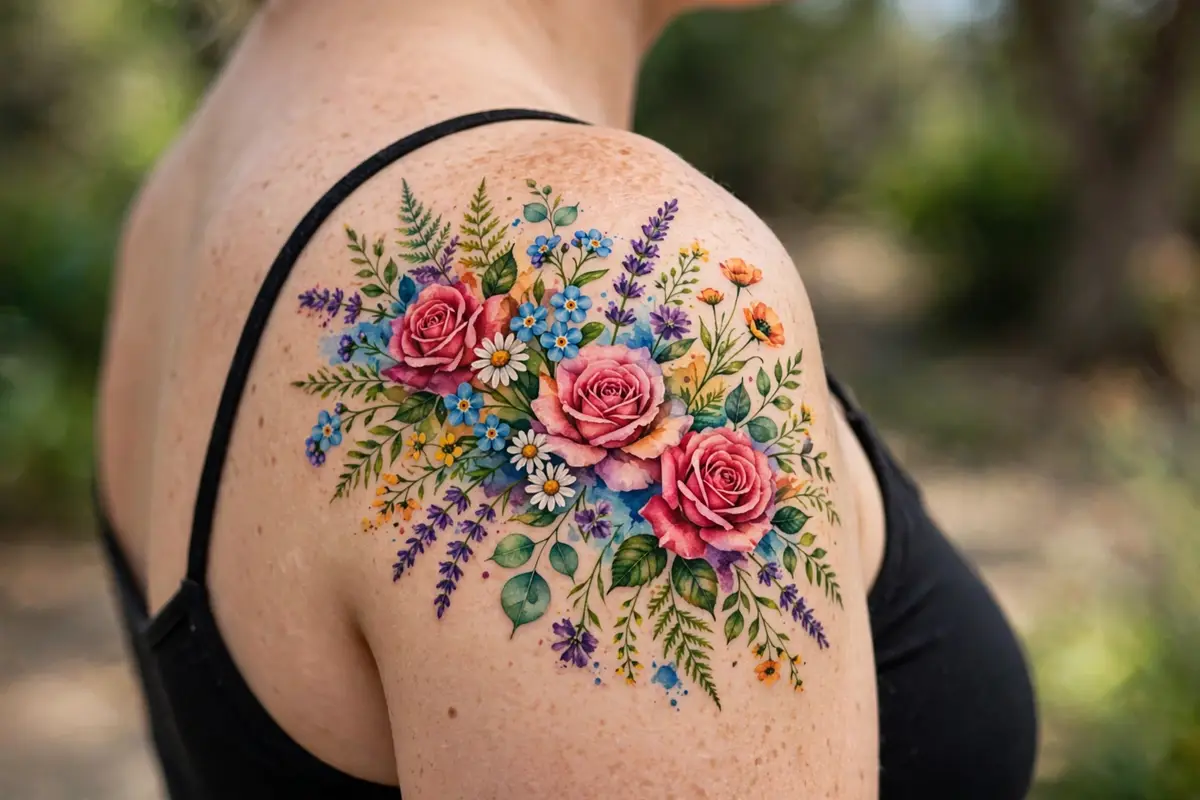
Flower Tattoos: Meaning, Styles, Placements and Ideas
A flower tattoo is the oldest idea in tattooing that never went out of style. Sailors carried roses home across oceans a century ago; grandmothers hide violets their grandchildren are now copying; and today the flower is the most versatile subject in the studio — it can be two fine lines on a wrist or a botanical sleeve, a memorial, a birth month, a private joke or a public banner. No other tattoo family carries this much meaning in this many sizes, for this many different kinds of people. This is the complete guide: what flower tattoos mean, the flowers people choose most and why, the six styles that shape them, where they sit best, and the practical thinking that separates a tattoo you love at year ten from one you explain away.
Whether this is your first tattoo or your fifteenth, start here: choose the flower by its meaning, the style by your temperament, and the placement by your life — in that order.
Quick Answer
A flower tattoo is a tattoo of any flower, carrying that flower’s meaning — love (rose), rebirth (lotus), remembrance (poppy), joy (sunflower), a birth month, a person, or a season of your life. The most popular flower tattoos are the rose, lotus, peony, sunflower, cherry blossom and daisy. They suit every placement from a 2 cm wrist bloom to a full floral back piece, work in styles from fine-line minimalism to bold traditional colour, and age best when the design keeps strong outlines, sensible detail for its size, and daily sun protection once healed.
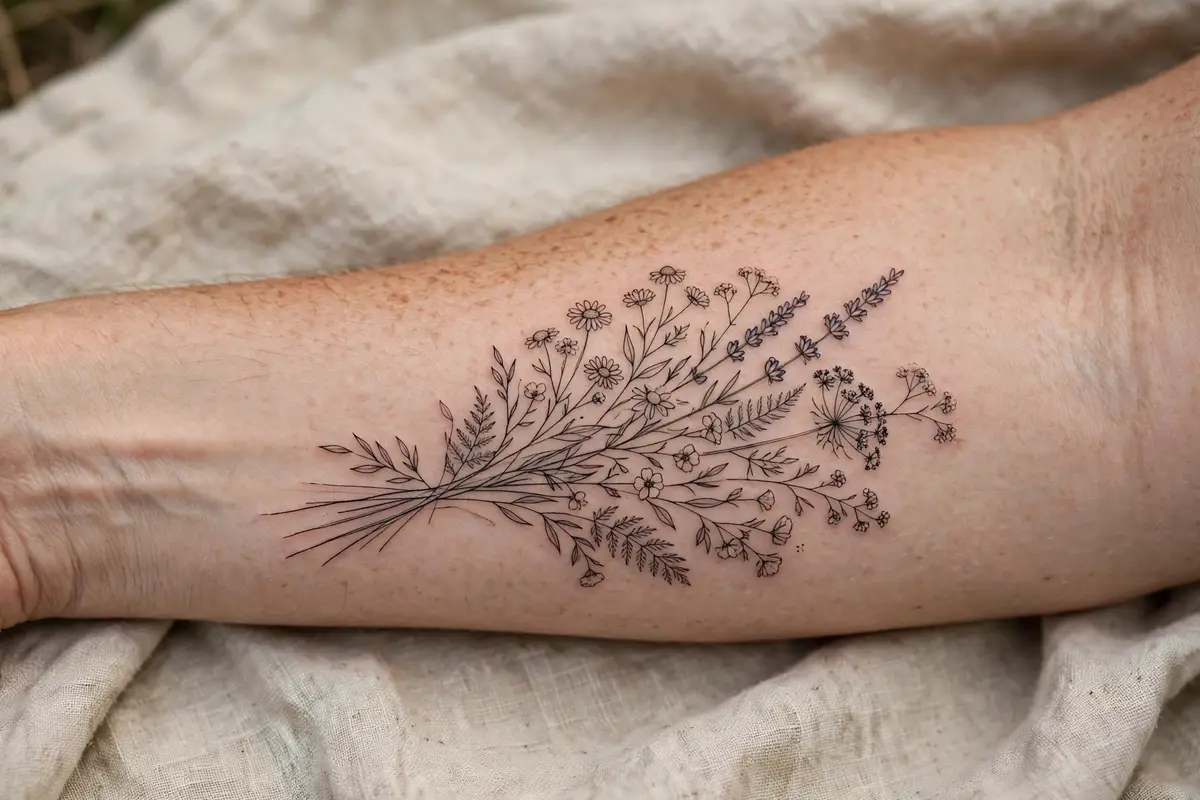
Table of Contents
- What Do Flower Tattoos Mean?
- The Flowers People Choose Most
- 6 Flower Tattoo Styles
- Best Placements for Flower Tattoos
- How to Choose Yours: 4 Questions
- Pain, Cost and Aftercare Basics
- Frequently Asked Questions
What Do Flower Tattoos Mean?
Flowers were a written language before they were tattoos. Victorian floriography assigned every bloom a meaning — the “language of flowers” that lovers used to send whole sentences in a bouquet — and tattooing inherited the dictionary entire: a rose still says love, a poppy still says remembrance, a sunflower still says devotion and joy. You can read the full history on the language of flowers page on Wikipedia. On skin, though, flower tattoos gather a few meanings of their own. They mark growth — the before-and-after of a life. They carry people: a grandmother’s favourite bloom outlasts every portrait. They declare birth months — the birth flowers guide covers all twelve, the fastest-growing family of flower tattoos. And they do what flowers do in every garden: they make the place they are in unmistakably, defiantly alive.
Flower Tattoo Quick Facts
- The family: any flower, any style — the broadest and oldest category in floral tattooing.
- Most requested: rose, lotus, peony, sunflower, cherry blossom, daisy, lavender, poppy.
- Meaning sources: floriography (Victorian flower language), cultural symbolism, birth months, personal association.
- Size range: 2 cm micro blooms to full sleeves and back pieces.
- Best first placements: forearm, shoulder, ankle, upper back — visible, coverable, mild-to-moderate pain.
- Aging rule: bold lines age bold; the finer the line, the simpler the design must be.
- Good to know: flower tattoos are the most cover-up-friendly designs in tattooing — dense petals and leaves hide old work brilliantly (see the FAQ).
The Flowers People Choose Most
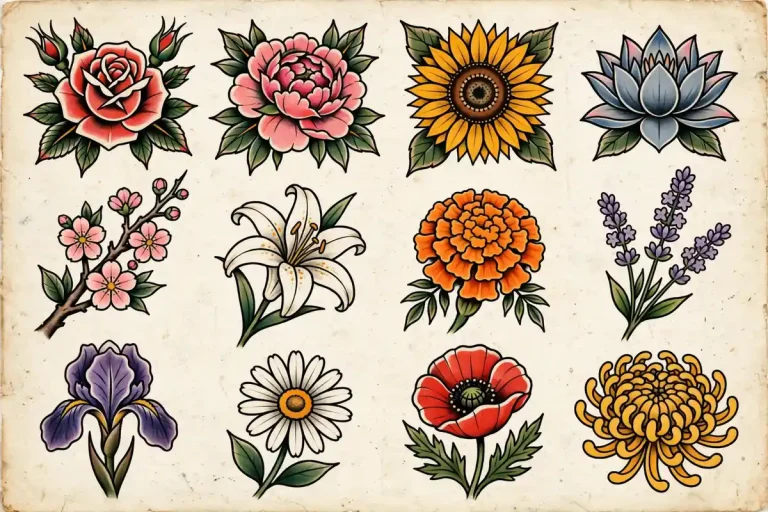
Eight blooms do most of the world’s flower tattooing, each with its own following. The table lays them side by side; the notes underneath say why each one wins its people.
| Flower | Core meaning | Signature style | Classic placement |
|---|---|---|---|
| Rose | Love, balance, remembrance | Traditional, blackwork | Forearm, chest, hand |
| Lotus | Rebirth, resilience, awakening | Fine line, dotwork mandala | Spine, sternum, wrist |
| Peony | Prosperity, romance, honour | Japanese, neo-traditional | Thigh, shoulder, back |
| Sunflower | Joy, devotion, loyalty | Colour realism, traditional | Shoulder, arm, calf |
| Cherry blossom | Life’s brevity, renewal | Japanese branch work | Ribs, back, arm |
| Daisy | Innocence, new beginnings | Fine line, minimalist | Ankle, wrist, collarbone |
| Lavender | Calm, healing, devotion | Fine-line sprig | Forearm, spine, ankle |
| Poppy | Remembrance, sleep, peace | Blackwork, watercolour | Arm, ribs, thigh |
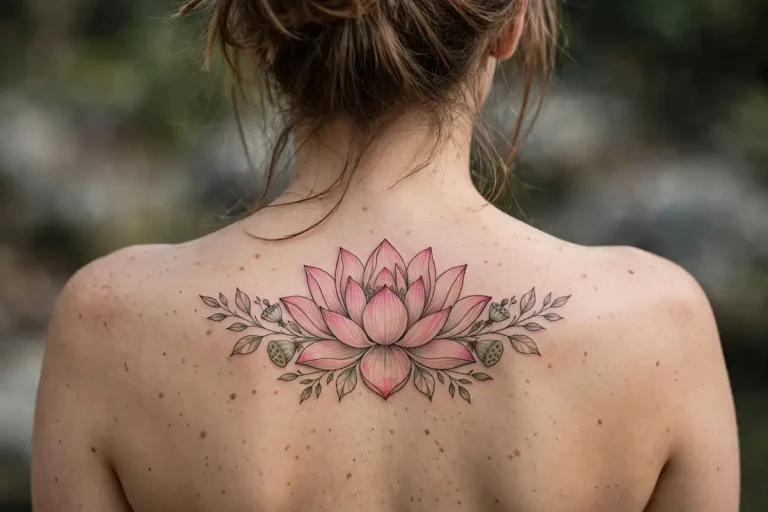
The rose is the eternal first place — love with thorns, beauty with a defence — and the only flower tattoo as common on sailors in 1920 as on influencers today. The lotus is the meaning-champion: our dedicated lotus flower tattoo guide covers its symbolism, colours and designs in depth. The peony brings the lushest petals in the business — the flower of prosperity and romance in our peony guide — and fills thighs and shoulders like brocade. The sunflower is joy you can see across a room. Cherry blossom trades in beautiful impermanence, petals drifting down a branch and a back. The daisy is the minimalist’s flower — innocence drawn in twelve white strokes. Lavender grows as a single elegant sprig, calm made visible. And the poppy carries remembrance in red and black, the memorial flower of two world wars.
6 Flower Tattoo Styles
The same rose becomes six different tattoos in six styles. Style is temperament made visible — pick the one that sounds like you. For hundreds more blooms to feed a design, browse our flower names A to Z guide.
1. Fine Line — the Delicate Modern Classic
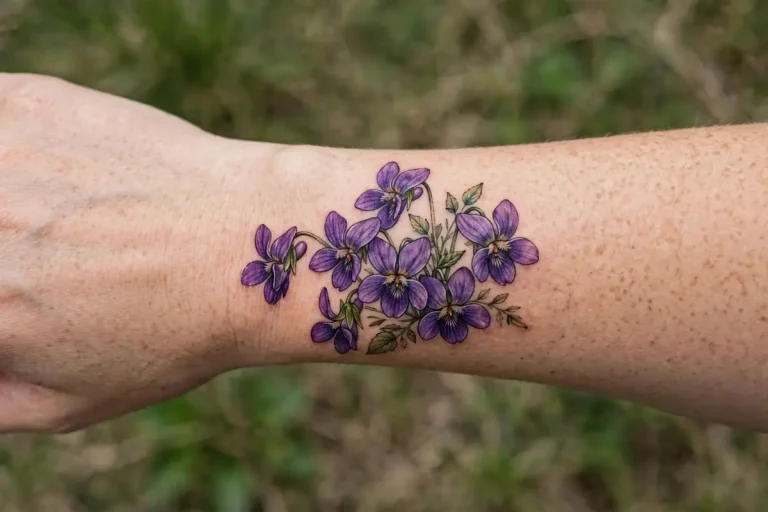
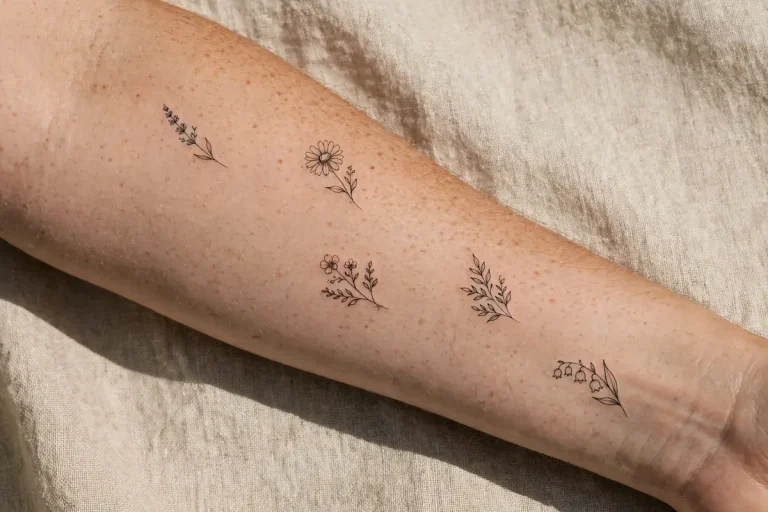
Single-needle outlines, minimal shading, maximum elegance: stems down spines, sprigs along collarbones, tiny bouquets on wrists. The style of the moment, and the one that demands the most honesty about aging — fine lines soften, so designs must stay simple, and the artist’s healed work is the only portfolio that counts.
2. Traditional — Bold Will Hold
The sailor’s creed and tattooing’s foundation: thick black outlines, a limited palette of red, green, gold and black, designs built to outlive their wearer. A traditional rose at year thirty looks like a tattoo; a faded whisper looks like a rumour. If permanence is the point, this is the style that guarantees it.
3. Watercolour — the Painted Garden
Colour that behaves like paint on wet paper — splashes, bleeds and washes behind or instead of outlines. Watercolour flower tattoos are the most painterly and the softest-aging of all styles: edges diffuse gently over the years. Wearers choose them for the feeling and accept the patina as part of the art.
4. Blackwork and Dotwork — Ink Without Colour
Solid blacks, stippled gradients, sacred geometry: blackwork flowers trade colour for contrast and age superbly. Dotwork mandalas built around lotuses and peonies are the meditative end of the style — thousands of dots, one calm image, and a design that holds its edges for decades.
5. Japanese (Irezumi) — Flowers With Weather
In Japanese tattooing, flowers never appear alone: peonies ride wind bars, cherry blossoms scatter over waves, chrysanthemums coil with dragons. The style composes whole scenes across backs and sleeves, seasonal and symbolic at once — peony for spring wealth, maple and chrysanthemum for autumn. Large, committed, and among the most beautiful tattoos on earth.
6. Realism — the Botanical Portrait
A flower rendered like a photograph or a Dutch still life: dew on a rose petal, a sunflower’s seeded heart in full texture. Realism demands the largest canvas, the most skilled hand and the most honest conversation about touch-ups — colour realism is the highest-maintenance style here, and on the right artist’s client, the most breathtaking.
Best Placements for Flower Tattoos
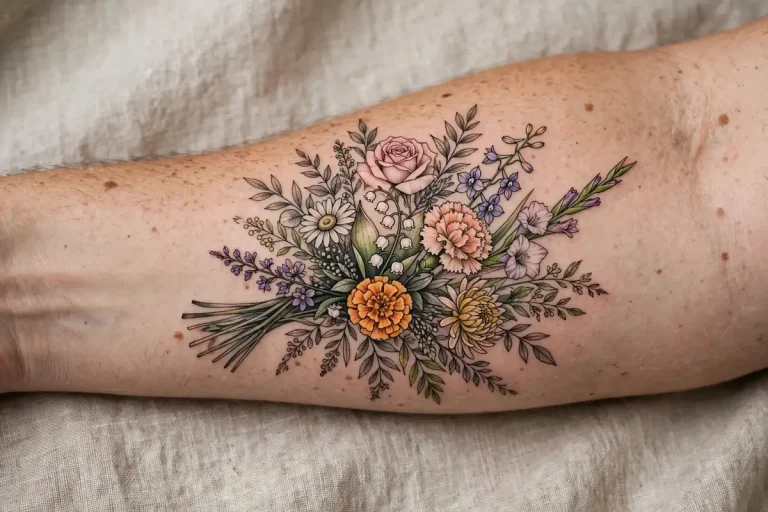
Flowers follow the body’s lines better than almost any subject, because stems curve and petals fan. Forearm — the modern default: visible to you daily, mild pain, easy to size up or extend into a sleeve of more flowers later. Shoulder and upper arm — the classic round canvas; a rose or peony sits on the deltoid like a brooch. Spine — a single stem with blooms, drawn vertically, is the most elegant small-to-medium design in the family. Sternum — mirrored flowers under the bust or a single bloom at the centre: private, symmetrical, sharp on the pain scale. Thigh — the big soft canvas for peonies, bouquets and garlands; easily covered, gently tattooed. Ankle and wrist — the dainty zone: sprigs, micro-blooms and bracelet vines. Ribs — branches and trailing stems follow the ribs’ curve beautifully and hurt accordingly. And behind the ear, fingers and feet — the discreet micro zone, with the standing caveat that these placements fade fastest and budget for touch-ups from day one.
How to Choose Yours: 4 Questions
One: whose flower is it? A tattoo that means someone — their favourite bloom, their birth flower, the flower from their garden — never goes out of fashion in your own eyes. Two: what should it say when you can’t explain it? Meanings compress: joy (sunflower), survival (lotus), love (rose), remembrance (poppy). Pick the word first; the flower follows. Three: public or private? That answer picks the placement, and placement picks the possible sizes — decide visibility before design, not after. Four: how will you treat it at year ten? If you want it crisp, choose bold lines and sunscreen habits; if you want it painterly, choose watercolour and embrace the softening. Every disappointment in tattooing is one of these four questions answered in the wrong order.
Pain, Cost and Aftercare Basics
Pain maps to anatomy, not to flowers: fleshy outer arm and thigh sit at 3–4 out of 10, forearm and calf at 4–5, ankle and wrist at 5–6, ribs, sternum and feet at 7–9. Cost scales with size, colour count and the artist’s rate — small fine-line pieces at studio minimums, large colour work by the session — and the design consultation, with the stencil tried on your skin, should always come before any deposit. Aftercare follows the universal routine shared across r/tattoos on Reddit and every good studio sheet: gentle washing, thin balm, no picking the flakes, no soaking or sun for two weeks, then sunscreen for life. (The week-by-week version, written for fine-line work, is in our lotus guide above.) A flower tattoo’s only special need is line protection: the thinner the stems in your design, the more religiously that sunscreen matters.
Frequently Asked Questions
What does a flower tattoo mean?
Each flower carries its own meaning — rose for love, lotus for rebirth, poppy for remembrance, sunflower for joy and devotion — drawn from the Victorian language of flowers and older cultural symbolism. Worn together or alone, flower tattoos most often mark growth, a person, a birth month or a chapter survived. If your question is not answered here, the questions about flower tattoos on Quora cover most of the rest.
Are flower tattoos only for women?
No — they never have been. Roses were standard on sailors, soldiers and dockers for a century before fine-line sprigs existed, and men’s floral work today runs from traditional roses and Japanese peony sleeves to blackwork botanical pieces. The flower is a subject, not a gender; the style and scale make the statement.
What is the best flower for a first tattoo?
The one whose meaning you will still want at forty — then drawn simply, at palm size or smaller, on the forearm, shoulder or ankle. Daisies, lavender sprigs, small roses and single lotuses are the classic first pieces: quick to tattoo, easy to live with, and endlessly extendable if the first becomes a garden.
Do flower tattoos age well?
The bold ones age beautifully — traditional and blackwork flowers hold for decades. Fine-line and watercolour pieces soften by design: lines spread slightly, washes diffuse. Two habits decide most of it: an artist who designs for the size (no tiny detail crammed small), and sunscreen on the healed tattoo, since UV fades colour and blurs line faster than time does.
How much does a flower tattoo cost?
By size, style and artist: small fine-line flowers commonly sit at a studio’s minimum charge, medium colour pieces at a few hours’ rate, and sleeves or back pieces by the session over months. Colour realism and large Japanese work are the premium end. Always price the final drawing at consultation — never the idea alone.
Can a flower tattoo cover up an old tattoo?
Better than almost anything else. Dense petals, layered leaves and deep colour let an artist bury old lines inside a peony, a rose or a sunflower — the old design becomes shadow inside the new bloom. Cover-ups need to run larger and darker than the original, and they belong to artists who show healed cover-up work in their portfolios.
One Comment