Best Plants for Enclosed Terrarium: The Complete Closed Terrarium Guide
A closed terrarium is one of the most satisfying projects a plant lover can take on: a living miniature landscape sealed inside glass, quietly watering itself through its own rain cycle. But the magic only works if you choose the right residents. Put the wrong plants inside a sealed jar and you will get a foggy box of mush within weeks. Pick the right ones and your tiny ecosystem can thrive for years with barely any input from you.
This guide covers the best plants for enclosed terrariums in real depth — which species genuinely thrive in sealed, high-humidity glass, how the famous terrarium water cycle works, the exact layers to build, step-by-step planting instructions, and honest troubleshooting for condensation, mold and overgrowth. If you are new to terrariums in general, start with our broader terrarium plant guide first, then come back here for the sealed-container specifics.
Quick Answer
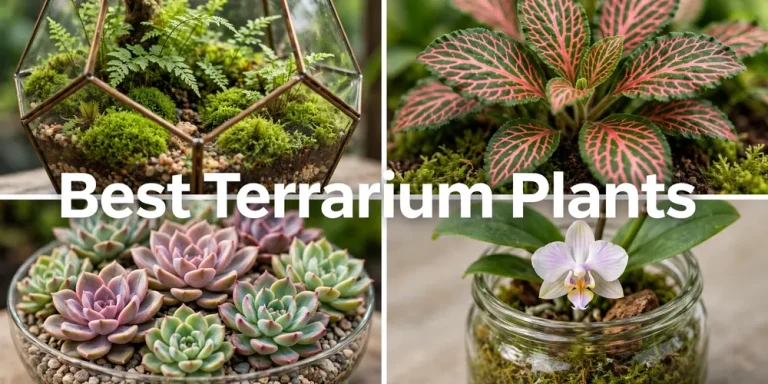
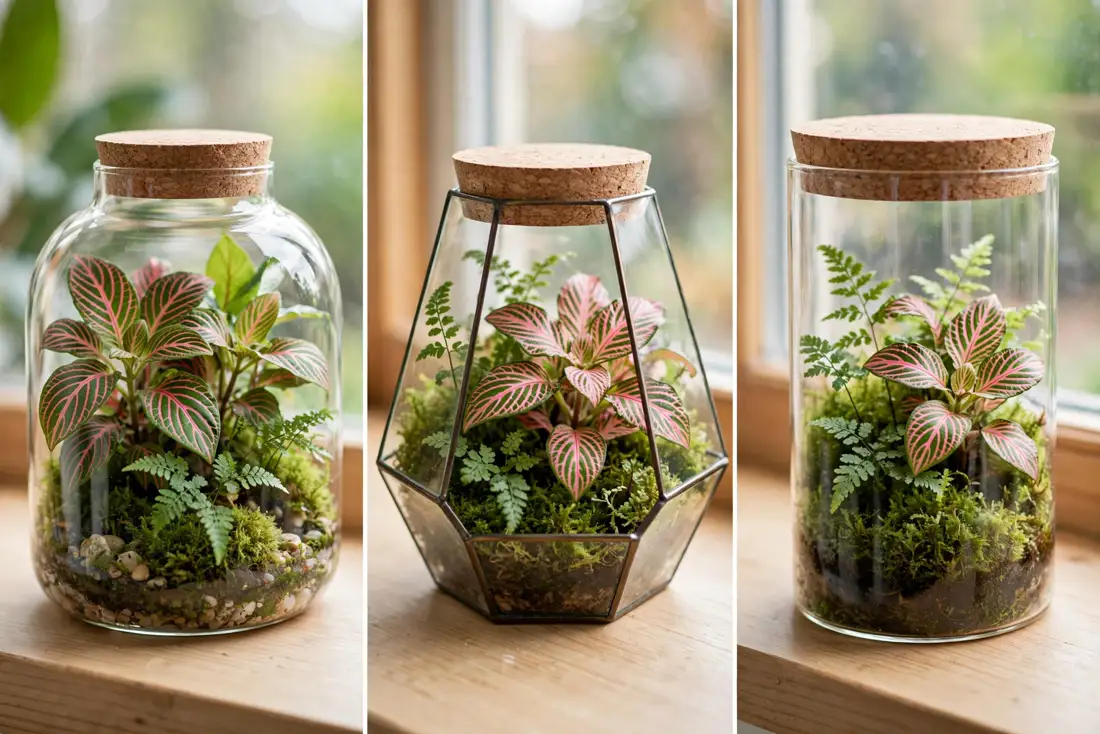
The best plants for enclosed (sealed) terrariums are small, slow-growing tropicals that love constant humidity: Fittonia (nerve plant), mosses, button and maidenhair ferns, Peperomia, Pilea, baby’s tears (Soleirolia), Selaginella (spike moss), Rex begonias and jewel orchids. They all share three traits — they stay compact, tolerate low airflow, and thrive in the 70–90% humidity a sealed jar creates. Succulents and cacti do NOT belong in closed terrariums — they rot in trapped moisture and need the dry airflow of an open terrarium instead.
Table of Contents
- How Closed Terrariums Work: The Water Cycle
- Best Closed Terrarium Plants at a Glance
- Fittonia (Nerve Plant)
- Mosses
- Ferns: Button Fern & Maidenhair
- Peperomia
- Pilea
- Baby’s Tears (Soleirolia soleirolii)
- Selaginella (Spike Moss)
- Rex Begonia
- Mini Orchids
- African Violets: The Honest Verdict
- Why Succulents and Cacti Don’t Belong in Sealed Terrariums
- Closed vs Open Terrariums Compared
- The Layering Guide: Drainage, Charcoal, Soil
- Planting Steps
- Maintenance & Troubleshooting
- FAQ
- References
How Closed Terrariums Work: The Water Cycle
A closed terrarium is a genuine miniature ecosystem. Once you seal the lid, the plants and soil inside create their own weather system — a scaled-down version of the rain cycle you learned about in school.
Here is what happens inside the glass, step by step:
1. Evaporation and transpiration. Moisture evaporates from the damp soil, and the plants themselves release water vapor through tiny pores in their leaves (transpiration). In an open pot this vapor simply drifts away into your room. In a sealed terrarium it has nowhere to go.
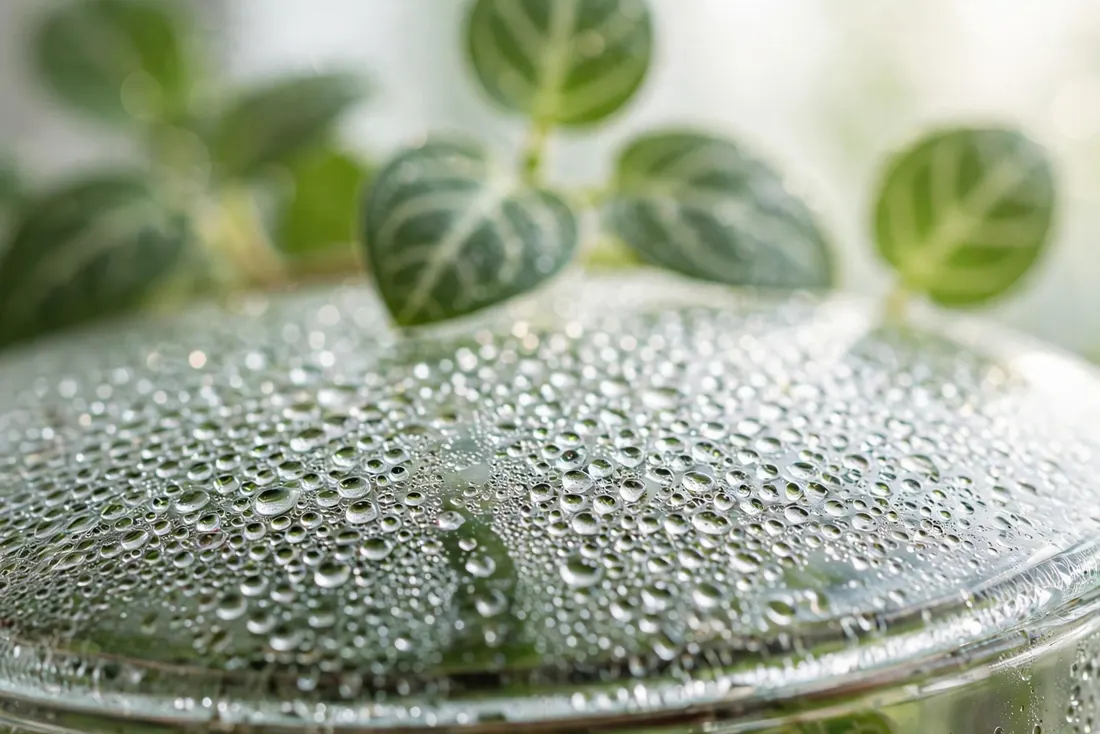
2. Condensation. Warm, humid air rises, hits the cooler glass walls and lid, and condenses into visible droplets. That foggy glass you see in the morning is literally your terrarium exhaling.
3. “Rain.” The droplets grow heavy, run down the glass, and drip back into the soil — watering the plants all over again. The cycle repeats indefinitely.
This self-watering loop is why a healthy sealed terrarium may only need watering a few times a year. The Royal Horticultural Society notes that in a true sealed terrarium, moisture is re-circulated so effectively that you shouldn’t need to water more than a few times a year, and University of Minnesota Extension guidance puts it at roughly once every four to six months for a balanced closed system.
But — and this is the critical point most beginners miss — the water cycle only works with plants built for it. The inside of a sealed terrarium sits at roughly 70–90% relative humidity with almost no air movement. Tropical understory plants read that as “home.” Desert plants read it as a death sentence. Every plant profile below was chosen because it genuinely enjoys life inside the jar.
Best Closed Terrarium Plants at a Glance
Before the detailed profiles, here is the shortlist in one view. Difficulty is rated for terrarium growing specifically, not general houseplant care — some of these are fussy as room plants but effortless once sealed in humid glass.
| Plant | Mature size in terrarium | Humidity needs | Difficulty |
|---|---|---|---|
| Fittonia (nerve plant) | 3–6 in | Very high | Easy |
| Mosses (cushion, sheet, star) | Under 2 in | Very high | Easy |
| Button fern / maidenhair fern | 6–12 in | High | Easy–Moderate |
| Peperomia (P. caperata, watermelon) | 6–8 in | High | Easy |
| Pilea (aluminum, friendship plant) | 6–12 in | High | Easy |
| Baby’s tears (Soleirolia) | 1–3 in (spreading) | Very high | Easy |
| Selaginella (spike moss) | 2–6 in (spreading) | Very high | Easy |
| Rex begonia (compact cultivars) | 6–12 in | High | Moderate |
| Mini / jewel orchids | 4–8 in | High | Moderate–Advanced |
| African violet (borderline) | 4–6 in | Moderate–High | Moderate |
Notice the pattern: every reliable closed-terrarium plant is a small, slow-to-moderate grower with a tropical or subtropical background. Vigorous growers will outgrow the jar in months, and anything that needs dry air between waterings will rot. Keep this filter in mind and you can evaluate any new plant you are tempted to add.
Fittonia (Nerve Plant)
If closed terrariums had an official mascot, it would be Fittonia albivenis. This South American rainforest-floor native is practically engineered for sealed glass: it stays under six inches tall, adores humidity, tolerates the low light inside a jar, and — most usefully — faints dramatically when it needs water, then perks straight back up after a drink. No other plant gives you such an honest moisture reading.
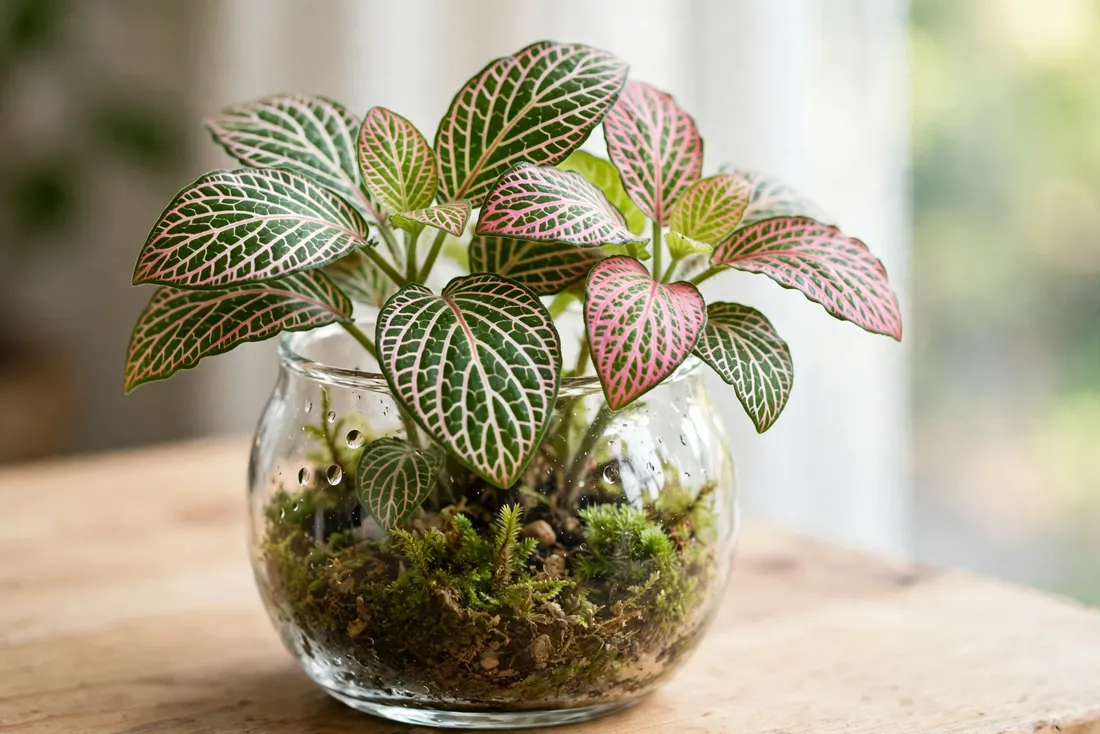
Why it thrives sealed in: Fittonia evolved under dense rainforest canopy where the air is permanently damp. Household air (often 30–40% humidity) is what makes nerve plants crispy and miserable as ordinary houseplants; a closed terrarium’s 70–90% humidity is their native climate. The Royal Horticultural Society specifically lists fittonias among its recommended closed-terrarium plants, naming compact forms like Fittonia albivenis (Argyroneura Group) ‘Nana’.
Care inside the jar: Bright, indirect light — a north or east window, or a few feet back from a brighter one. Keep the soil lightly moist at all times but never soggy; the plant will tell you when it is thirsty by drooping. Pinch the growing tips regularly to keep it bushy, because leggy fittonia stems will stretch for the lid. If you want more variety, browse our roundup of plants that start with F — fittonia and ferns both make the list for good reason.
Watch out for: Cold drafts (fittonia hates temperatures below about 60°F / 15°C) and direct sun, which turns a sealed jar into an oven. Faded or bleached leaves usually mean too much light.
Mosses
Moss is the groundcover that makes a closed terrarium look like a real forest floor instead of a few plants stuck in dirt. Because mosses have no true roots and absorb water directly through their leaves, they are perfectly at home in constant humidity — they are among the few plants that genuinely cannot be over-misted in a sealed environment, provided air can still circulate a little.
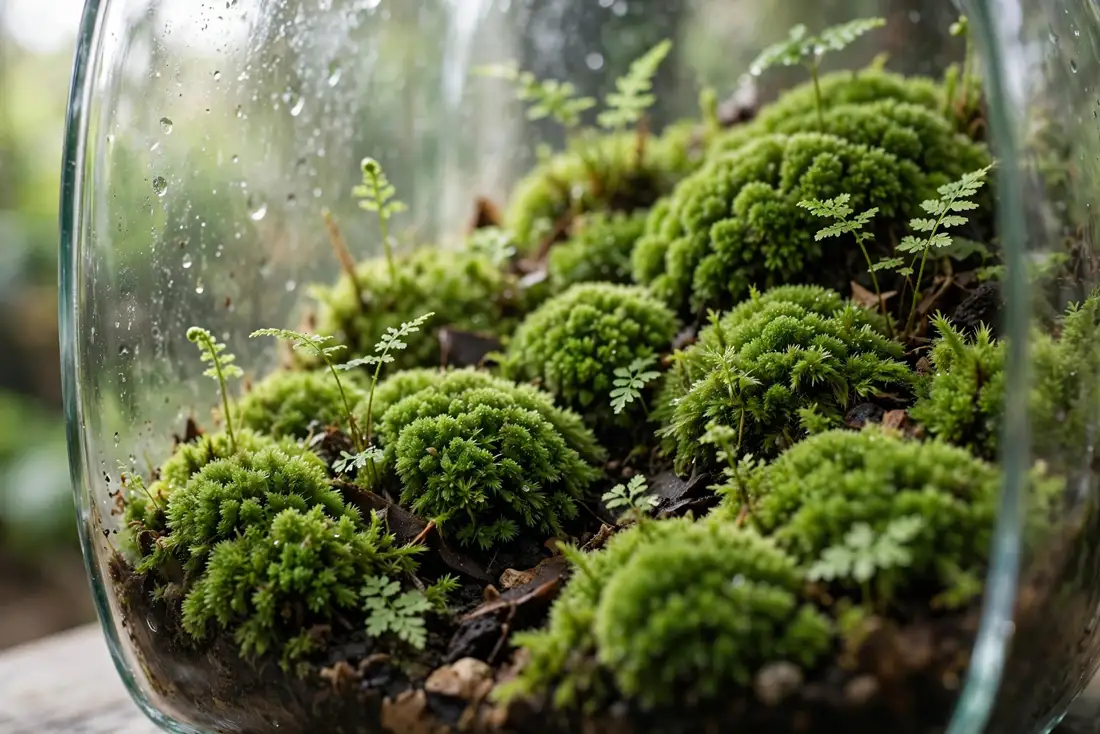
Best types for terrariums: Cushion moss (Leucobryum) forms soft, pillowy mounds; sheet moss (Hypnum) spreads into a flat green carpet; star moss (Tortula ruralis) adds interesting starburst texture. All three stay under two inches tall and creep slowly, which is exactly what you want.
Care inside the jar: Moss wants constant light moisture and low to medium indirect light — it actually prefers shadier spots than most terrarium plants, making it ideal for tucking around the base of taller specimens. Press moss patches gently onto damp soil or over the drainage layer and they will knit themselves in. If moss turns brown and crispy, the terrarium is too dry; if it turns slimy, there is too much standing water and you should vent the lid for a day or two.
Sourcing honestly: Buy nursery-grown or terrarium-cultured moss rather than ripping it from the wild, where many species are protected or slow to recover. Rinse any moss before planting to remove hitchhiking pests.
Ferns: Button Fern & Maidenhair
Ferns and sealed glass are a natural pairing — ferns reproduce by spores that need moisture, and most of the small species evolved in damp, shaded forests. Two stand out for closed terrariums because they stay compact and handle the still air.
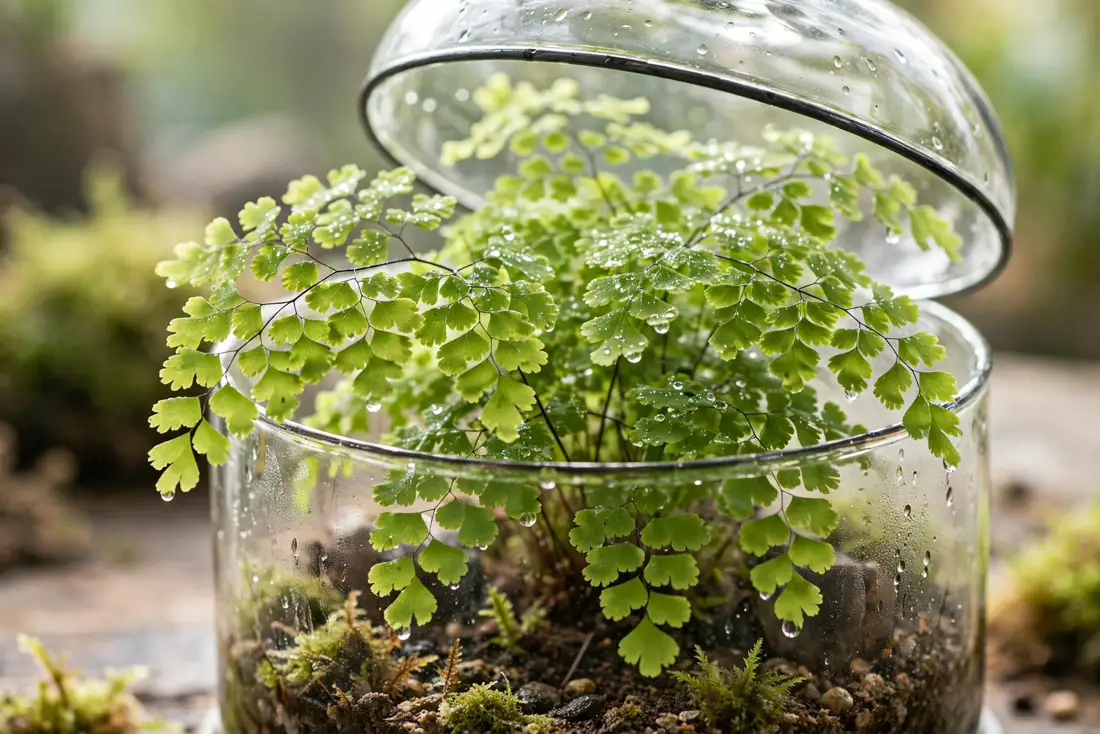
Button fern (Pellaea rotundifolia): The beginner’s fern. Round, leathery leaflets on arching fronds, tolerant of the occasional dry spell, and slow-growing enough to behave in a jar for a long time. Reaches about 6–12 inches but takes its time getting there.
Maidenhair fern (Adiantum spp.): The showstopper — black wiry stems with impossibly delicate fan-shaped leaflets. It is fussier than the button fern and will crisp at the edges if humidity drops, which is precisely why a sealed terrarium suits it better than an open pot on a windowsill. Dwarf forms stay small enough for medium jars.
Care inside the jar: Bright, indirect light and evenly moist (never waterlogged) soil. Remove brown fronds at the base to keep air moving around the crown. Ferns also appreciate an occasional lid-off airing — an hour every week or two — which mimics the gentle air movement of a forest floor. For more fern inspiration, see our plants that start with F collection.
Peperomia
Peperomias are the slow, steady backbone plants of the terrarium world. With over a thousand species, the genus offers ripple-textured leaves, watermelon stripes and silvery patterns — all on plants that rarely exceed eight inches and grow at a pace that won’t overwhelm the glass for years.
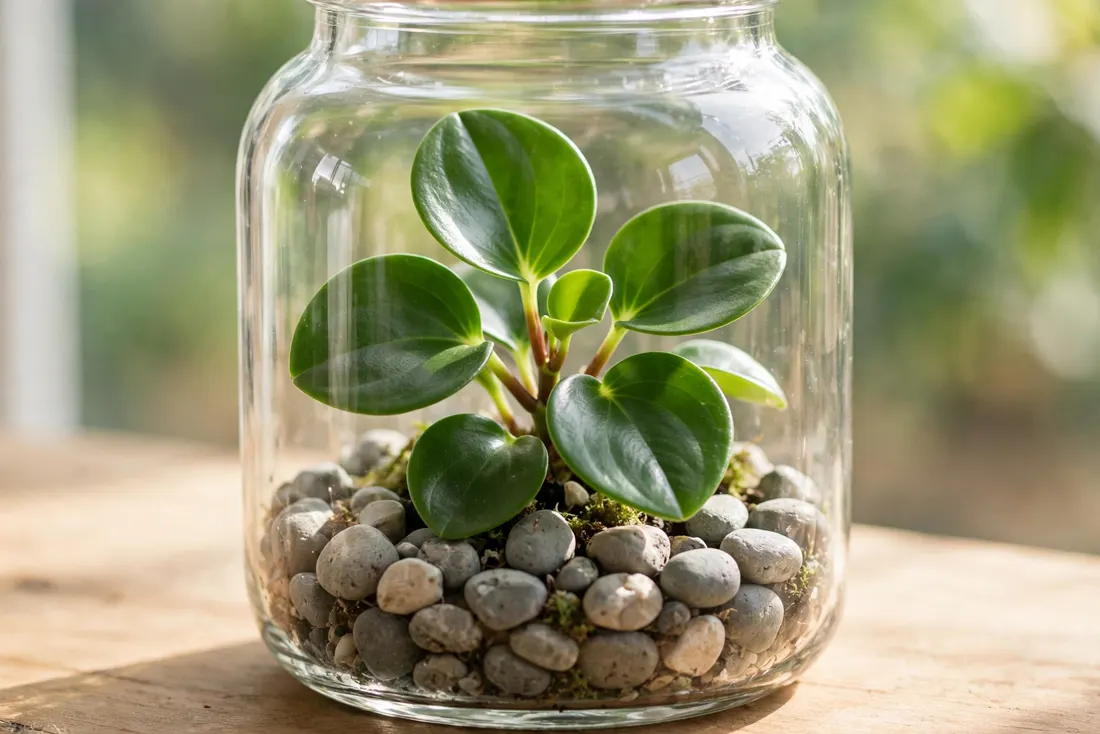
Best species: Peperomia caperata (emerald ripple) with its deeply quilted heart-shaped leaves, P. argyreia (watermelon peperomia) with silver-striped foliage, and P. griseoargentea — all three appear on the RHS’s own recommended list for closed terrariums. Their slightly succulent leaves store a little water, which makes them forgiving if you are late with the rare watering a sealed terrarium needs.
Care inside the jar: Bright, indirect light; a light, well-draining mix (add extra perlite to standard potting soil); and a genuinely light hand with water. Peperomia roots rot faster than almost any other terrarium plant if the soil stays soggy, so let the top of the soil dry slightly between the infrequent waterings a sealed system needs. Good drainage layers matter more for peperomias than for any other plant on this list.
Pilea
Pileas bring texture and contrast that few other small tropicals can match. Pilea cadierei (aluminum plant) carries silver-splashed leaves, P. involucrata (friendship plant) has quilted bronze-green foliage, and P. microphylla (artillery fern — not a true fern) forms a delicate mound of tiny leaves. All three are RHS-recommended for closed terrariums and stay in the 6–12 inch range with pruning.
Care inside the jar: Bright, indirect light keeps the silver and bronze markings vivid; too little light and the patterns fade to plain green. Keep soil lightly moist and pinch stem tips to encourage branching — pileas respond to pruning by doubling their stems, which is how you get that lush, full look. They root easily from cuttings, so trimmings can be tucked straight back into the soil to fill gaps.
Baby’s Tears (Soleirolia soleirolii)
Baby’s tears is the classic terrarium groundcover: a dense mat of tiny round leaves on thread-thin creeping stems that will carpet every inch of exposed soil in a sealed jar. In the wild it grows on damp rocks and stream banks in the Mediterranean, so constant moisture is its love language.
Care inside the jar: This is a plant that wants to be damp — never let the soil dry out, and it will reward you with explosive growth. That vigor is also the warning: baby’s tears can smother slower neighbors, so plant it as an accent and trim it back ruthlessly every few weeks. It roots wherever stems touch soil, so pulled-up handfuls can be replanted or composted. Bright, indirect light; it tolerates lower light than most on this list but grows leggier there.
Best use: Tuck it around the base of a fern or peperomia where it acts as living mulch, keeping the soil surface moist and hiding bare dirt.
Selaginella (Spike Moss)
Despite the name, spike moss is not a moss at all — it is an ancient clubmoss lineage over 400 million years old, and it looks like something from a prehistoric forest. Selaginella kraussiana spreads into a feathery emerald carpet, while S. uncinata (peacock moss) flashes iridescent blue-green in good light. Both stay under six inches and spread slowly outward rather than upward.
Care inside the jar: Selaginella demands what a sealed terrarium provides by default: high humidity and constantly moist (not flooded) soil. It sulks below about 50% humidity, which rules it out as an open-air houseplant in most homes but makes it a star under glass. Bright, indirect light; direct sun scorches the fine foliage. Like baby’s tears, it will creep — trim edges to keep it in its lane.
Rex Begonia
For pure visual drama, nothing in a closed terrarium beats a rex begonia. The rex-cultorum group offers leaves painted in silver, burgundy, pink and near-black, often with spiraled or ruffled edges. Choose compact cultivars and young plants — full-size rexes will outgrow a jar, but small varieties can live happily under glass for a year or more before needing a move. Our plants that start with B roundup has more begonia ideas if you fall for the genus.
Care inside the jar: Bright, indirect light (too dim and the colors wash out; direct sun burns the leaves). Keep soil lightly moist and — critically — keep water off the leaves, which spot and rot easily in still humid air. Good air circulation matters more for begonias than for most terrarium plants, so give them a lid-off airing weekly. Remove spent leaves promptly; decaying begonia foliage is one of the fastest routes to mold in a sealed jar.
Honest caveat: Rex begonias are the most disease-prone plants on this list. They are worth it for the color, but if you want a truly hands-off terrarium, lean on fittonia, moss and ferns instead.
Mini Orchids
Orchids in a terrarium sound advanced, and the flowering kinds are — but foliage-first jewel orchids like Ludisia discolor are surprisingly well suited to sealed glass. Grown for their velvety, gold-veined leaves rather than their modest flower spikes, jewel orchids stay compact, love humidity, and tolerate the lower light inside a jar. For more orchid relatives and ideas, browse our plants that start with O collection.
Care inside the jar: Bright, indirect light and an airy, bark-based mix rather than dense potting soil — orchid roots need oxygen even in humidity. Water lightly and let the mix approach dryness between waterings. Miniature Phalaenopsis can work in larger sealed terrariums with occasional venting, but they demand brighter light and better airflow than a beginner jar provides; treat flowering minis as an intermediate project.
Best use: One jewel orchid as the “jewel” of the arrangement, surrounded by moss that keeps its root zone evenly moist.
African Violets: The Honest Verdict
African violets (Streptocarpus sect. Saintpaulia) come up in terrarium discussions because they love humidity and stay small — both true. But here is the honest verdict: they are a borderline choice for fully sealed terrariums, and the RHS advises avoiding flowering plants in closed terrariums generally, because every time you open the jar to deadhead spent blooms, you disturb the sealed balance.
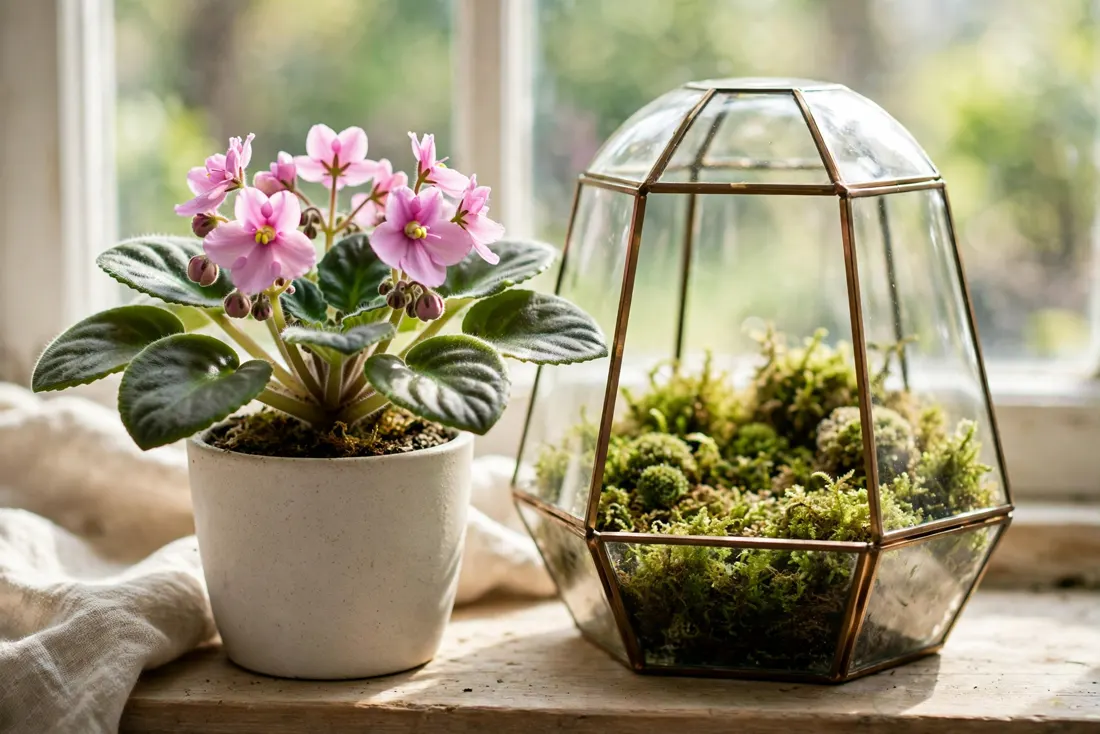
African violets also dislike water on their fuzzy leaves and need decent airflow to avoid crown rot — two things a sealed jar struggles to provide. They perform far better in open-top or partially covered terrariums where humidity stays elevated but air still moves. If your heart is set on blooms under glass, a jar with a loose-fitting lid or a wide mouth is the compromise. For genuinely reliable sealed-jar color, stick with the painted foliage of fittonias, rex begonias and peperomias instead.
Why Succulents and Cacti Don’t Belong in Sealed Terrariums
This deserves its own section because it is the single most common closed-terrarium mistake. Succulents and cacti are desert plants. Their entire biology — thick water-storing leaves, waxy coatings, CAM photosynthesis — is optimized for long dry spells and fast-draining soil with constant airflow around the leaves.
A sealed terrarium is the precise opposite of a desert: humidity near 90%, still air, and soil that rarely dries. Put a succulent in there and the outcome is predictable and quick — soft, translucent leaves, stem rot starting at the base, and a plant that collapses within weeks. Gardening Know How’s terrarium care guide states it plainly: most guides recommend avoiding desert plants such as cacti or succulents, which may succumb to rot, unless the container is left open.
The rule is simple: succulents and cacti go in open terrariums only, where excess moisture can escape. If you love the succulent look, build an open dish garden instead — our terrarium plant guide covers which plants suit open containers. Never mix a succulent into a sealed jar “just to try it.” The humidity that makes your fittonia thrive will kill your echeveria.
Closed vs Open Terrariums Compared
Understanding the difference cements why plant selection matters so much. The two styles look similar on a shelf but run on completely different physics:
| Feature | Closed terrarium | Open terrarium |
|---|---|---|
| Humidity | 70–90%, self-sustaining | 40–60%, matches room air |
| Watering frequency | A few times per year | Every 1–2 weeks |
| Best plants | Tropical humidity-lovers: ferns, mosses, fittonia | Succulents, cacti, air plants |
| Airflow | Minimal; vent occasionally | Constant |
| Biggest risk | Mold and rot from excess moisture | Underwatering |
| Light needs | Bright indirect only (glass magnifies heat) | Can tolerate some direct sun |
| Maintenance level | Very low once balanced | Low–moderate |
Choose the container for the plants, not the other way around. If you already own the plants, match them to the right style using the table above.
The Layering Guide: Drainage, Charcoal, Soil
A closed terrarium has no drainage holes, so the layers at the bottom do the job that holes would do in a pot. Build them in this order — each one has a real function, and skipping the charcoal is the shortcut most failed terrariums have in common.
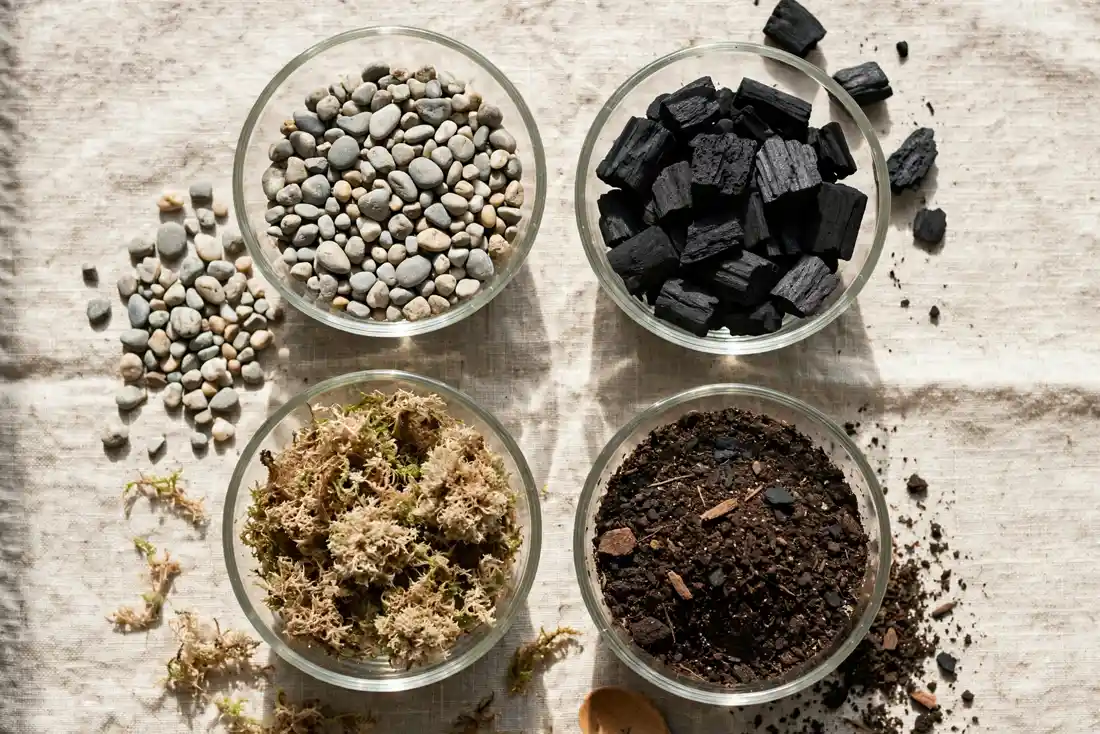
Layer 1 — Drainage (1–2 inches of gravel or pebbles). This is the reservoir. Any excess water sinks here instead of sitting around the roots, which is what causes root rot. Small aquarium gravel, pea gravel or expanded clay pebbles all work. Rinse them first.
Layer 2 — Activated charcoal (about ½–1 inch). Horticultural activated charcoal absorbs odors, toxins and the organic compounds that build up in a sealed system with no way out. University of Minnesota Extension guidance specifically calls charcoal “especially important in closed terrariums, which prevent the natural escape of chemicals.” Do not substitute barbecue charcoal — it contains additives. Buy horticultural or aquarium-grade activated charcoal.
Layer 3 — Sphagnum moss barrier (thin layer, optional but recommended). A sheet of damp sphagnum moss over the charcoal stops fine soil particles from washing down and clogging the drainage layer. It also wicks a little moisture upward.
Layer 4 — Growing medium (2–3 inches). Use a sterile, light, well-draining potting mix — never garden soil, which compacts, harbors pathogens and drains poorly in a sealed container. A peat- or coco-based houseplant mix with added perlite is ideal; Oregon State Extension recommends a soilless potting mix for terrarium builds. For orchids or plants that want extra air around their roots, mix in fine orchid bark.
Optional top dressing: A thin scattering of fine gravel, sand or decorative stone over the soil surface looks finished and helps keep the very top of the soil from staying soggy. Keep it thin near plant crowns so stems don’t stay wet.
Planting Steps
With layers built, planting is the fun part. Work slowly — you only get one comfortable planting session before the glass fogs and the space gets cramped.
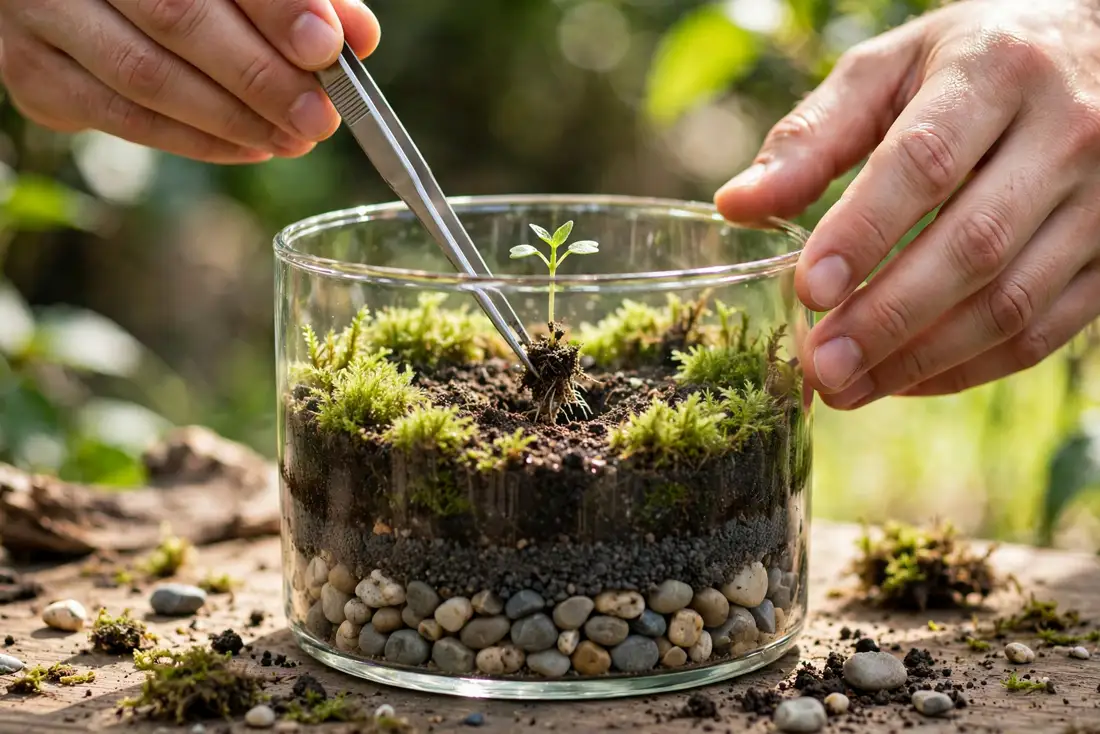
Step 1 — Clean everything. Wash the glass container with hot soapy water, rinse well and dry. Gardening Know How’s terrarium guide stresses starting with thoroughly cleaned glass and sterile mix, because you are sealing a warm, humid box — any existing mold spores get a perfect incubator. Rinse plants’ nursery pots too, and shake off loose old soil so you don’t import pests.
Step 2 — Add the layers. Build drainage, charcoal, moss barrier and soil as described above. Lightly moisten the soil — damp like a wrung-out sponge, not wet. Mound the soil slightly higher at the back or center for a natural landscape feel.
Step 3 — Plan the arrangement. Set the potted plants (still in their nursery pots) inside the empty terrarium and shuffle them until the composition pleases you. Put taller plants (ferns, pilea) at the back or center, mid-size plants (peperomia, fittonia) in the middle ground, and groundcovers (moss, baby’s tears, selaginella) at the front. Leave breathing room — plants will grow, and cramming is the top aesthetic mistake.
Step 4 — Plant. Working from back to front, dig a hole with a chopstick, spoon handle or long tweezers, settle each plant in at the same depth it grew in its nursery pot, and firm the soil gently around the roots. Long tweezers and a small funnel are the classic terrarium toolkit for reaching through narrow necks.
Step 5 — Finish and water in. Add top dressing, tuck in moss patches, and mist everything lightly so leaves are clean and soil is evenly damp. Wipe any soil smears off the inside glass now — they are much harder to reach later.
Step 6 — Seal and place. Put the lid on and set the terrarium in bright, indirect light — an east-facing window or a bright spot out of direct sun. Never place a sealed terrarium in direct sunlight: the glass magnifies heat and can literally cook the plants within hours. Then leave it alone for a week and watch the water cycle start.
Maintenance & Troubleshooting
A balanced closed terrarium is famously low-maintenance, but “low” is not “zero.” A five-minute check every week or two keeps small problems from becoming jar-ending ones.
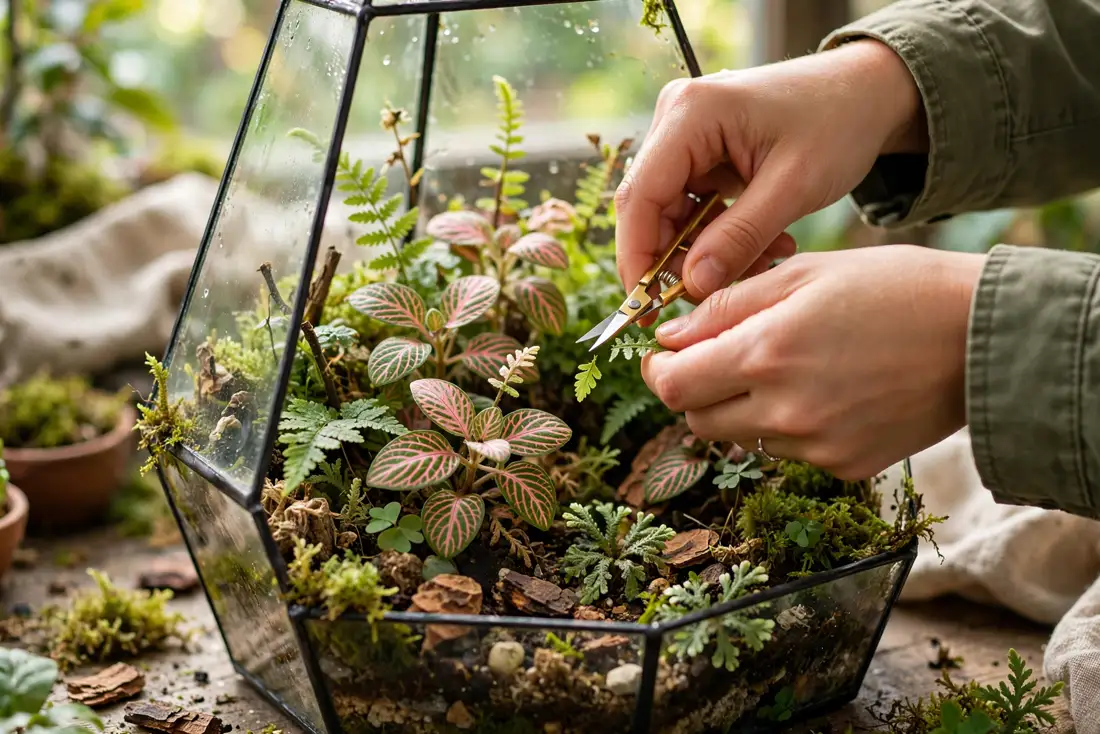
Reading the condensation. Your glass is a dashboard. A light misting in the morning that burns off by afternoon means the moisture balance is perfect. Glass that stays heavily fogged or drips constantly means too much water — take the lid off for a few hours (or a day) and let excess moisture escape, then reseal. No condensation at all for several days, plus dry soil, means it is time to add a little water. When in doubt, underwater: you can always add moisture, but you cannot easily remove it.
Watering. When watering is needed — typically every few months in a well-sealed jar — add small amounts with a mister, syringe or narrow-spout watering can, targeting the soil rather than the leaves. Distilled water, rainwater or dechlorinated tap water prevents mineral crusts on the glass. Terrarium pruning uses the same basic skills as general houseplant care — if you also keep flowering houseplants, our mum care guide walks through seasonal feeding and deadheading routines in a similar level of detail.
Ventilation. Even sealed terrariums benefit from fresh air. Open the lid for an hour or two every week or two — more often right after watering. This discourages mold, replenishes CO₂ for photosynthesis, and mimics natural air movement. If you spot fuzzy white or grey mold on soil or dead leaves, remove the affected material immediately, vent the jar for a day, and spot-treat remaining patches with diluted hydrogen peroxide.
Pruning and grooming. Remove dead or yellowing leaves promptly — decaying matter in still, humid air is mold’s favorite food. Pinch back vigorous growers (baby’s tears, fittonia, pilea) before they shade out slower neighbors. Overgrown specimens can be lifted out, divided or replaced; a terrarium is a garden, not a time capsule, and editing is part of the hobby.
Light and temperature. Keep the jar in bright, indirect light and rotate it a quarter-turn every couple of weeks so all sides grow evenly. Ideal temperatures are 60–75°F (15–24°C). Keep terrariums away from radiators, heating vents and cold drafty windows — sealed glass amplifies temperature swings.
Pests. Fungus gnats love damp terrarium soil. A thin sand or fine-gravel top dressing makes the surface less inviting for egg-laying, and sticky traps near (not inside) the jar catch adults. Springtails — tiny white jumping specks in the soil — are actually beneficial cleanup crew that eat mold and decaying matter; many terrarium keepers introduce them deliberately. If you want more botanical projects once your jar is thriving, our unusual and beautiful flowers collection is full of striking plants for the rest of your home.
Fertilizer. Less is more. Terrarium plants in rich soil rarely need feeding; if growth stalls after a year or more, apply a balanced liquid houseplant fertilizer at quarter strength, once, in spring. Over-fertilizing causes salt buildup and leggy growth that ruins the scale of the planting.
FAQ
How often should I water a closed terrarium?
Far less than you think. A well-balanced sealed terrarium typically needs water only every few months — the internal rain cycle does the rest. Water only when two conditions are both true: there has been no condensation on the glass for several days, and the soil feels dry to the touch. When you do water, add a little at a time; overwatering is the number-one killer of closed terrariums.
Why is my closed terrarium always foggy?
Constant heavy condensation means there is too much moisture inside. Remove the lid for several hours or up to a day to let water escape, and blot any puddles on the soil surface. If fogging never clears, you likely added too much water at planting — vent the jar over a few days until only a light morning mist remains. Persistent fog plus a sour smell can indicate anaerobic soil; in that case, rebuild the drainage layer with fresh charcoal.
Can succulents go in a closed terrarium?
No. Succulents and cacti are desert plants that need dry air, fast-draining soil and airflow — the sealed, near-100% humidity inside a closed terrarium rots them quickly. They belong in open terrariums or dish gardens where moisture can escape. For sealed glass, choose tropical humidity-lovers like fittonia, ferns, mosses and peperomias instead.
Do closed terrariums need direct sunlight?
No — and direct sun is actively dangerous. Glass magnifies sunlight and can overheat a sealed terrarium to plant-killing temperatures within hours. Bright, indirect light is ideal: near an east-facing window, a few feet from a south or west window, or under a grow light. If plants stretch toward the light with long pale stems, move the jar slightly brighter; if leaves bleach or scorch, move it back.
How do I stop mold growing in my terrarium?
Mold feeds on excess moisture plus decaying organic matter. Prevent it by watering sparingly, including activated charcoal in your layers, removing dead leaves promptly, and venting the lid for an hour or two every week or two. If mold appears, pick out the affected leaves or soil, ventilate the jar for a day, and dab remaining spots with diluted hydrogen peroxide. A colony of springtails will then help keep mold from returning.
How long will a closed terrarium last?
Years — even decades — with basic care. The famous sealed bottle garden planted by David Latimer in 1960 is still alive, watered only once in over 60 years. Realistically, expect your terrarium to need a replant or refresh every 2–4 years as plants outgrow the space or soil depletes. Regular pruning and the occasional plant swap keep a jar going indefinitely.
References
- RHS: Terrariums and Bottle Gardens — the Royal Horticultural Society’s advice on suitable closed-terrarium plants, watering frequency and placement.
- Gardening Know How: How to Make a Terrarium – Care and Maintenance Guide — watering, moisture control and plant choices for open and closed containers.
- Gardening Know How: Succulent Terrarium Instructions — why succulents need an open rather than closed system to avoid fatal moisture buildup.
- University of Minnesota Extension: Terrarium Gardening — layering, soil selection and watering guidance from Extension Master Gardener volunteers.
- Oregon State University Extension: Tiny Gardens, Big Impact — step-by-step terrarium building instructions including charcoal and soil depths.