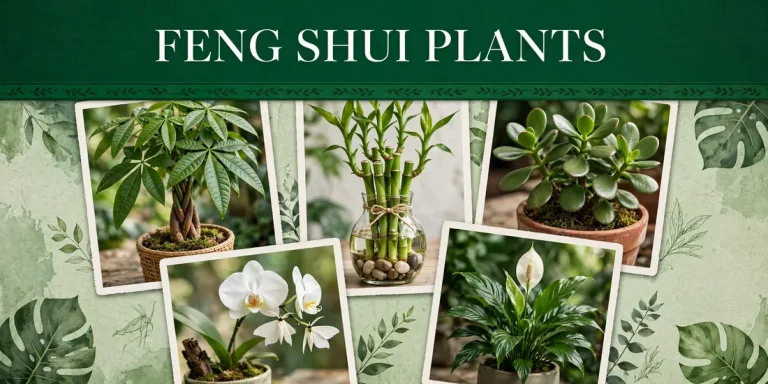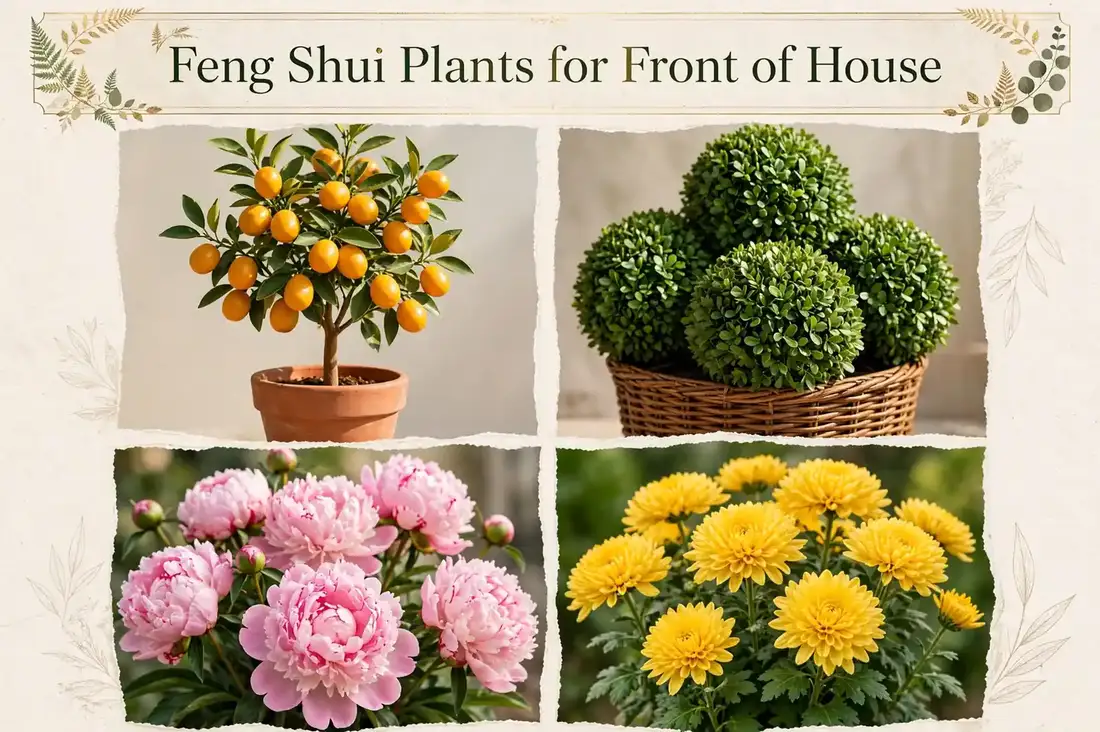
Feng Shui Plants for Front of House: 12 Lucky Plants & Placement Guide
Your front door is the first thing guests notice and, in feng shui, the single most important part of your home. Practitioners call it the “mouth of chi” — the opening through which energy, opportunities, and abundance flow into your life. Choosing good feng shui plants for front of house is therefore about far more than curb appeal: the right plants at your entrance are believed to welcome positive energy, protect the household, and set the tone for everything inside.
This guide covers the twelve best feng shui plants for the front of the house, from fruiting citrus trees and coin-leafed jade plants to evergreen boxwood topiary and long-lived chrysanthemums. You will learn exactly where to place them — left, right, or flanking both sides of the door — which plants to avoid (dead plants, thorny blockers, overgrown shrubs), and how to style your entrance through every season so it looks beautiful and feels welcoming all year. If you want the broader indoor picture too, see our complete guide to feng shui plants for room-by-room placement ideas.
Quick Answer
What are the best feng shui plants for the front of the house? The top picks are citrus trees (kumquat or calamondin — golden fruit symbolizes wealth), jade plants (coin-shaped leaves for prosperity), boxwood topiary (evergreen protection), peonies (honor and good fortune), chrysanthemums (longevity), lavender (calm and purification), clumping bamboo (upright resilience), azaleas, camellias, gardenias, Boston ferns, and rosemary. Place healthy plants in pairs flanking the door, keep the path completely clear, and remove anything dead or dying immediately — a struggling plant at the entrance works against you.
Table of Contents
- Quick Answer
- Best Entrance Plants at a Glance
- Why the Front Door Is the “Mouth of Chi”
- 1. Citrus Trees (Kumquat & Calamondin)
- 2. Jade Plant
- 3. Boxwood
- 4. Peony
- 5. Chrysanthemum
- 6. Lavender
- 7. Clumping Bamboo
- 8. Azalea
- 9. Camellia
- 10. Gardenia
- 11. Boston Fern
- 12. Rosemary
- Where to Place Plants: Left, Right & the Path
- Good vs Bad Feng Shui: Plants to Avoid
- Curb Appeal Meets Energy Flow
- Seasonal Entrance Styling
- Frequently Asked Questions
- References
Best Entrance Plants at a Glance
Scan this comparison before diving into the details — it covers each plant’s feng shui meaning, ideal spot by the door, light needs, and hardiness.
| Plant | Feng Shui Symbolism | Best Spot | Sun | USDA Zones |
|---|---|---|---|---|
| Citrus tree (kumquat) | Wealth & prosperity | Flanking pair in pots | Full sun | 9–11 (pot elsewhere) |
| Jade plant | Money & good fortune | Porch pot, right of door | Bright sun | 10–12 (pot elsewhere) |
| Boxwood | Protection & endurance | Topiary pair by the door | Full sun to part shade | 5–8 |
| Peony | Honor & romance | Foundation bed, left side | Full sun | 3–8 |
| Chrysanthemum | Longevity & joy | Fall containers by steps | Full sun | 5–9 |
| Lavender | Calm & purification | Path edging | Full sun | 5–9 |
| Clumping bamboo | Resilience & upright growth | Side screening, in pots | Full sun to part shade | 7–11 (by species) |
| Azalea | Family happiness | Foundation beds, dappled shade | Part shade | 5–9 |
| Camellia | Devotion & longevity | Sheltered foundation bed | Part shade | 7–10 |
| Gardenia | Peace & harmony | Fragrant spot near door | Morning sun, afternoon shade | 7–10 |
| Boston fern | Soft, welcoming energy | Hanging baskets on porch | Shade | 9–11 (pot elsewhere) |
| Rosemary | Protection & remembrance | Sunny pot by the door | Full sun | 7–10 (pot elsewhere) |
Why the Front Door Is the “Mouth of Chi”
In classical feng shui, the front door is called the mouth of chi (qi) — the opening through which life-force energy enters your home. Just as your mouth takes in nourishment, your front door takes in opportunities, relationships, and wealth. Everything about the entrance either invites that energy in or turns it away: a dark, cluttered, or neglected entry is said to starve the home of good fortune, while a bright, clean, well-tended one welcomes it.
This is why plants matter so much at the threshold. Living, thriving greenery is the purest visual signal of vitality — it tells every visitor, and every passerby, that life is flourishing here. But feng shui goes further than decoration. The shape of a plant’s leaves, its growth habit, its color, and even its scent are all read as energetic qualities. Rounded, upward-growing, glossy-leaved plants are considered the most auspicious because they suggest coins, growth, and abundance. Sharp, spiky, drooping, or dying plants suggest the opposite.
Practically speaking, the feng shui entrance checklist and the curb-appeal checklist are almost identical: clear the path, make the door visible and easy to find, add balanced planting on both sides, keep everything healthy and trimmed, and light it well. You do not need to believe in chi to benefit — an entrance designed this way simply feels better to walk through, and that feeling is the whole point.
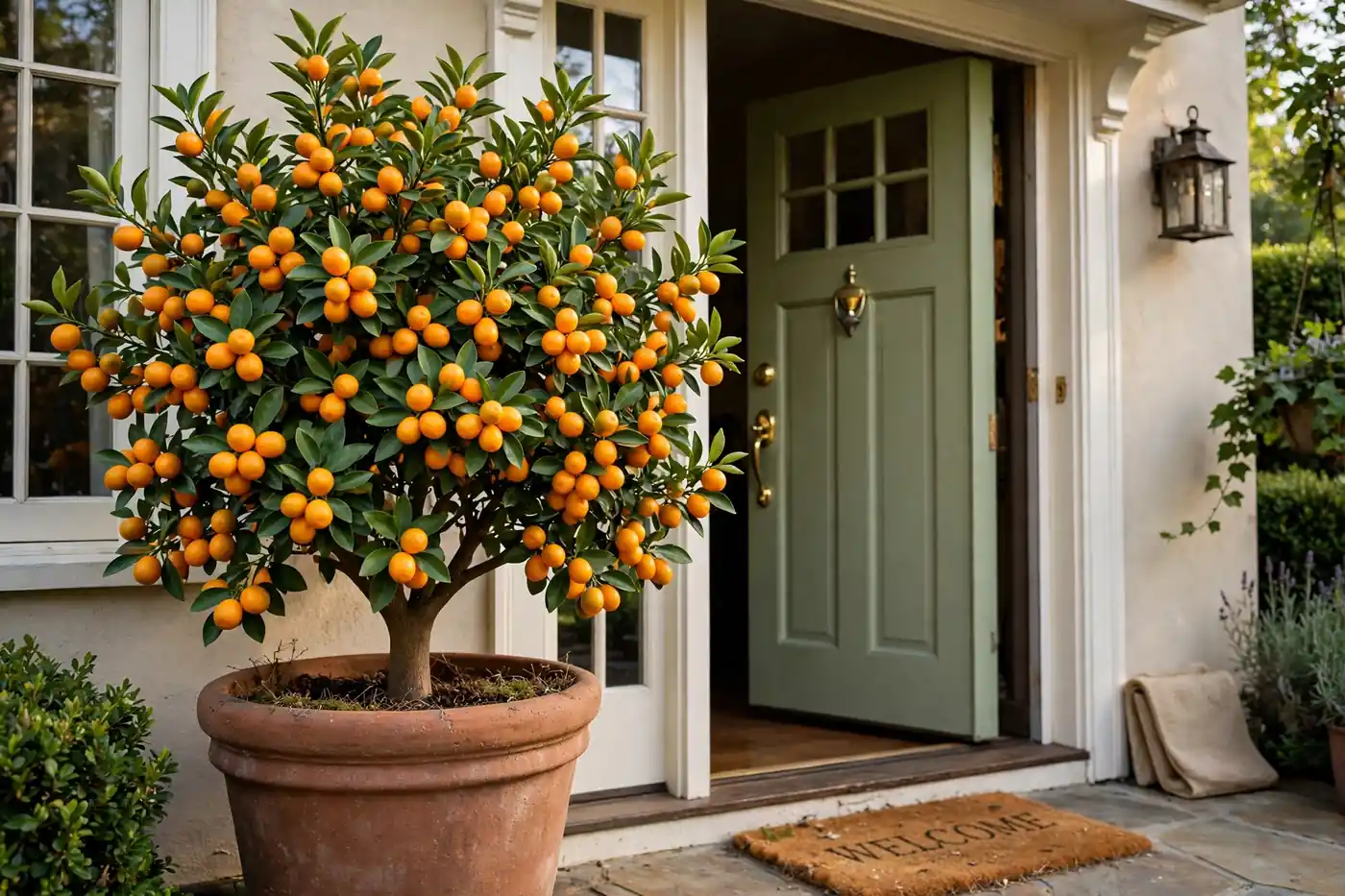
1. Citrus Trees — Kumquat & Calamondin (Fortunella spp. / Citrus microcarpa)
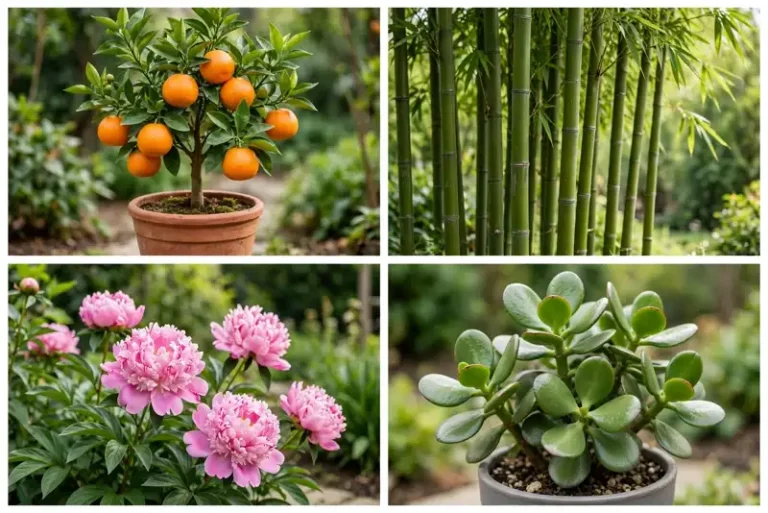
No plant says “prosperity at the front door” like a citrus tree heavy with golden fruit. In Chinese culture, kumquats and calamondins (often sold as “calamansi”) are the classic Lunar New Year plant — the round, gold-orange fruits resemble coins and are given as symbols of wealth and good luck. A pair of fruiting citrus trees flanking a front door is the single most iconic feng shui entrance planting in the world.
For most gardeners, the practical choice is a dwarf kumquat (such as ‘Nagami’) or a calamondin, both of which fruit generously in containers and stay a manageable 3–6 feet tall. They need full sun — six or more hours — and can live outdoors year-round in zones 9–11. In colder climates, grow them in large pots and overwinter indoors near a bright window; a citrus on a sunny porch from May to October still brings the full effect for the seasons you actually use the entrance.
Growing tips: Use a large pot with excellent drainage and a citrus or acid-formulated potting mix. Water deeply when the top two inches of soil dry out, and feed with citrus fertilizer through the growing season. Fruit left on the tree stays ornamental for months, but harvest some for cooking — using the fruit keeps the symbolism active rather than decorative. Protect from frost below about 28°F (-2°C).
2. Jade Plant (Crassula ovata)
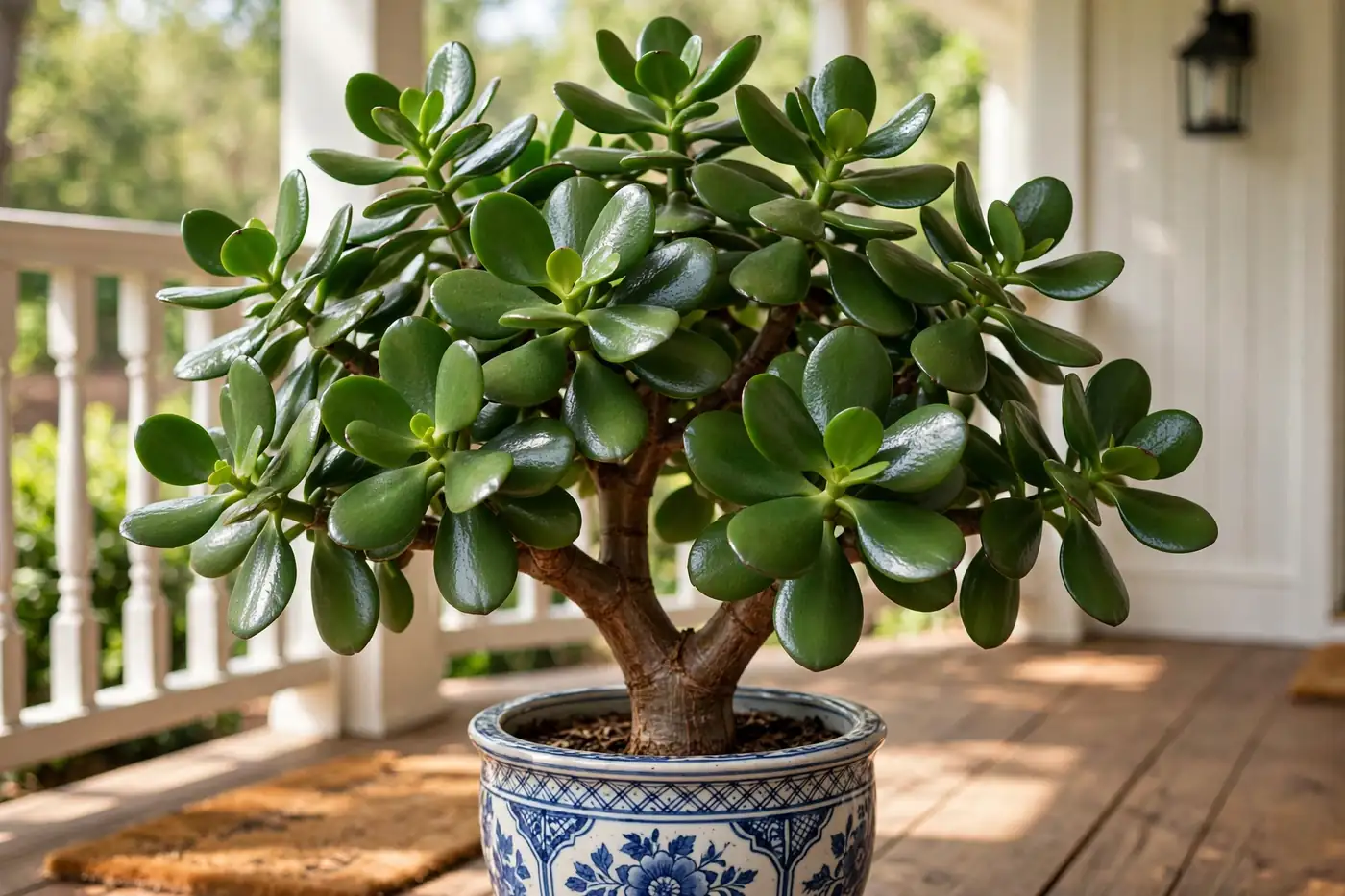
The jade plant is feng shui’s most famous wealth plant, and for good reason: its thick, round, coin-shaped leaves look like green money, and the plant’s slow, steady, almost indestructible growth suggests finances that accumulate over time. Restaurants and shops across Asia place jade plants by their entrances to invite prosperity — your front porch works exactly the same way.
Jade is a succulent, so it suits a bright, sheltered porch pot beautifully. It wants strong light and very little fuss: the classic mistake is overwatering. A mature jade with a thick, woody trunk looks like a miniature tree and makes a superb specimen in a handsome ceramic pot to the right of the door (the right side, as you face the house, is traditionally associated with the “white tiger” — a protective position).
Growing tips: Give jade the brightest spot on the porch and gritty, fast-draining cactus soil. Water deeply, then wait until the soil is completely dry before watering again — in winter, barely water at all. It is hardy only in zones 10–12, so in colder climates bring the pot indoors before the first frost. Pinch growing tips to encourage the branching, tree-like form. If you love jade’s sculptural succulent look indoors too, our guide to the best terrarium plants covers more compact succulents that thrive under glass.
3. Boxwood (Buxus sempervirens)
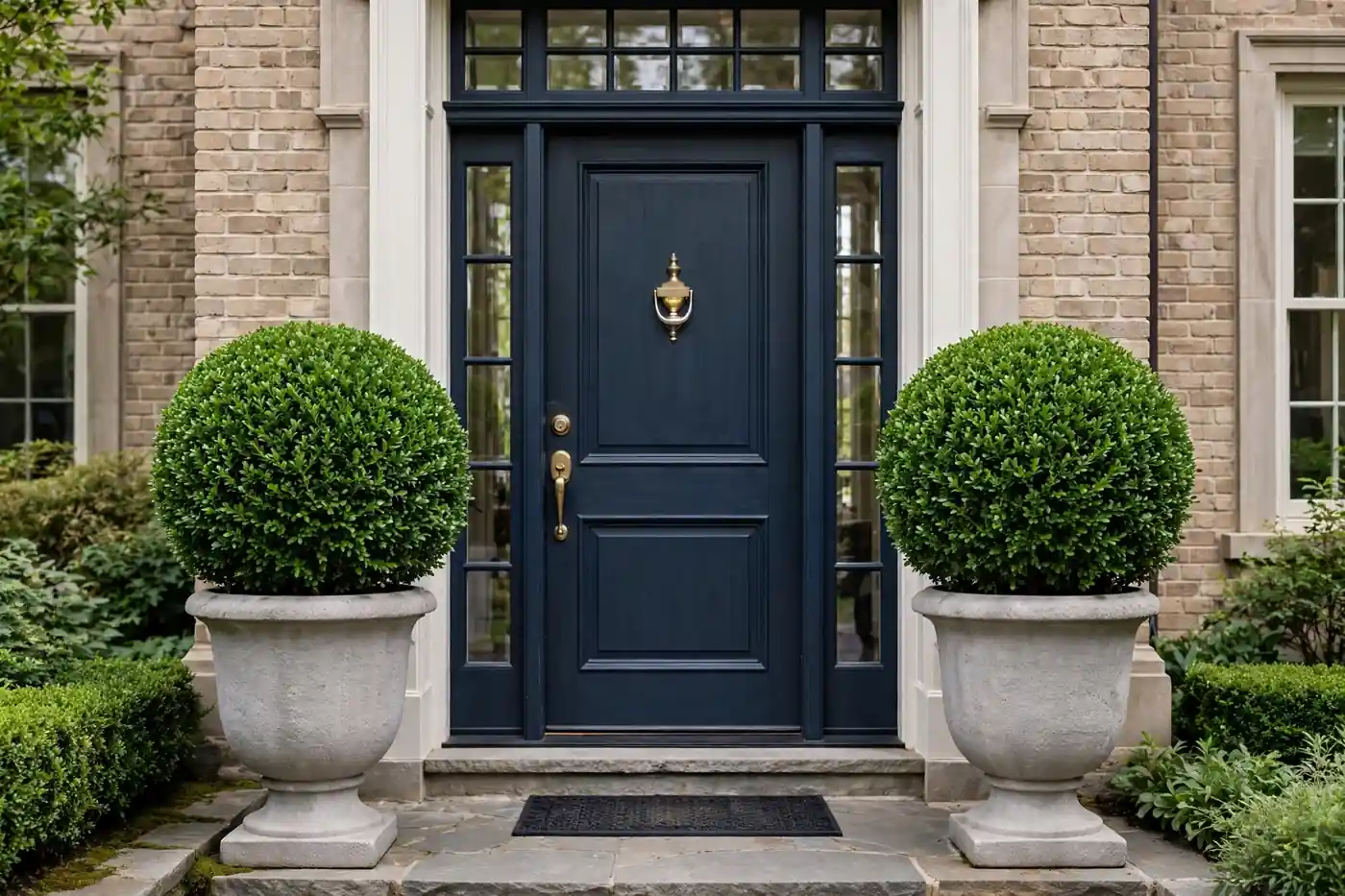
Boxwood is the backbone of the formal entrance garden — dense, evergreen, and endlessly shapeable. In feng shui terms, its year-round green presence means the entrance never looks “dead,” even in the depth of winter, which is exactly the kind of constant vitality the mouth of chi wants. A pair of boxwood spheres or cones flanking the door creates instant symmetry, and symmetry at the entrance reads as balance and order.
Boxwood is hardy in zones 5–8 and thrives in pots as well as in the ground, which makes it the most climate-flexible plant on this list. The Missouri Botanical Garden notes it prefers full sun to part shade with protection from harsh winter wind. Keep topiary shapes crisp with a light shear in late spring after the last frost, and mulch the root zone to conserve moisture.
Growing tips: Plant in well-drained soil — boxwood hates wet feet — and water deeply during the first two years to establish. For container topiary, choose a pot at least 16 inches wide so the root ball stays insulated, and water containers through winter thaws. Watch for boxwood blight in humid regions: buy from reputable nurseries, space plants for airflow, and clean tools between cuts.
4. Peony (Paeonia spp.)
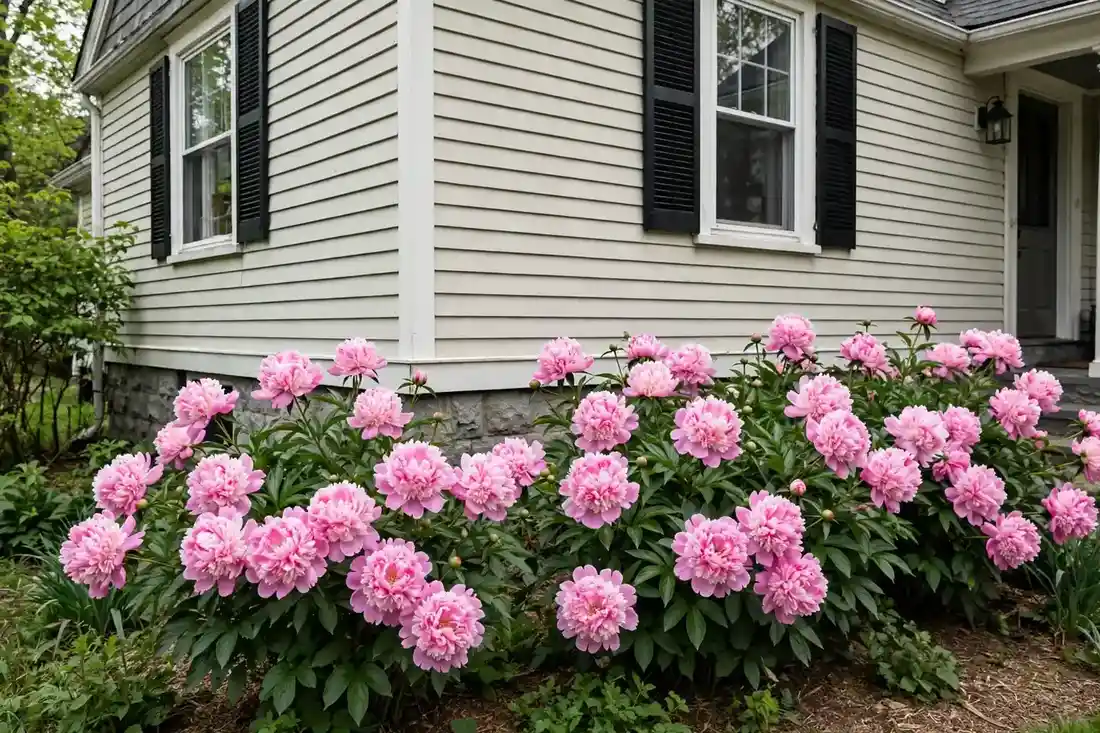
In China the peony is the “king of flowers” and the “flower of riches and honor” — for over a thousand years it has symbolized prosperity, good fortune, and happy marriage. Few plants make a stronger statement at the front of a house: in late spring, peony bushes erupt in huge, lush, fragrant blooms in pink, red, white, and coral that stop foot traffic. Planting peonies along the front foundation is like hanging a banner that says this household is thriving.
Herbaceous peonies are hardy in zones 3–8 and famously long-lived — a well-planted bush can outlive the gardener who planted it, blooming for fifty years or more. That longevity is part of the feng shui appeal: plants that endure suggest a household that endures. Site them where their brief but spectacular bloom season gets maximum visibility, ideally on the left side of the entrance as you face the house (the “green dragon” side, associated with growth and new beginnings).
Growing tips: Plant bare-root peonies in fall with the “eyes” (buds) no more than two inches below the soil surface — planted too deep, they refuse to bloom. Give them full sun and rich, well-drained soil, and do not move them once established; peonies resent disturbance. Provide discreet staking for heavy double blooms, and cut foliage to the ground in fall to prevent disease.
5. Chrysanthemum (Chrysanthemum × morifolium)
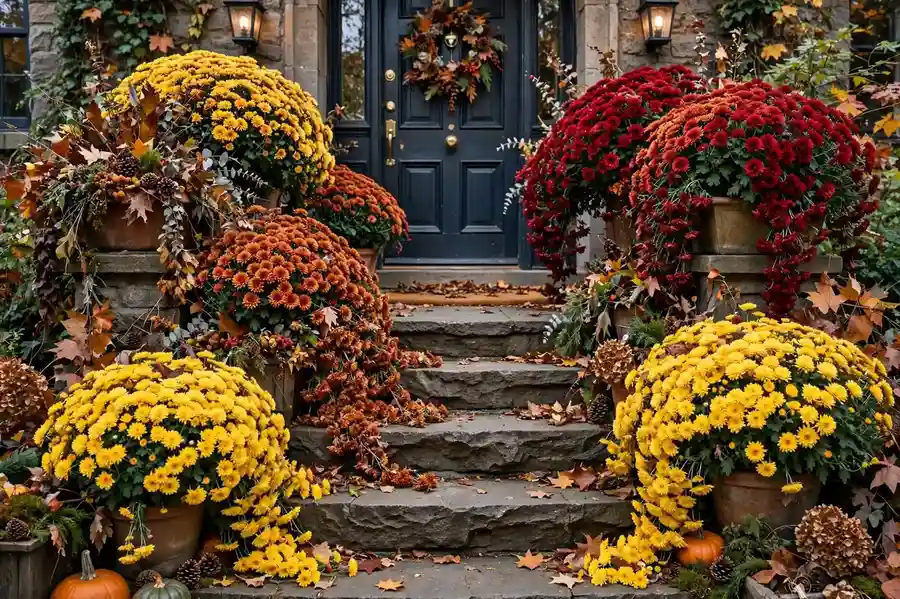
The chrysanthemum is one of the “Four Gentlemen” of Chinese garden culture — plum, bamboo, orchid, and chrysanthemum — plants honored for noble character. Mums symbolize longevity, joy, and a life well-lived, and their round, abundant flower heads in gold, rust, bronze, and crimson are pure autumn abundance. In feng shui, golden-yellow flowers are especially linked to wealth, which makes yellow mums doubly auspicious at the entrance.
Practically, garden mums are the workhorse of the fall entrance: they bloom exactly when summer containers are fading, they come in every warm color, and they are inexpensive enough to refresh yearly. Hardy varieties (zones 5–9) planted in spring can become permanent perennials, but most gardeners treat fall mums as seasonal color — and that is fine, as long as spent plants are removed promptly rather than left to wither by the door.
Growing tips: Buy plants with tight buds rather than full-open flowers for the longest display. Plant in full sun, water at the base to keep foliage dry, and deadhead regularly. For perennial mums, plant in spring, pinch stems until early July for bushy growth, and mulch after the ground freezes. Our detailed mum care guide covers overwintering, dividing, and keeping blooms coming for weeks.
6. Lavender (Lavandula angustifolia)
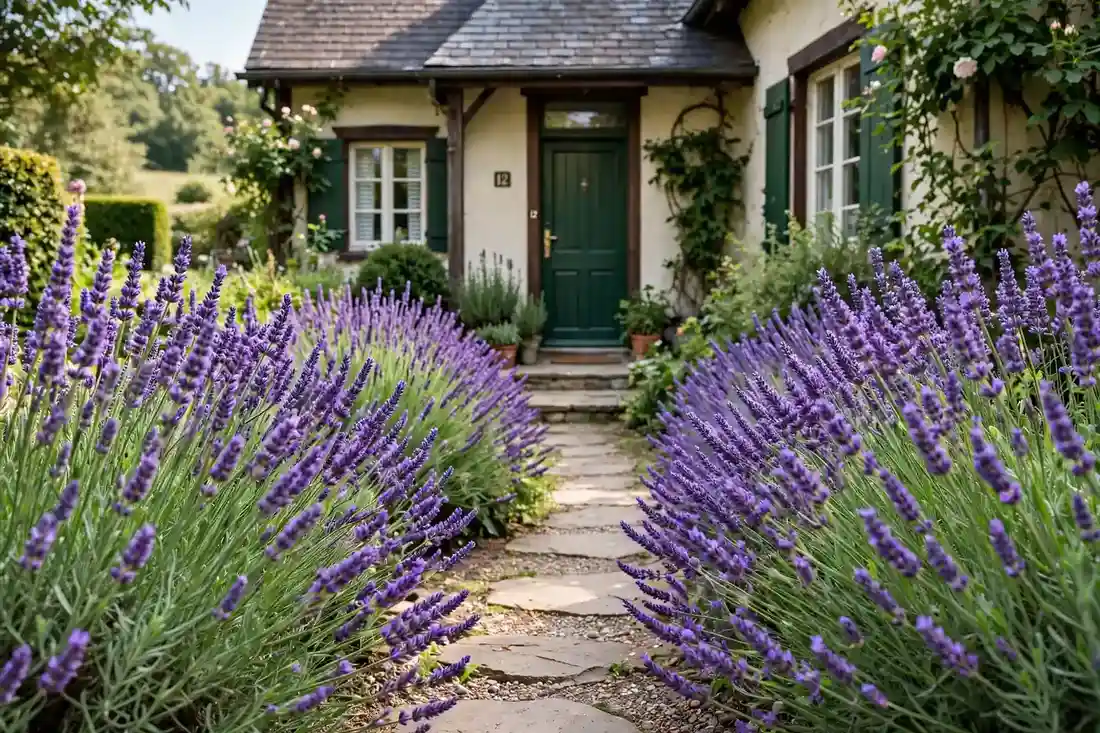
Lavender earns its place at the entrance through the senses: its fragrance is instantly calming, and in feng shui it is considered a purifying plant that clears stagnant or negative energy from a space. Lining the walkway with lavender means every arrival begins with a breath of calm — guests literally smell serenity before they reach your door. The soft purple-blue flower spikes also bring the water element’s colors to the entrance, which suits north-facing doors especially well.
English lavender is hardy in zones 5–9 and demands what many entrance beds already offer: full, blazing sun and sharp drainage. It doubles as a practical path edging because brushing against it releases scent, and bees adore it — a lavender-lined path hums with life in summer, which is exactly the vitality an entrance wants. For more purple power in sunny beds, pair lavender with other purple perennial flowers for a layered, long-blooming border.
Growing tips: Never plant lavender in heavy, wet soil — it will rot. Amend with grit or plant on a slight mound, and give each plant 2–3 feet of space for airflow. Shear plants back by a third after the first flush of bloom to encourage a second round, and never cut into old woody stems that show no green. Among full-sun perennials, lavender is one of the most drought-tolerant once established; water deeply but infrequently.
7. Clumping Bamboo (Bambusa / Fargesia spp.)
Bamboo is feng shui royalty: its hollow, upright canes symbolize humility and resilience — bending in storms without breaking — and its evergreen foliage means constant life at the entrance. It is also one of the Four Gentlemen, representing the upright, disciplined character. A screen of bamboo beside the entrance can do real energetic work too: it softens harsh lines, buffers wind, and gives the doorway a sense of sheltered arrival.
The critical rule is to plant only clumping bamboo, never running bamboo. Running types (most Phyllostachys) spread aggressively by underground rhizomes and can become a neighborhood menace — the opposite of harmonious. Clumping species like Bambusa multiplex (zones 8–11) or cold-hardy Fargesia (zones 5–9) stay in a tidy, slowly expanding clump. For total control near foundations, grow bamboo in large containers or install a root barrier at planting time.
Growing tips: Plant in spring in rich, moisture-retentive but well-drained soil, in full sun to part shade. Water generously the first year; established clumps are surprisingly drought-tolerant. Thin out the oldest, weakest canes each spring to keep the clump airy and elegant. In containers, choose a pot at least 24 inches wide and divide the clump every three to four years.
8. Azalea (Rhododendron spp.)
Azaleas bring the entrance to life in spring with clouds of pink, red, white, and coral blooms — and in feng shui they are associated with family happiness, joy, and the gentle, harmonious energy of home life. Because they bloom so abundantly on a compact, rounded shrub, they embody the “abundant but contained” quality that suits a doorway: generous, welcoming, never overwhelming.
Azaleas are ideal for the common situation of a shaded or north-facing entrance where sun-lovers struggle. Most are hardy in zones 5–9 and want exactly what a foundation bed under an overhang provides: dappled shade, acidic soil, and protection from harsh afternoon sun. Encore-type reblooming azaleas extend the show into fall, giving the entrance two seasons of color from one plant.
Growing tips: Azaleas demand acidic soil (pH 4.5–6.0); in alkaline soil their leaves yellow. Plant high, with the root ball slightly above grade, in soil amended with composted pine bark, and mulch with pine needles. Water consistently the first year — azaleas have shallow roots that dry out fast. Prune right after flowering, never in late summer, or you will cut off next year’s buds.
9. Camellia (Camellia japonica / C. sasanqua)
The camellia is the aristocrat of the winter garden: glossy evergreen foliage year-round, then exquisite rose-like blooms from fall through spring — precisely when the entrance needs beauty most. In Chinese and Japanese tradition it symbolizes devotion, longevity, and the noble spirit; its habit of dropping whole, perfect blooms rather than scattering petals is read as a dignified, complete ending to each flower’s life.
Sasanqua camellias (zones 7–10) are the best entrance choice in most climates: more sun-tolerant and cold-hardy than C. japonica, with a slightly looser habit that suits foundation plantings. Site them where you will see the winter blooms from inside the house too — beside the door, under a front window — so the plant rewards you in both directions.
Growing tips: Like azaleas, camellias need acidic, well-drained soil rich in organic matter. Plant in part shade with shelter from harsh morning sun in winter, which can damage buds after frosty nights. Mulch generously and water during dry spells; drought-stressed camellias drop their buds. Prune lightly after flowering if shaping is needed.
10. Gardenia (Gardenia jasminoides)
Few experiences say “welcome home” like the perfume of gardenias drifting across a porch on a summer evening. In feng shui, gardenia symbolizes peace, harmony, and gentle refinement — its creamy white blooms are the color of purity, and its glossy evergreen leaves keep the entrance looking alive year-round. Placing gardenias where their fragrance greets arrivals turns the walk to your door into a small ritual of calm.
Gardenias are hardy in zones 7–10 and want morning sun with afternoon shade — the east side of the entrance is ideal. They are famously particular about soil: it must be acidic (pH 5.0–6.5), consistently moist, and rich in organic matter. In alkaline soils the leaves yellow with iron chlorosis, so container growing with an acid potting mix is often the more reliable route, and pots let you move the plant to shelter if a hard freeze threatens.
Growing tips: Feed with an acid-forming fertilizer made for azaleas and camellias, and mulch with pine bark to hold moisture and acidity. Never let the root ball dry out completely, but do not waterlog it either. Avoid moving or repotting once buds form — gardenias drop buds at the slightest stress. Prune right after the main bloom flush to shape.
11. Boston Fern (Nephrolepis exaltata ‘Bostoniensis’)
If the plants above are the entrance’s jewelry, the Boston fern is its welcoming embrace. In feng shui, ferns carry soft, yin energy — their arching fronds have no sharp points and no harsh angles, so they literally cannot create the “poison arrows” of spiky foliage. A pair of lush ferns hanging on a shaded porch says comfort and shelter before a guest ever knocks.
Boston ferns are the classic porch plant of the American South for good reason: they love the exact conditions a covered porch provides — bright indirect light, high humidity, and protection from harsh sun. They are hardy outdoors only in zones 9–11, but as a seasonal porch plant they are inexpensive, fast-growing, and spectacular. Hang them where air circulates freely and fronds can cascade without brushing the walkway.
Growing tips: Keep the soil consistently moist — ferns sulk dramatically when dry — and mist fronds on hot days. Feed monthly with diluted liquid fertilizer through summer. Turn hanging baskets a quarter-turn each week for even growth. Bring indoors before nighttime temperatures drop below 50°F (10°C); cut back any brown fronds at the base rather than trimming green tips.
12. Rosemary (Salvia rosmarinus)
Rosemary has guarded doorways since ancient times — the Romans planted it at entrances for protection, and Mediterranean households still do. In feng shui it functions as a protective herb: its upright, needle-like evergreen foliage is believed to deflect negative energy, while its scent sharpens the mind and lifts the mood. As a bonus, it is genuinely useful — snip sprigs for the kitchen on your way in.
Rosemary wants what a sunny south-facing entrance provides: full sun, sharp drainage, and lean soil. It is hardy in zones 7–10; in colder climates, grow it in a terracotta pot and overwinter indoors in a bright, cool room. Upright cultivars like ‘Tuscan Blue’ or ‘Arp’ can even be sheared into small standards or cones, giving you a fragrant, edible alternative to boxwood topiary.
Growing tips: The number-one killer of rosemary is wet winter soil — plant high, amend heavily with grit, and never mulch against the stem. Water deeply but infrequently once established. Prune after flowering, never cutting into old wood with no green growth. Harvest regularly; frequent light snipping keeps plants bushy and productive.
Where to Place Plants: Left, Right & the Path
Choosing the right plants is only half the work — where you put them decides whether the energy flows or stalls. The foundational feng shui entrance rule is symmetry: a matching pair of healthy plants flanking the front door creates balance, frames the entrance, and signals intention. Mismatched, lopsided, or single-sided planting makes the entry feel accidental. The pair does not need to be two identical specimens down to the leaf, but they should match in size, health, and style of container.
Traditional placement assigns meaning to each side. As you face the house from the street, the left side is the “green dragon” position — associated with growth, new beginnings, and prosperity energy. This is the natural home for your wealth plants: citrus trees, jade plants, flowering abundance like peonies. The right side is the “white tiger” position — protective, grounding, stabilizing. Evergreens like boxwood, rosemary, and camellia suit this side, standing guard over the household. These are guidelines, not laws; a beautiful, healthy pair in any arrangement beats a “correct” but struggling one.
Direction adds a second layer. In feng shui’s five-element system, each compass direction resonates with an element, and you can echo it with plant and pot choices. An east- or southeast-facing door belongs to wood — emphasize lush green foliage and tall, upward growth. A south-facing door is fire — add red, orange, and pink flowers (azaleas, camellias, red geraniums in summer pots) and it will feel electrifying. A north-facing door is water — deep blues and purples (lavender, blue-flowering companions), dark or black pots, and flowing, soft forms. West and northwest are metal — white and silver tones, round shapes, white gardenias or white-flowered companions. Southwest and northeast are earth — yellows, terracotta pots, square planters, golden mums.
The non-negotiable rule, in every tradition, is the path. The walkway to your door must be completely clear, well-lit, and easy to follow — energy, like a guest, should never have to squeeze past an overgrown shrub, duck under low branches, or step around pots. Keep planting beds edged back at least a foot from the path’s edge, prune anything that leans over the walk, and make sure the door itself — not the plants — is the visual destination. A visitor should see the door first and the planting second.
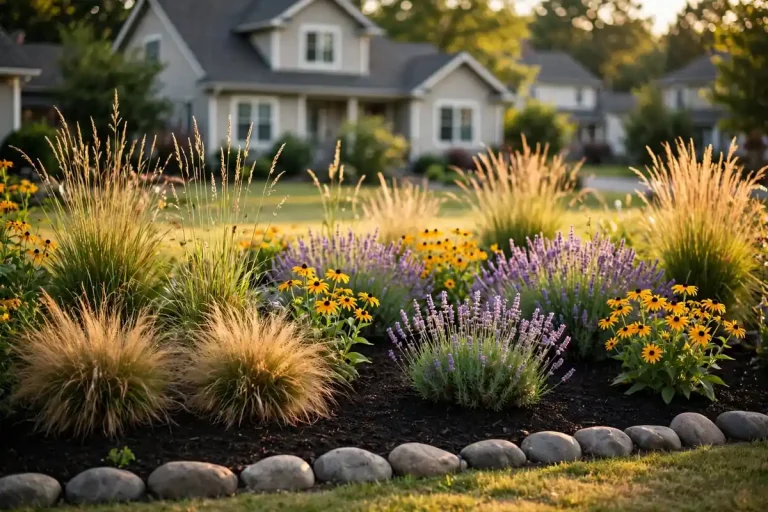
Finally, think in layers. The most inviting entrances read like a small composition: tall anchors (a citrus tree, a bamboo screen, a topiary cone) at the back or sides, mid-height shrubs (azaleas, camellias, boxwood) in the middle ground, and low edging (lavender, seasonal color) along the path. Keep the “bright hall” — the open space directly in front of the door — genuinely open. Plants frame the stage; they should never stand on it.
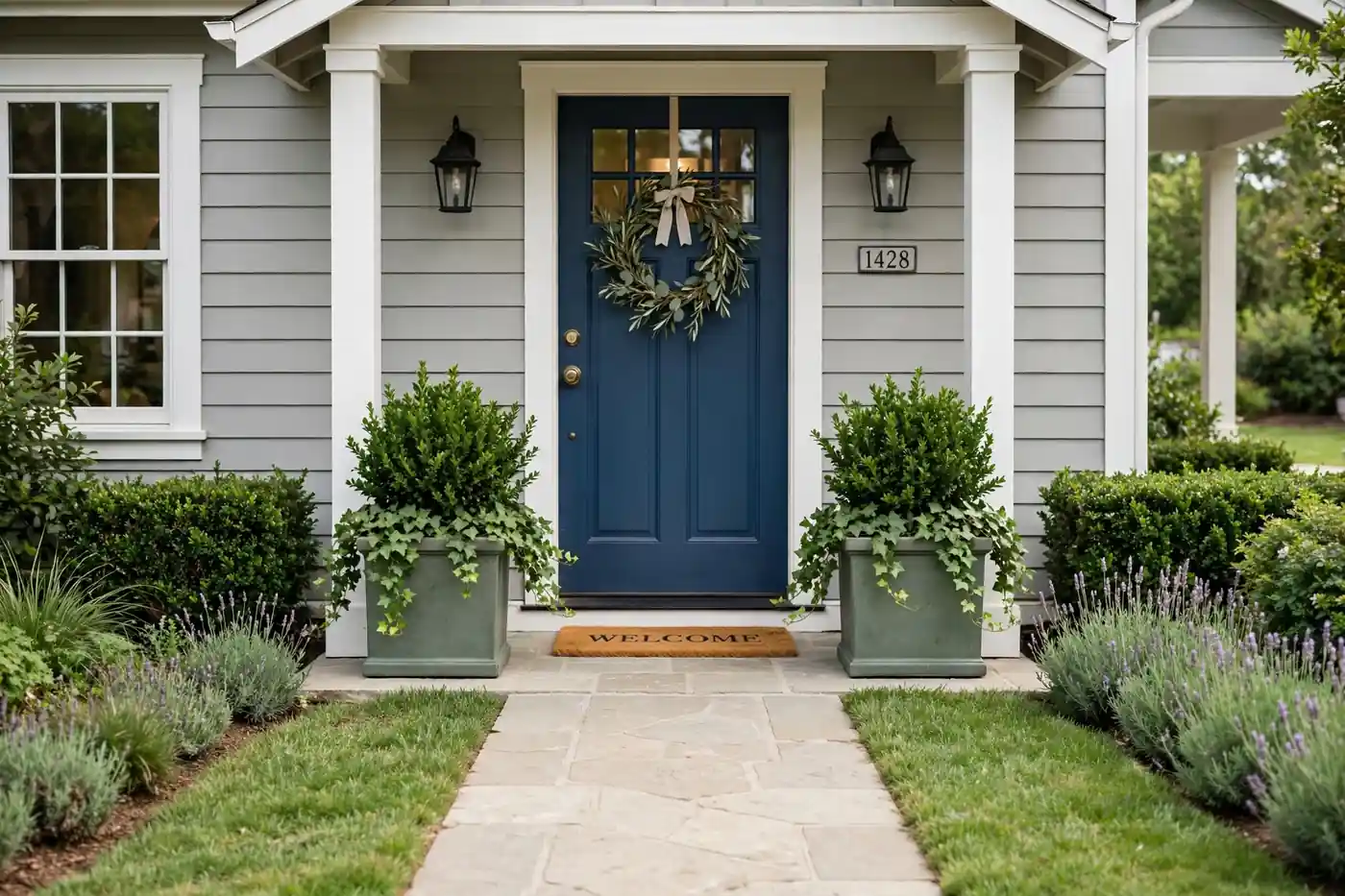
Good vs Bad Feng Shui: Plants to Avoid at the Entrance
Feng shui is as much about what you remove as what you add, and the entrance is where bad plant choices do the most damage — because every visitor, and every bit of incoming energy, meets them first. Use this comparison as a quick audit of your own front garden.
| Good Feng Shui ✓ | Bad Feng Shui ✗ |
|---|---|
| Healthy, thriving plants with glossy foliage | Dead, dying, or yellowing plants left in place |
| Rounded, soft, upward-growing leaves | Sharp, spiky foliage aimed at the door or path |
| Matching pairs flanking the door | A single lonely plant, or mismatched lopsided pair |
| Clear, wide, well-lit path to the door | Shrubs overgrowing or blocking the walkway |
| Right-sized plants, pruned regularly | Overgrown shrubs swallowing the facade |
| Fragrant, welcoming flowers near the door | Strongly thorny plants (roses, barberry) crowding the entrance |
| Evergreens for year-round life | Bare, leggy plants with all growth at the top |
| Real, living plants | Artificial plants or dried arrangements as permanent “planting” |
Dead and dying plants are the single biggest entrance mistake in feng shui — a dead plant at the mouth of chi is read as dead energy entering the home. This is horticultural common sense too: nothing drags down curb appeal faster than a brown skeleton in a pot. Check entrance plants weekly, water before they stress, and the moment a plant is beyond saving, replace it the same weekend. Keep a spare seasonal container ready so the spot is never empty.
Thorny plants blocking the path are the second classic error. In feng shui, thorns and spikes project “sha chi” — sharp, hostile energy — and at an entrance they symbolically attack everyone who approaches. This does not mean you must banish every rose from the property; it means keeping barberry, thorny roses, yucca, agave, and cacti away from the doorway and the walkway edges, where they can also physically scratch visitors. If you love roses, plant thornless or low-thorn varieties set well back from the path, or enjoy them in the side garden instead.
Overgrown shrubs are the slow-motion version of the same problem. A foundation planting left unpruned for years swallows windows, hides the door, and turns the entrance into a dark tunnel — the exact opposite of the bright, open “bright hall” feng shui wants before a door. Walk your entrance once each season with shears in hand: if you cannot see the door clearly from the street, or if branches touch the house, it is time for a hard prune. When a shrub has outgrown its space for good, replace it with a naturally smaller variety rather than fighting it forever.
Two more things to skip: dried flower arrangements and artificial plants as permanent entrance decor. Dried materials are, energetically, dead — fine for a temporary autumn wreath, not as a year-round substitute for living plants. And a single tree planted dead-center in front of the door, blocking the view and the path, is considered one of the worst entrance configurations in classical feng shui; always offset trees to the side so the door stays visible and the way stays clear.
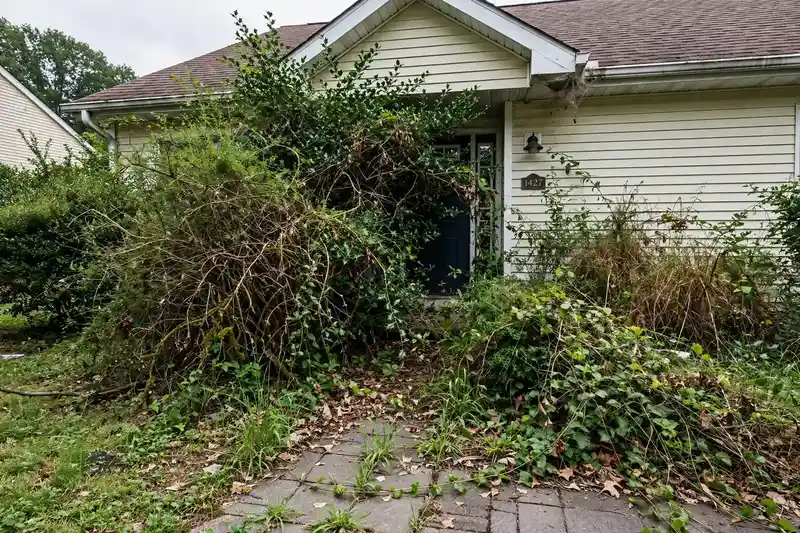
Curb Appeal Meets Energy Flow
Here is the open secret of feng shui entrances: almost everything the tradition prescribes is also just excellent landscape design. Real-estate agents and feng shui masters give nearly identical advice — clear sight lines to the door, balanced planting, good lighting, a path you can follow without thinking — because both are describing the same human response. We are drawn toward places that look cared for, open, and alive, and we hesitate at places that look neglected, blocked, or dark. “Good energy flow” is, in large part, the felt sense of a well-designed arrival.
Design your entrance as a sequence, not a snapshot. From the street, the composition should read in three beats: the path (clear, edged, lit), the frame (the flanking pair and foundation planting drawing the eye inward), and the destination (a clean, visible, well-lit door with a fresh mat and working doorbell). Plants support each beat without stealing it. The biggest curb-appeal mistake is also the biggest feng shui mistake: planting so much, or so large, that the door disappears behind the garden.
Color does quiet work here. Green is the baseline — it reads as life and growth in every culture. Then layer in the accent colors with intention: red and warm tones near the door feel energizing and auspicious (a red door with green flanking plants is a classic for a reason); white and silver flowers feel calm and clean, ideal for a shaded or north-facing entry; golden yellows — mums, marigolds, the fruit of your citrus trees — read as warmth and wealth. Keep the palette to two or three colors plus green; a riot of every color reads as noise, not abundance.
Do not forget the entrance after dark. In feng shui, a dark entry is a dead entry — energy cannot find a door it cannot see. Solar path lights along the walkway, a warm porch light, and a soft uplight on your flanking pair transform the entrance at night and extend the welcome past sunset. Lighting is also pure practicality: guests should never have to fumble for the doorbell in the dark.
Seasonal Entrance Styling
A feng shui entrance is not a one-time project — it is a living arrangement that should look intentional in every season. The goal is simple: something alive and attractive by the door, twelve months a year, with the stars of the show rotating as the garden changes.
Spring is the season of new beginnings, and the entrance should celebrate it. Underplant your evergreen anchors with spring bulbs — daffodils, tulips, hyacinths — for an early burst that fades just as the main cast wakes up. This is azalea and camellia season at the door, and the moment to set out fresh annuals in the flanking pots once frost danger passes. Prune winter damage off boxwood and evergreens now, refresh mulch, and edge the beds — the spring cleanup is the single highest-impact hour you will spend on the entrance all year.
Summer belongs to fragrance and abundance. Citrus trees move out to their full glory, lavender lines the path in purple haze, gardenias perfume the porch, and the flanking pots can carry heat-loving color — geraniums, lantana, or trailing sweet potato vine for a south-facing door. Water containers daily in heat waves; a wilted flanking pair in August undoes all your spring work. Deadhead spent blooms weekly to keep the display — and the energy — fresh.
Fall is chrysanthemum season, and the entrance should lean into it. Swap tired summer annuals for mums in gold, bronze, rust, and crimson — the warm palette of the season is also feng shui’s wealth palette. Add ornamental kale, pumpkins, or gourds to the steps for harvest abundance, but keep it tasteful: a few well-chosen pieces, not a yard sale. This is also planting season for spring bulbs and for any new shrubs, so the entrance you style now sets up the entrance you will enjoy in April.
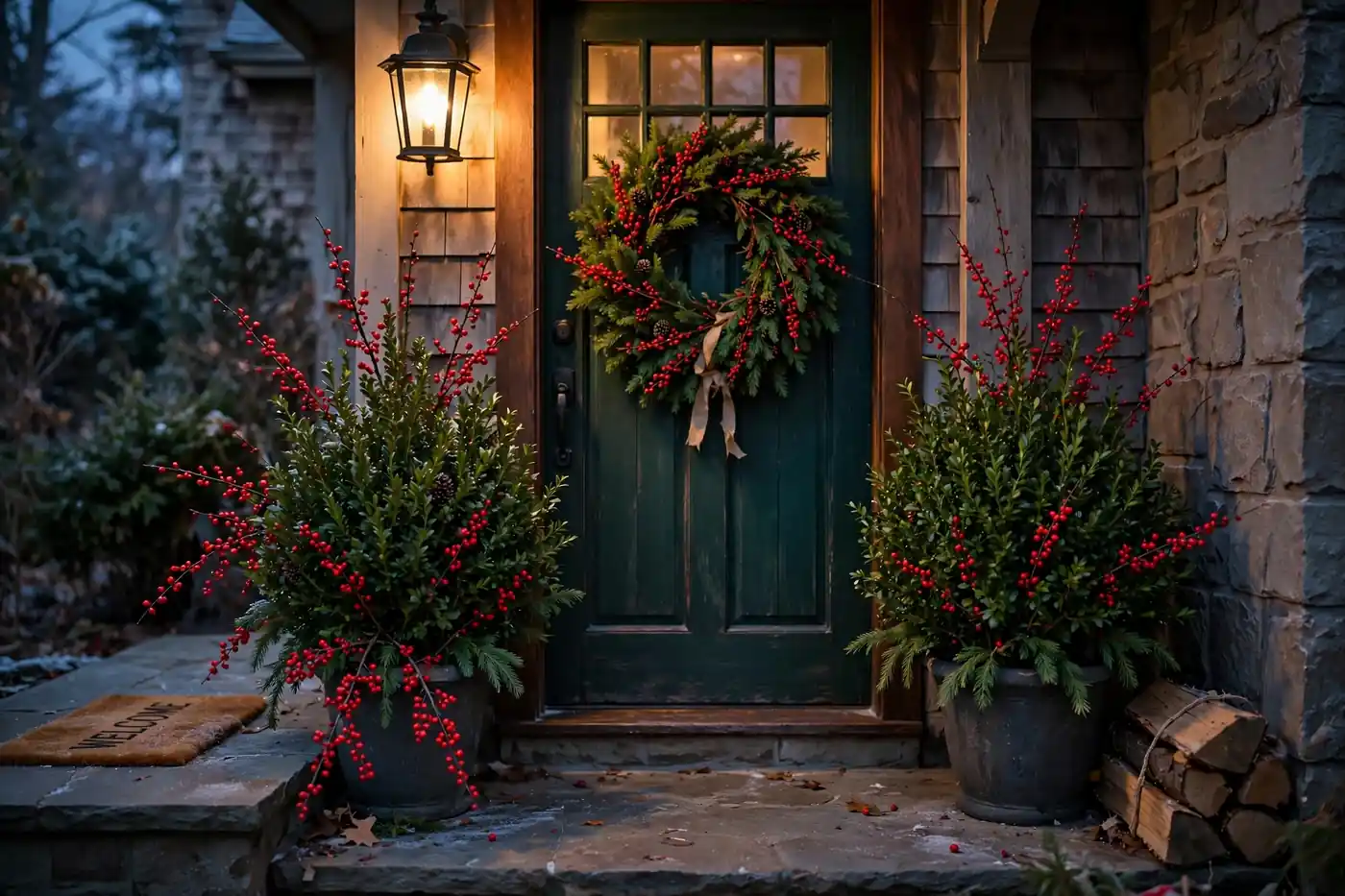
Winter is where evergreens earn their keep. Boxwood topiary, camellia foliage, rosemary, and the bare architecture of bamboo carry the entrance when flowers are gone. Dress the flanking pots for the season: a small potted spruce or cypress, red-berried holly or winterberry branches tucked into the containers, pinecones and evergreen boughs as mulch. Keep the path clear of ice and snow — in feng shui terms, a blocked winter path blocks the year’s incoming opportunities — and make sure the porch light and path lights are working on the darkest evenings.
The thread through all four seasons is maintenance as ritual. Spend ten minutes at the entrance each week: deadhead, sweep the path, wipe the door, check the lights, water the pots. This small habit is the real engine of both curb appeal and good feng shui — a tended entrance stays a welcoming one, and a welcoming entrance keeps inviting good things in.
Frequently Asked Questions
What are the luckiest plants to put by the front door?
The most auspicious choices are citrus trees (kumquat or calamondin — golden fruit symbolizes wealth), jade plants (coin-shaped leaves for prosperity), boxwood topiary (evergreen protection), and peonies (the Chinese “flower of riches and honor”). Chrysanthemums add longevity and autumn abundance. Whichever you choose, the plant must be healthy — a struggling “lucky” plant works against you.
Should plants go on the left or right side of the front door?
Use a matching pair flanking both sides for balance — symmetry is the core rule. Traditionally, the left side as you face the house (the “green dragon” position) suits growth and wealth plants like citrus and jade, while the right side (the “white tiger” position) suits protective evergreens like boxwood and rosemary. Matching size, health, and containers matter more than strict side assignments.
What plants are bad feng shui for the front of the house?
Avoid dead or dying plants (the worst offense), thorny plants crowding the doorway or path (roses, barberry, cacti, yucca), overgrown shrubs that hide the door or block the walkway, dried or artificial plants as permanent decor, and a single tree planted dead-center in front of the door blocking the view and path.
Can I use potted plants instead of planting in the ground?
Absolutely — pots are often better at an entrance. Containers let you create the classic flanking pair even without beds, move tender plants like citrus and jade indoors for winter, refresh seasonal color cheaply, and control aggressive growers like bamboo. Use large, heavy pots that suit the house style, ensure drainage holes, and water containers more often than ground plantings.
How do I feng shui a north-facing or shaded front door?
Match the plants to the conditions — a shaded entry needs shade-lovers, not struggling sun plants. Azaleas, camellias, gardenias, Boston ferns, and boxwood all thrive with less sun. Echo the water element of the north with deep blue and purple flowers (lavender where sun allows, blue-flowering companions in shade), dark-colored pots, and soft, flowing forms. Keep lighting warm and generous since north entries run dark.
Do I need to believe in feng shui for this to work?
No. Nearly every feng shui entrance principle — a clear path, a visible door, balanced planting, good lighting, healthy plants, seasonal care — is also standard good landscape design and real-estate curb-appeal advice. An entrance designed this way feels welcoming whether you call it chi or simply good design. The weekly ten-minute tidy is what makes it last.
References
- The Spruce — Gardening & Feng Shui Guides — plant care guides and feng shui room-by-room advice, including the front door as the “mouth of qi.”
- Gardening Know How — Money Tree Propagation — growing and propagating the money tree (Pachira aquatica), including its feng shui reputation for attracting fortune.
- Missouri Botanical Garden — Plant Finder: Boxwood — detailed botanical profile of Buxus sempervirens with culture, hardiness, and landscape use.
- The Old Farmer’s Almanac — planting calendars, frost dates, and growing guides for timing your entrance plantings.