Snowdrop Flower: Types, Meaning and How to Grow It
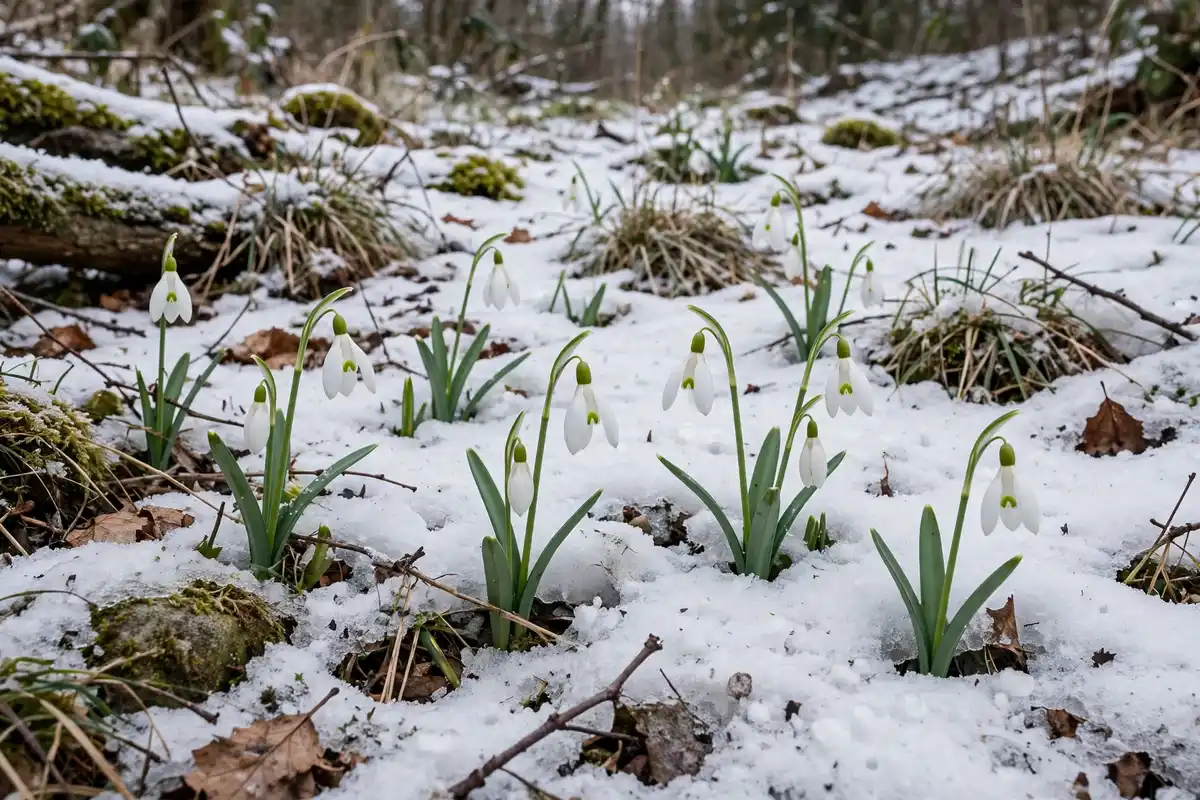
Every garden has a first page of the year, and this is the flower that writes it: a single white drop on a green stem, nodding through frost in the bare weeks when nothing else dares. The snowdrop does not wait for spring — it starts without it, flowering in January and February, sometimes pushing its bud up literally through snow, which is why the French call it perce-neige: the snow-piercer. It is a tiny plant with an outsized following — collectors called galanthophiles trade rare bulbs for sums that would buy a car, and one snowdrop relative quietly gave modern medicine a drug for Alzheimer’s disease.
This guide covers the six snowdrops worth knowing (the common snowdrop, its double form, the giant, the honey-scented ‘S. Arnott’, long-stemmed ‘Magnet’ and the Crimean), what it means — hope, purity and consolation — and how to grow drifts of your own, with the “in the green” planting rule that decides whether bulbs thrive or vanish.
Quick Answer
The snowdrop is Galanthus nivalis, a small bulbous perennial in the amaryllis family Amaryllidaceae from Europe and western Asia, flowering in mid-winter with a single nodding white bloom — three long outer tepals over a short green-marked cup — on a stem 3 to 6 inches tall. Snowdrops are hardy in zones 3 to 8 for moist, humus-rich soil in part shade; they are planted as bulbs in autumn or, far more reliably, “in the green” in spring, and they naturalize into drifts under trees and in grass. The snowdrop means hope, purity and new beginnings.
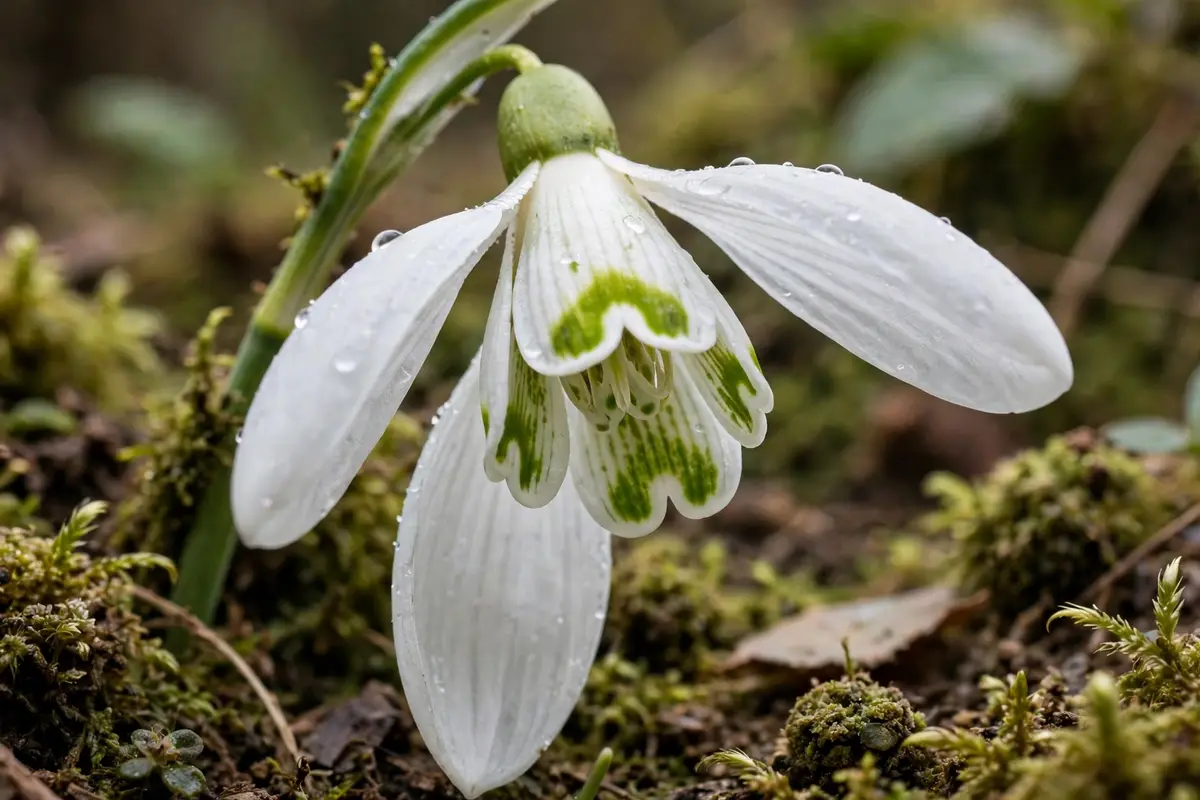
Table of Contents
- What Is a Snowdrop?
- Types of Snowdrop and 6 Kinds Worth Knowing
- Snowdrop Flower Meaning and Symbolism
- Snowdrop Colours and Their Meanings
- How to Grow Snowdrops
- Common Mistakes When Growing Snowdrops
- Snowdrop Mania: The Collectors and the Medicine
- Frequently Asked Questions
What Is a Snowdrop?
The name is a translation: Galanthus is Greek for “milk flower” (gala, milk; anthos, flower), and nivalis means “of the snow” — the milk flower of the snow, which is the whole plant in four words. It belongs to the amaryllis family alongside daffodils, and it is built like a lantern: one nodding flower per stem, its three long outer tepals flaring white, its three inner tepals fused into a short notched cup marked with green. Bees working at winter’s edge find it honey-scented and precious — one of the earliest pollen sources of the year. You can read more on the Galanthus nivalis page on Wikipedia.
The genus holds about 20 species, from the Pyrenees across Europe to the Caucasus and northern Iran, and hundreds of named cultivars selected from them — differing in the green (or yellow) markings, the flower’s shape, the flowering time by a week here or there. To most eyes a snowdrop is a snowdrop; to a galanthophile, those green marks are handwriting. What all of them share is the timing: this is a plant that treats winter not as an obstacle but as its season, opening in the year’s coldest, barest weeks and finishing before the trees leaf out.
Snowdrop Quick Facts
- Botanical name: Galanthus nivalis; genus Galanthus, about 20 species and hundreds of cultivars.
- Family: Amaryllidaceae, the amaryllis family (cousin to daffodils).
- Native range: Europe to western Asia — woodland edges, damp meadows, mountain slopes.
- Hardiness: zones 3 to 8; fully hardy, needs a cold winter to flower well.
- Height: 3 to 6 inches (giant kinds to 9–10 inches).
- Bloom time: mid-winter to early spring — January to March, sometimes December, through snow.
- Sun and soil: part shade (under deciduous trees is ideal); moist, humus-rich, well-drained soil.
- Good to know: the bulbs are poisonous (lycorine and other alkaloids — never eat them); the same genus produces galantamine, a licensed Alzheimer’s medicine; January’s birth flower (shared with carnation).
Types of Snowdrop and 6 Kinds Worth Knowing
The wild original, its garden forms, and the collector’s favourites. The table separates them; the profiles follow. For the full list of flower names, see our flower names A to Z guide.
| Type | Flowers | Height | Season | Best use |
|---|---|---|---|---|
| Common (G. nivalis) | Single white, green-marked cup | 3–6 in | Jan–Mar | Drifts, naturalizing |
| Double (‘Flore Pleno’) | Layered white rosette | 4–6 in | Feb–Mar | Close-up beds, pots |
| Giant (G. elwesii) | Large, bold green marks | 7–10 in | Jan–Feb | Early display, dry shade |
| ‘S. Arnott’ | Large, honey-scented | 6–8 in | Feb–Mar | Paths, doorsteps |
| ‘Magnet’ | Long swinging stem | 6–8 in | Feb–Mar | Grass, specimen clumps |
| Crimean (G. plicatus) | Broad leaves, strong marks | 6–8 in | Feb–Mar | Collectors, breeding |
1. Common Snowdrop — the Wild Original
Galanthus nivalis, the snowdrop of European woods and a thousand churchyards: small, perfect, single flowers in drifts that can number in the millions on old estates. It is the cheapest kind, the toughest kind, and the one to plant by the hundred in grass and under trees. If you plant only one snowdrop, this is it — everything else in this list is a variation on its theme.
2. Double Snowdrop — ‘Flore Pleno’
The common snowdrop with its cup stuffed full of extra tepals, so the flower opens like a tiny white petticoat or rosette. Doubles have been grown since the 1700s, they bulk up fast (they are sterile, spreading by bulb division alone), and they are best appreciated close — in pots, at path edges, anywhere the layered flower can be seen at kneeling distance. In drifts they read as a softer, fuller white.
3. Giant Snowdrop — ‘Elwesii’
Galanthus elwesii, from Turkey and the Balkans: everything scaled up — broader grey-green leaves, flowers twice the common kind’s size, bold green markings, and a constitution that tolerates drier soil and more sun. It flowers early (often the first of all) and its dry-bulb form establishes better than most, which is why the bags of snowdrop bulbs in garden centres are usually this species. The beginner’s snowdrop, in the best sense.
4. ‘S. Arnott’ — the Honey-Scented One
A large, shapely hybrid famous for one extra gift: scent. On a still February day a clump of ‘S. Arnott’ perfumes the air around it with honey — plant it by a doorstep or a bench where you will actually pass in winter. It is vigorous, increases well, and is the connoisseur’s recommendation when asked for a single snowdrop for a small garden.
5. ‘Magnet’ — the Swinging One
An old, elegant cultivar whose flower dangles from an unusually long, arching stalk (the pedicel), so the bloom nods and swings in the wind well clear of the leaves — named, it’s said, for a horseshoe magnet, whose shape the stalk echoes. ‘Magnet’ is the snowdrop for grass and for collectors of poise: in a breeze, a clump of it is the most graceful thing in the winter garden.
6. Crimean Snowdrop — ‘Plicatus’ and the Marked Kinds
Galanthus plicatus, from Crimea and the Black Sea: broad leaves folded back at the edges, strong green markings, and the species behind a swarm of elite cultivars — including the yellow-marked line (‘Wendy’s Gold’ and kin) whose “green” marks are actually gold, and the record-priced rarities like ‘Golden Fleece’. This is the galanthophile’s snowdrop: the one where single bulbs change hands for serious money.
Snowdrop Flower Meaning and Symbolism
The snowdrop’s meaning is hope — specifically, hope at the hardest point of the year. In the language of flowers it stands for hope, purity and consolation, and it is a birth flower of January, the month that needs it most. Its loveliest legend is a consolation story: when Adam and Eve were driven from Eden into a winter world, an angel took pity on Eve’s despair and turned falling snowflakes into snowdrops as they touched the ground — proof, in flower form, that winter does not last forever and spring is a promise, not a hope against hope. Old English folklore also gave it a shadow: bringing the first snowdrops indoors was once thought unlucky, a flower too tied to churchyards and Candlemas for the house — a superstition the modern cut-flower trade has cheerfully outgrown.
It opens the year among the winter crew in our flowers that start with S guide — the smallest letter-guest with the biggest job.
Snowdrop Colours and Their Meanings
- White — hope and purity: the milk flower of the snow, the only true colour.
- Green marks — new life at winter’s heart: the cup’s signature, and the collector’s handwriting.
- Yellow-marked kinds — rarity and sunlight stored: ‘Wendy’s Gold’ and the golden line.
How to Grow Snowdrops
Buy them growing, plant them where winter sun reaches, and never let the bulbs dry out: that is the whole syllabus. Gardeners on r/gardening on Reddit pass on the rule as the genus’s first commandment: “in the green, or not at all.”
Planting — In the Green
Snowdrops famously resent being dried, stored bulbs — they dehydrate in the packet and sulk for years. The reliable method is planting “in the green”: buy or lift clumps in leaf, just after flowering in spring, and replant at once, about 3 inches deep and 3 inches apart, in moist, humus-rich soil in part shade (under deciduous shrubs and trees is perfect — winter light, summer shade). Dry bulbs in autumn are the second-best route: plant them the day they arrive, as deep and as fast as you can. Water in well either way.
Care and Naturalizing
After that, the plant asks for almost nothing: leave the leaves alone until they yellow (they are refilling the bulb), feed lightly with leaf mould or compost in autumn if the soil is thin, and let clumps spread — snowdrops naturalize gloriously in grass, provided the first cut waits until the leaves die back. Lift and divide congested clumps every 3–5 years, always in the green, and replant the same day: division is also how a £5 clump becomes a drift worth a photograph.
Common Mistakes When Growing Snowdrops
Mistake one is planting tired dry bulbs that sat in a warm shop all autumn — they fail quietly underground, and the gardener blames the winter. Mistake two is a dry, sunny bank: snowdrops want moisture in spring growth, and thin soil under thirsty roots shrinks them yearly. Mistake three is mowing or tidying too early — cutting the leaves in March starves next year’s flower, the bulb’s whole income spent and none banked.
Mistake four is planting too shallow or in ones and twos: snowdrops are a drift plant, lost as singletons and glorious by the hundred — plant deep (3 inches) and in crowds. Mistake five is letting squirrels and mice run the buffet: they dig freshly planted bulbs, so a layer of grit or mesh over new plantings pays. And mistake six is expecting summer interest: the plant is finished by spring, and the wise gardener marks the clumps so later digging doesn’t find them the hard way.
Snowdrop Mania: The Collectors and the Medicine
Two facts lift this little flower out of the ordinary. The first is the money: snowdrop collectors — galanthophiles — hold February sales and auctions where single bulbs of new or rare cultivars fetch startling prices; a bulb of the yellow-marked ‘Golden Fleece’ sold for £1,390 in 2015, and in 2022 a single snowdrop bulb sold at auction for £1,850 — for one bulb, of one plant, smaller than a thumbnail. The second is the medicine: snowdrops and their relatives produce galantamine, an alkaloid used as a licensed treatment that helps preserve memory function in Alzheimer’s disease — the folk observation that snowdrops “awaken” something, turned into pharmacology. A flower of hope, indeed: hope collected, and hope prescribed.
Frequently Asked Questions
When do snowdrops flower?
Mid-winter to early spring — January to March in most gardens, with early kinds and mild winters bringing December flowers, and always the possibility of blooms pushing through actual snow. The season is short and early; the plant is finished above ground by mid-spring. If your question is not answered here, the questions about the snow drop flower on Quora cover most of the rest.
What does “planting in the green” mean?
Planting snowdrops while they are in leaf, just after flowering, instead of as dry bulbs. Snowdrop bulbs dehydrate quickly out of the ground, so in-the-green plants establish far more reliably. Buy them that way in spring, or lift and divide your own clumps then — and replant the same day.
Are snowdrops poisonous?
The bulbs are — they contain lycorine and related alkaloids, and eating them (they are sometimes mistaken for onions) causes real stomach illness. The flowers and leaves above ground are not a food either. Treat the plant as look-and-enjoy: beautiful in the border, off the menu entirely.
Do snowdrops spread?
Yes — by bulb division underground and, for the common kind, by seed carried by ants, which is how churchyard drifts wander. A happy clump doubles every few years; divide in the green every 3–5 years to spread it faster yourself.
Why didn’t my snowdrops flower?
Usually one of three causes: the bulbs were planted too dry or too late as stored bulbs and need a year to recover; the leaves were cut or mown off too early the previous spring, starving the bulb; or the spot is too dry and hot in summer. In-the-green planting, patience with the leaves, and moister soil fix most cases.
What is a galanthophile?
A snowdrop collector — from Galanthus, the genus name. Galanthophiles meet at February galas and snowdrop sales, trade cultivars distinguished by their green markings, and occasionally pay four-figure sums for a single rare bulb. It is one of gardening’s most devoted subcultures, built on a flower three inches tall.