Lily of the Valley Flower: Meaning, Types and Growing Tips
A flower you smell before you see: lily of the valley perfumes whole corners of the May garden from bells the size of thimbles, white as wedding cake, sweet as anything in perfumery — and poisonous through and through. It is the flower of royal bouquets and French May Day streets, Finland’s national emblem, and the most successful shade groundcover ever planted by accident.
This guide covers the plant itself and its five garden forms, what it means (the return of happiness — the loveliest definition in the whole language of flowers), how to grow, force and contain it, and the safety facts every household should know before the first stem comes indoors.
Quick Answer
Lily of the valley is Convallaria majalis, a rhizomatous perennial in the asparagus family whose arching stems carry rows of tiny, intensely fragrant white bells in late spring. It is a May birth flower, grows 6 to 12 inches tall in USDA zones 3 to 7, spreads by creeping rhizomes into a self-renewing carpet in shade — and every part of it, including the red berries and even the water in its vase, is seriously poisonous (cardiac glycosides). Grow it for scent and shade cover; admire it; never eat it, and keep it from grazing pets and curious toddlers.
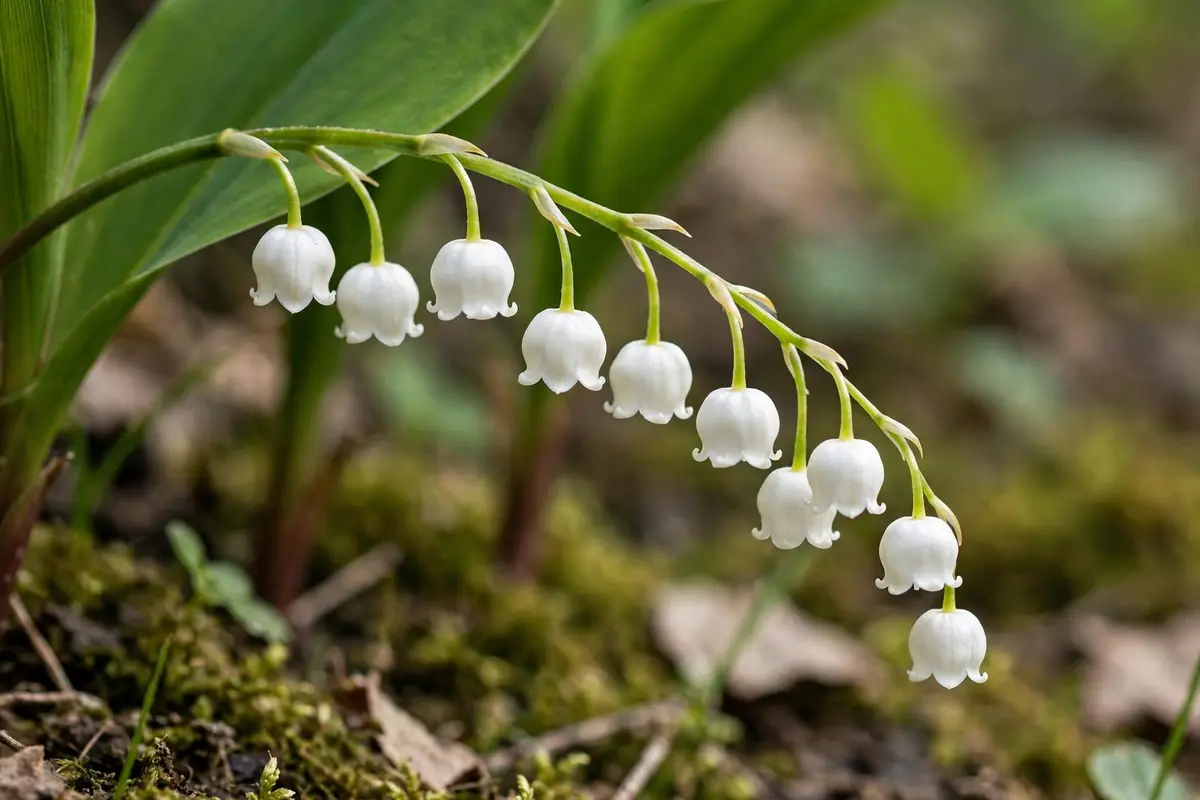
Table of Contents
- What Is a Lily of the Valley Flower?
- Types of Lily of the Valley and 6 Kinds Worth Knowing
- Lily of the Valley Flower Meaning and Symbolism
- Lily of the Valley Flower Colours and Their Meanings
- How to Grow Lily of the Valley
- Common Mistakes When Growing Lily of the Valley
- Lily of the Valley vs False Lily of the Valley
- Frequently Asked Questions
What Is a Lily of the Valley Flower?
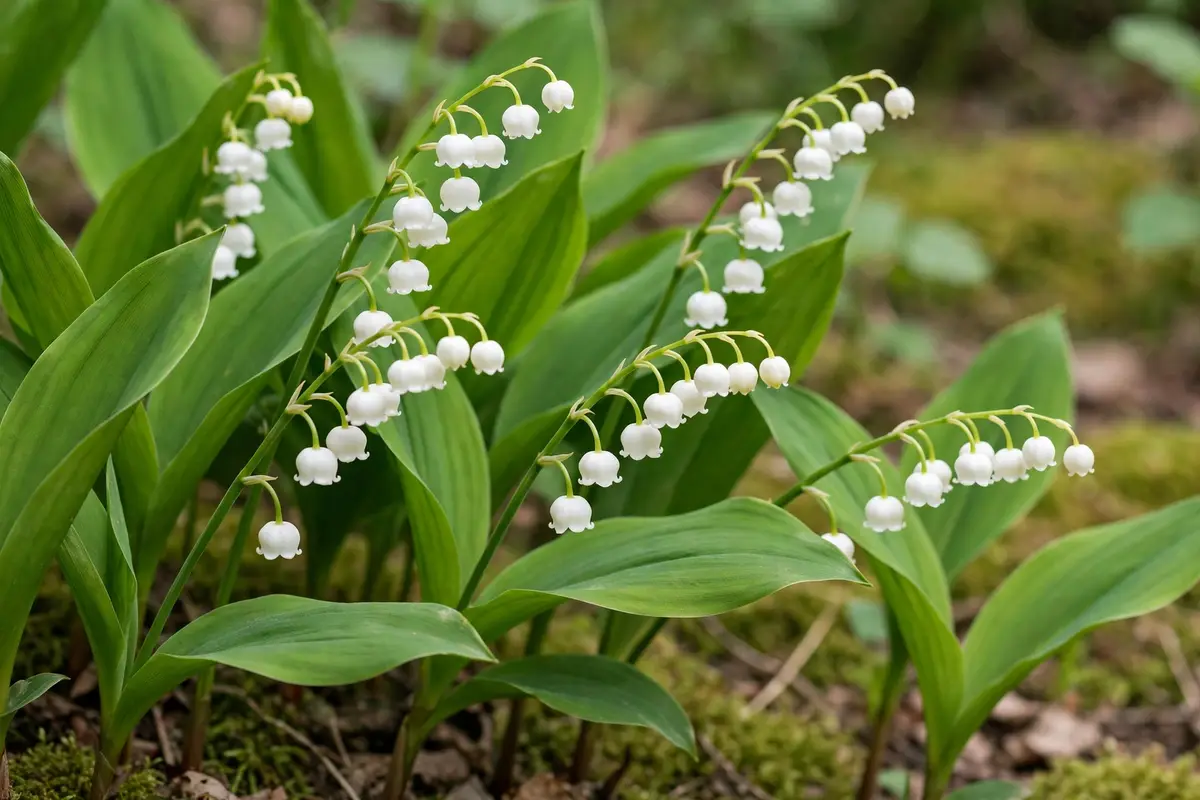
Convallaria majalis is a woodland perennial native across the cool temperate Northern Hemisphere — Europe, Asia and (in its American variety) the Appalachian mountains — despite the name being no lily at all in the modern sense: it sits in the asparagus family, Asparagaceae. The plant is minimal and perfect: from a creeping rhizome (the nursery trade calls the flowering crowns “pips”) rise two broad green leaves and one stem of a dozen or more nodding white bells, each a tiny lantern of fused petals with a scent out of all proportion to its size. Orange-red berries follow in autumn. The name Convallaria is Latin for “of the valley”, and the old biblical name — the lily of the valleys of the Song of Solomon — gave it two thousand years of devotional meaning before florists got to it. You can read more on the Lily of the valley page on Wikipedia.
The fame is disproportionate too. The scent cannot be distilled from the flowers (perfumers rebuild it synthetically — muguet is a cornerstone of classic perfumery, from Diorissimo onward), yet a bunch of stems scents a whole room. France celebrates it on May 1st at La Fête du Muguet, when muguet may legally be sold on the street tax-free, a tradition traced to King Charles IX receiving a sprig as a lucky charm in 1561. Finland made it the national flower. Princess Grace of Monaco and Catherine, Princess of Wales, both carried it down the aisle — the royal wedding flower par excellence. And underneath the romance sits the chemistry: convallatoxin and some three dozen other cardiac glycosides, digitalis-class compounds in every part of the plant. Beautiful, beloved, and to be handled with respect.
Lily of the Valley Flower Quick Facts
- Botanical name: Convallaria majalis.
- Family: Asparagaceae, the asparagus family.
- Hardiness: USDA zones 3 to 7 (struggles in hot summers).
- Height: 6 to 12 inches.
- Bloom time: late spring (April to May).
- Sun and soil: part to full shade; moist, humus-rich soil.
- Good to know: highly poisonous in all parts; spreads vigorously by rhizomes — site it where spread is welcome or contained.
Types of Lily of the Valley and 6 Kinds Worth Knowing
One species, a handful of refined forms, and its continental varieties. The table separates them; the profiles follow. For the full list of flower names, see our flower names A to Z guide.
| Type | Flowers | Leaves | Height | Best use |
|---|---|---|---|---|
| Species (C. majalis) | Classic white bells | Plain green | 8–12 in | Shade carpet, cutting |
| ‘Bordeaux’ | Larger bells, taller stems | Plain green | 12–15 in | Floristry, bigger bouquets |
| Rosea (pink form) | Blush-pink bells | Plain green | 8–10 in | Collectors, soft drifts |
| ‘Flore Pleno’ | Double white bells | Plain green | 8–10 in | Close-up beds, pots |
| ‘Albostriata’ | White bells | Cream-striped | 8–10 in | Brightening dark shade |
| American & Asian varieties | White bells (keiskei often larger) | Plain green | 6–12 in | Native-range plantings |
1. The Species — the Wild Original
The plant of European woods and a million cottage gardens: pips planted once become a scented carpet within a few years, flowering reliably in the awkward dry shade under trees where little else performs. As the defining bloom of the May birth flower pair (with hawthorn), it carries the birthday meaning — the return of happiness — on its own two leaves. For groundcover at scale, nothing fragrant beats it.
2. ‘Bordeaux’ — the Florist’s Upgrade
A taller, larger-belled selection bred for the cut-flower trade: stems to 15 inches with bells you can actually see across a room. If lily of the valley is destined for vases and wedding work, ‘Bordeaux’ is the professional choice; in the garden it reads as the species with the volume turned up, flowering a touch later.
3. Rosea — the Pink Form
The blush-pink variant, known since the 16th century: bells of the softest shell-pink over the same green leaves. Pinker in bud and in cool springs (heat bleaches it toward white). Collectors plant it in drifts of its own so the colour reads; in mixed plantings it disappears politely into the white.
4. ‘Flore Pleno’ — the Double
A double-flowered form whose bells open as tiny layered rosettes — less carrying scent than the single, more jewellery per stem. Slow to bulk up and priced accordingly; plant it where you pass at nose height (raised beds, pots by the door) and let it take its time.
5. ‘Albostriata’ — the Striped Leaf
The variegated form: leaves painted with cream longitudinal stripes, extending the plant’s season of interest months beyond the bells. Variegation makes it slower and less thuggish than the species — a virtue in smaller gardens. The flowers remain the classic white, and the whole plant lights the dark corners it was sent to.
6. The Continental Varieties — montana and keiskei
Botanists split the species by continent: the American lily of the valley (var. montana, Appalachian woodlands) and the Asian (var. or species keiskei, often larger in all parts, the form behind much Japanese forcing). For gardeners within those ranges, the home variety is the ecologically right choice; for everyone else they are proof the same white bells ring on three continents.
Lily of the Valley Flower Meaning and Symbolism
Lily of the valley means the return of happiness — the tenderest definition in floriography, given because it arrives when spring finally commits. Around it gather purity and humility (the bowed white bells), sweetness of heart, and in Christian tradition the tears of the Virgin, sprung where they fell. In France on May 1st it is simpler: muguet is luck, sold on every corner for La Fête du Muguet and given to everyone you wish well for the year.
Its wedding career follows the same logic: a bride carries the return of happiness in her hands. Grace Kelly’s bouquet was lily of the valley; so was Catherine Middleton’s in 2011, drawn largely from royal gardens. Give the flowers for reconciliations, homecomings, new beginnings after hard winters — and for May birthdays, where the flower is the month made visible. Just pair the gift with its one rule, below: this bouquet is admired, never tasted, and its vase water is poured away, not sipped by pets.
Lily of the Valley Flower Colours and Their Meanings
Essentially one colour, perfectly kept:
- White — purity, humility and the return of happiness: the species and its classic forms, standard-bearers of our white flowers.
- Blush pink — sweetness and tender affection: the Rosea form’s soft exception.
- Red berries (autumn) — the warning colour: beautiful, and strictly for the birds’-eye view at a distance (they are poisonous; admire only).
How to Grow Lily of the Valley
Plant it once, in the right shade, with a plan for its enthusiasm. Gardeners on r/gardening on Reddit divide into two camps — “best groundcover ever” and “beautiful thug” — and the difference is entirely where they put it.
Planting Pips
Plant pips (the rhizome crowns) in autumn or early spring, an inch deep with the bud tips just at the surface, 6 inches apart, in part-to-full shade and soil enriched with leaf mould that stays moist through spring. It is the definitive answer for dry shade under trees and north walls — the ground your bluebell flower patch also loves, and the two make classic woodland partners (bluebells first, lily of the valley a fortnight later). Water in dry spells the first year; afterwards the carpet is self-sufficient.
Spread, Containment and Forcing
The rhizomes run — give the plant a contained territory (between path and wall, under shrubs, in a bottomless-barrier bed) or a wild corner where running is the job description; do not plant it beside choice small perennials you love. To keep a patch flowering strongly, lift and divide congested clumps every few years in autumn, replanting the fattest pips. For winter flowers indoors, the old florist’s trick still works: lift pips in autumn, pot them tight in moist compost, give them 8–10 weeks of cold (fridge or cold frame), then bring them into warmth — scented bells in three to four weeks, Christmas’s most luxurious houseplant.
The Safety Rules
All parts — leaves, bells, berries, roots — contain cardiac glycosides and are seriously poisonous; the vase water takes up the compounds too. Handle plants and bouquets freely (skin contact is fine for most people), wash hands after dividing clumps, keep berries and vase water away from children and pets, and never plant it where grazing animals browse. The perfume is the plant’s gift; the rest is look, don’t taste.
Common Mistakes When Growing Lily of the Valley
The classic mistake is planting it in a mixed border and being surprised, three years later, at whose border it now is — the rhizomes thread through everything. The second is sun and drought: in hot sunny beds the leaves scorch and the carpet sulks (it is a cool-shade plant, and in zones warmer than 7 it wants the coolest corner you own). The third is planting pips too deep or in summer heat, when they rot or stall instead of establishing.
The fourth is eating-adjacent confusion: its leaves have been mistaken for wild garlic (ramsons) by foragers — with serious consequences — because both carpet spring woods and the leaves are superficially similar. Wild garlic smells powerfully of garlic when crushed; lily of the valley leaves smell of nothing. When in doubt, do not gather: that rule and the berries rule keep the plant’s one danger theoretical.
Lily of the Valley vs False Lily of the Valley
The woodland lookalike is Maianthemum — false lily of the valley (M. dilatatum on the Pacific coast, M. canadense, “Canada mayflower”, in the east) — a genuine relative with the same two-leaf woodland habit. Tell them apart at flowering: lily of the valley carries its bells on a leafless arching stem that rises between two broad leaves, each bell a white lantern an inch of stem below the next. Maianthemum puts its flowers in a small upright cluster of tiny white stars at the top of a leafy stem, weeks later, followed by speckled red berries in a bunch. Maianthemum is a fine native groundcover in its own right, far less aggressive, and the safe double-take: if the “bells” are a froth of little stars, it is the false one. Both are best admired unsampled, but only Convallaria carries the serious cardiac chemistry.
Frequently Asked Questions
Is lily of the valley poisonous?
Yes — genuinely. Every part contains cardiac glycosides (convallatoxin and relatives, the digitalis class), and poisoning cases in people and pets are documented, including from drinking vase water. Grow it, cut it, enjoy the scent — but keep it out of mouths, and wash hands after handling divisions. If your question is not answered here, the questions about lily of the valley on Quora cover most of the rest.
When does lily of the valley bloom?
Late spring — late April through May in most gardens — for two to three weeks, with the scent strongest on warm, still mornings. It is a May birth flower precisely because its season is so reliable.
Does lily of the valley spread?
Yes, steadily and sometimes eagerly, by creeping rhizomes — a six-inch spacing becomes a closed carpet in two to three years. Contain it with edging or barriers, or give it a wild corner; in small polite borders, grow it in a large buried pot to keep the peace.
Can lily of the valley grow in pots?
Yes, well — deep pots of humusy compost in shade, kept moist; pots also solve the containment problem elegantly. Potted pips can be forced indoors in winter after a cold spell (see the forcing note above).
Why is my lily of the valley not flowering?
Usually overcrowding (congested old clumps flower less — divide and replant the fat pips), too much sun and heat, or pips planted too deep or too young. Shade, moisture in spring, and a decrowding every few years restore the bells.
Is lily of the valley a good cut flower?
One of the greats — a small bunch scents a room for a week. Cut when half the bells on a stem are open, condition in deep water, and keep the vase where pets cannot drink from it. For more flowers under the same letter, see our guide to flowers that start with L.