Weeping Eastern Redbud: Planting & Care Guide for ‘Ruby Falls’
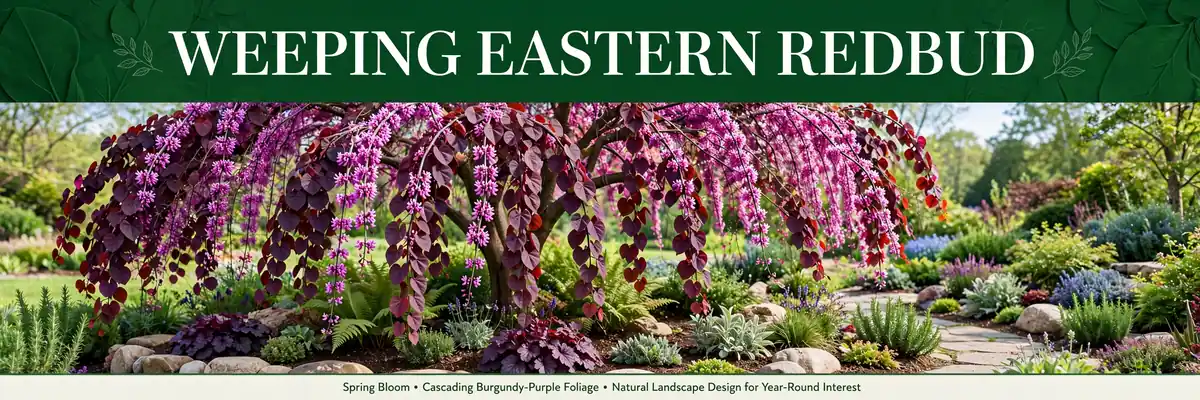
Few small trees deliver as much drama per square foot as the weeping eastern redbud. In early spring, before a single leaf appears, its cascading branches erupt in clusters of rosy-magenta, pea-shaped flowers — blooming directly on the bare wood and even on the trunk itself. Then come the heart-shaped leaves in deep maroon-purple, unfurling into a burgundy waterfall that holds its color all summer. The star cultivar, Cercis canadensis ‘Ruby Falls’, packs that entire performance into a tree that tops out at six to eight feet, making it one of the best specimen trees ever bred for small gardens, entryways, and patios.
This guide covers everything you need to grow it well: what the weeping eastern redbud actually is and where it came from, how ‘Ruby Falls’ compares with the other weeping redbud cultivars, exactly where and how to plant it, its soil, light, water, and pruning needs, the best companion plants, the pests and diseases to watch for, and a season-by-season care calendar. If you are torn between a weeping redbud and a similar ornamental tree, you will also find a head-to-head comparison table below. Gardeners working through our alphabet series can also browse our list of plants that start with R, where the redbud earns its place.
Quick Answer
What is a weeping eastern redbud? It is a compact, weeping cultivar of the eastern redbud (Cercis canadensis), most famously ‘Ruby Falls’ — a 2010 introduction from North Carolina State University, bred from a cross between the weeping ‘Lavender Twist’ and the purple-leafed ‘Forest Pansy’. It grows 6–8 feet tall and 4–6 feet wide in USDA zones 5–9, with dark rose-pink spring flowers on bare branches and burgundy, heart-shaped foliage all summer. Care basics: plant in full sun to part shade in well-drained, average soil; water deeply through the first year; mulch 2–3 inches deep without touching the trunk; prune only right after flowering; and stake the young tree if you want a taller trunk. Watch for Botryosphaeria canker and verticillium wilt — the two diseases that most often kill redbuds.
Table of Contents
- Quick Answer
- What Is a Weeping Eastern Redbud?
- Weeping Redbud Cultivars Compared
- Where to Plant a Weeping Eastern Redbud
- How to Plant It, Step by Step
- Watering Needs
- Fertilizing
- Pruning a Weeping Redbud
- Landscape Uses & Design Ideas
- Best Companion Plants
- Weeping Redbud vs. Similar Ornamental Trees
- Common Problems: Pests & Diseases
- Seasonal Care Calendar
- Frequently Asked Questions
- References
What Is a Weeping Eastern Redbud?
The eastern redbud (Cercis canadensis) is a small, deciduous understory tree native to eastern North America, beloved for the magenta-pink blossoms that open on its bare branches weeks before spring foliage arrives anywhere else. The species itself grows 20 to 30 feet tall with a rounded crown. A weeping eastern redbud is a cultivated variety — a cultivar — of that same species, selected for branches that arch, twist, and cascade downward instead of reaching upward.
The cultivar that defines the category is ‘Ruby Falls’. It was developed by Dr. Dennis Werner at North Carolina State University and released in 2010 as a second-generation cross between Cercis canadensis ‘Covey’ (sold as ‘Lavender Twist’, the original weeping redbud with green foliage) and ‘Forest Pansy’ (the classic purple-leafed redbud). ‘Ruby Falls’ inherited the best of both parents: a true weeping habit and the dark burgundy foliage, and it is protected under US plant patent PP22097. Because it is patented, every legitimate ‘Ruby Falls’ tree is vegetatively propagated by grafting — nurseries bud the cultivar onto a straight understock, usually at a trunk height of about four to five feet, so the weeping branches cascade from a single graft union like a fountain.
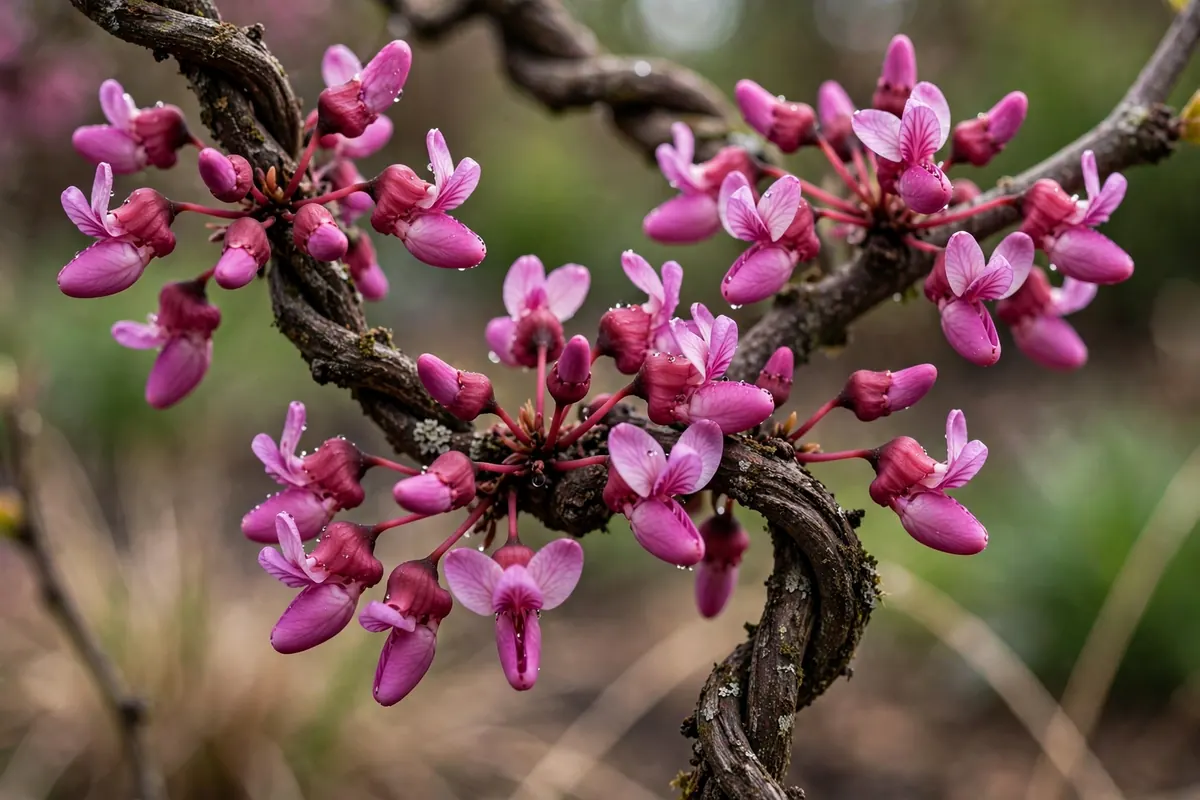
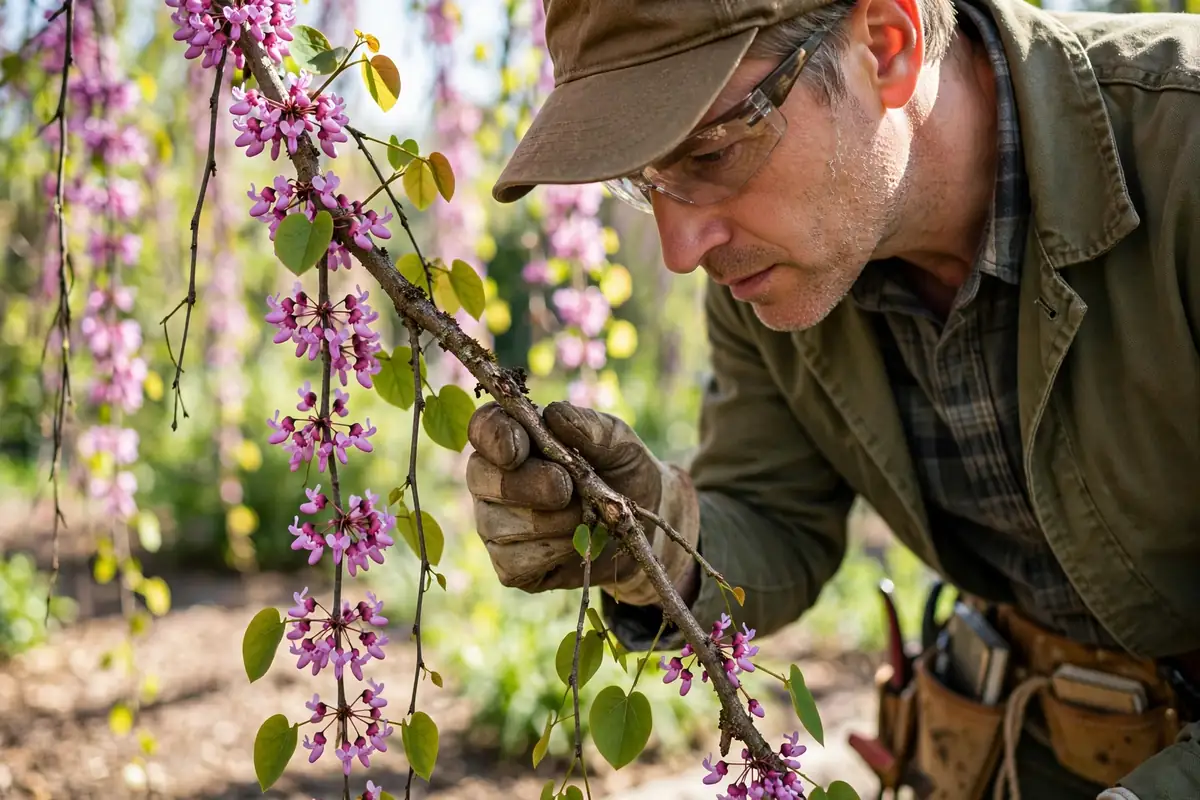
The spring show is what sells the tree. Redbuds exhibit cauliflory, a rare habit in temperate trees where flowers emerge directly from old wood and even the trunk. On ‘Ruby Falls’, clusters of dark rose, sweet-pea-like blossoms stud the weeping branches and trunk in early spring, typically for two to three weeks, before any leaves appear. The flowers are an important early-season food source for native bees, including the specialized southeastern blueberry bee (Habropoda laboriosa), and the blossoms are edible — they make a pretty, mildly tangy addition to spring salads.
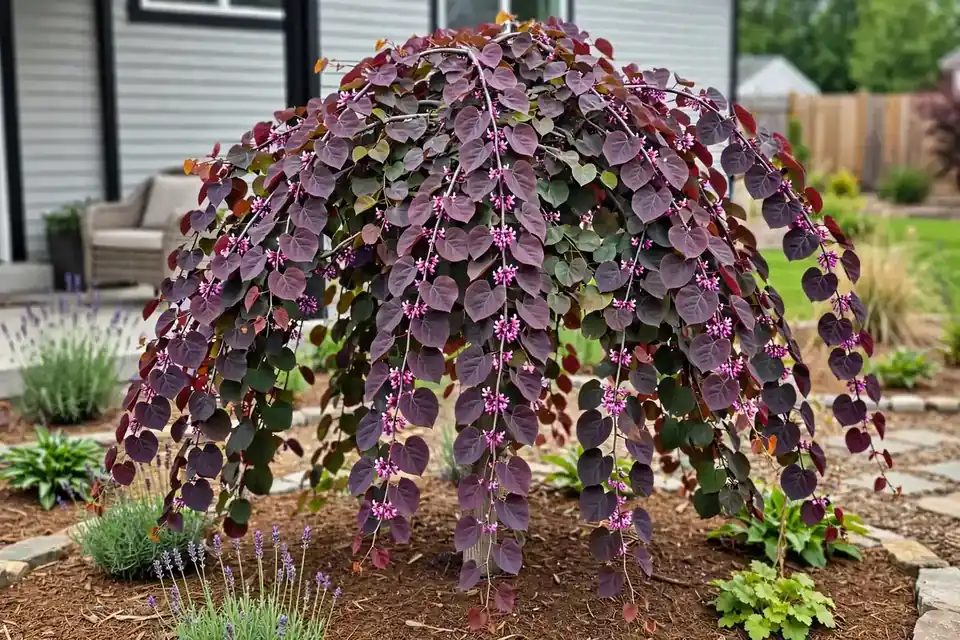
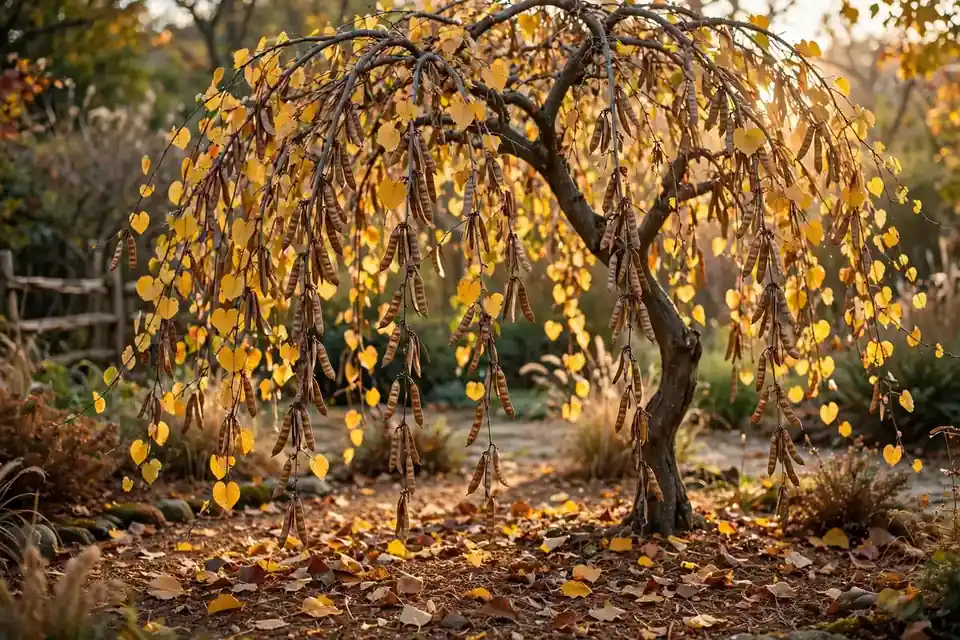
Foliage follows the bloom. The heart-shaped leaves — up to five inches across — emerge glossy and dark maroon-red, mature to a rich burgundy-purple through summer, and often take on a greener cast in late summer heat (more on why that happens in the FAQ). Fall color is yellow, sometimes streaked with purple. Flat, bean-like seed pods follow the flowers and may persist into winter, a reminder that redbuds belong to the legume family (Fabaceae). One honest caveat: redbuds are relatively short-lived trees, typically 20 to 30 years, so think of a weeping redbud as a glorious medium-term investment rather than a legacy planting.
Weeping Redbud Cultivars Compared
‘Ruby Falls’ gets the headlines, but it is not the only weeping redbud worth knowing. Each cultivar pairs the signature cascading habit with different foliage and flower colors, and sizes vary enough that the right choice depends on your space. All are grafted, patented selections that must be bought as named nursery stock — never as seed, which will not come true.
| Cultivar | Foliage | Flowers | Mature Size (H × W) | Zones | Best For |
|---|---|---|---|---|---|
| ‘Ruby Falls’ | Burgundy-purple hearts, greenish by late summer | Dark rose-pink | 6–8 ft × 4–6 ft | 5–9 | Maximum drama in minimum space; the all-rounder |
| ‘Lavender Twist’ (‘Covey’) | Green hearts, yellow fall color; contorted zigzag branches | Lavender-pink | 5–10 ft × 6–8 ft (staked) | 5–9 | Winter interest — twisted branches look sculptural bare |
| ‘Golden Falls’ | Golden-yellow maturing to chartreuse | Pink | 6–8 ft × 4–5 ft | 5–9 | Bright contrast against dark evergreens |
| ‘Whitewater’ | White-and-green variegated hearts | Deep rose-purple | 6 ft × 2–3 ft | 5–9 | The narrowest weeper; tight spaces and containers |
| ‘Pink Pom Poms’ | Green hearts | Double pink pom-poms (sterile, no pods) | 12–15 ft × 10–12 ft | 5–9 | Bigger spaces; no messy seed pods |
| ‘Vanilla Twist’ | Green hearts | Pure white | 8–10 ft × 6–8 ft | 5–9 | Moon gardens and white-themed borders |
Buying tips: choose a tree grafted at the trunk height you want, because the weeping top will never grow much taller on its own — the upward leader only extends while it is staked. Inspect the graft union for a clean, healed join with no swelling, cracking, or suckers sprouting from below it. Reject any plant with weeping branches emerging from beneath the graft (that is the rootstock, not the cultivar). Buy container-grown trees rather than bare-root when possible; redbuds resent transplanting, and a younger, smaller tree establishes far more reliably than a large one.
Where to Plant a Weeping Eastern Redbud
Light. Give your weeping redbud full sun to part shade — at least four to six hours of direct sun daily. The purple-leafed cultivars like ‘Ruby Falls’ hold their burgundy color best in full sun; in too much shade the foliage turns muddy green and flowering thins out. In hot southern climates (zones 8–9), morning sun with light afternoon shade is the sweet spot: it protects the leaves from scorch while still delivering enough light for strong bloom. Redbuds are naturally understory trees, so dappled light under a high-canopied shade tree also works, though bloom will be lighter than in the open.
Soil. Weeping eastern redbuds are adaptable but not indestructible. They grow best in average, moderately fertile, well-drained soil with a pH between 6.0 and 7.5, and they tolerate both clay and sandy soils as long as drainage is adequate. The single non-negotiable is drainage: redbuds will not tolerate waterlogged roots, and wet winter soil is a fast track to root rot and canker. If your site stays soggy after rain, plant on a slight mound or choose a different spot. They are notably tolerant of black walnut (juglone) toxicity, so planting near walnut trees — a death sentence for many ornamentals — is fine.
Space. Allow three to six feet of clear space around the tree so the cascading branches can drape without brushing walls, fences, or walkways. Remember that the mature spread comes mostly from the weeping top, so position the trunk with the future fountain shape in mind. Avoid planting beneath eaves where heavy drip lines pound the foliage, and give it shelter from harsh prevailing winds — weeping branches are brittle and snap in exposed sites.
Containers. Thanks to their compact size, weeping redbuds — especially ‘Ruby Falls’ and the extra-narrow ‘Whitewater’ — are among the few flowering trees that genuinely work in containers. Use a pot at least 20 gallons (about 18–24 inches across) with large drainage holes, filled with a quality bark-based potting mix rather than garden soil. Container trees need more frequent watering and a winter protection plan in zones 5–6: the roots are far less cold-hardy in a pot than in the ground, so move the pot to a sheltered spot or insulate it when hard freezes threaten.
How to Plant It, Step by Step
The best planting times are early spring or fall, when temperatures are moderate and the tree is dormant or just waking up. Redbuds have shallow root systems and dislike being moved, so treat the first planting as permanent — choose the site carefully and get it right the first time.
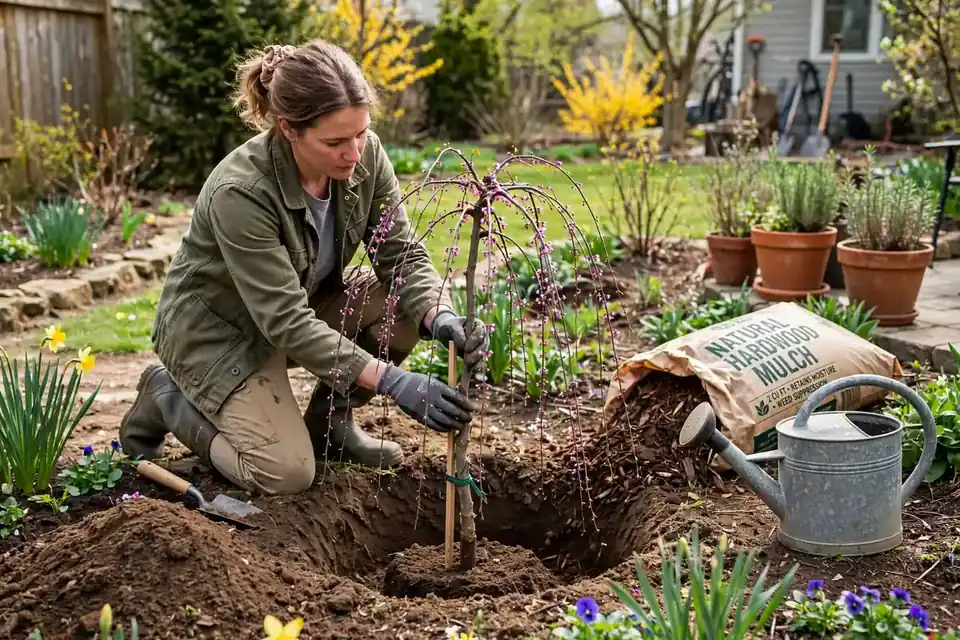
1. Prepare the hole. Dig a hole twice as wide as the root ball but no deeper. Roots spread sideways, not down, and a deep hole settles, burying the tree too low — the single most common cause of young redbud decline.
2. Find the root flare. Before planting, brush soil away from the top of the root ball until you see the trunk visibly widen where it meets the roots. If the flare is buried in the nursery pot, remove soil until you find it. Plant so the flare sits level with — or a finger’s width above — the surrounding grade, never below it.
3. Set the tree and backfill. Place the tree in the hole, check that it stands straight from two angles, and backfill with the native soil you removed. Do not create a pocket of pure compost or potting mix around the roots — in clay soil that forms a water-holding bowl. Firm the soil gently to remove large air pockets.
4. Water deeply. Soak the entire root zone immediately after planting until water pools briefly and drains. This settles the soil around the roots.
5. Mulch correctly. Spread two to three inches of shredded bark or wood-chip mulch in a wide, flat disc over the root zone — not a volcano piled against the trunk. Keep mulch three to four inches clear of the bark. The disc should look like a donut, not a mound; mulch against the trunk traps moisture and invites canker and borers.
6. Stake if needed. If you bought your tree staked to a taller trunk and want to keep that height, leave the nursery stake in place for the first year, checking ties monthly so they never girdle the stem. If you want a shorter, more fountain-like tree, you can remove the stake and let the leader arch over naturally — once the stake comes off, upward growth essentially stops and the weeping form takes over.
Watering Needs
First-year watering makes or breaks a redbud. Water newly planted trees deeply once or twice a week through their first growing season — enough to moisten the full root ball and the surrounding soil — rather than with daily sprinkles that keep roots shallow. A slow trickle from a hose for 30–45 minutes, or a five-gallon bucket with a small hole punched in the bottom set at the drip line, does the job well. During heat waves, check soil moisture with your finger: if the top two inches are dry, water.
Once established (usually by the second or third year), weeping eastern redbuds are moderately drought-tolerant but perform best with consistent moisture. In most climates, rainfall suffices except during extended dry spells, when one deep soaking every week or two keeps foliage lush and prevents premature leaf drop. Trees in containers are the exception — check them every couple of days in summer, as pots dry out far faster than garden soil. Overwatering is just as dangerous as drought: constantly soggy soil suffocates roots and invites the fungal diseases redbuds are prone to, so always let the top inch or two of soil dry between waterings.
Fertilizing
Healthy redbuds in decent soil need very little fertilizer — this is a low-maintenance tree, not a hungry one. A one-inch top-dressing of compost each spring, spread under the mulch, supplies all the nutrition most trees require. If growth is pale or sluggish and a soil test confirms a deficiency, apply a balanced, slow-release granular fertilizer (such as 10-10-10) in early spring before new growth begins, following label rates for the tree’s size.
What not to do matters more: avoid heavy nitrogen doses and avoid fertilizing after midsummer. Excess nitrogen pushes soft, leafy growth at the expense of flowers and leaves the tree vulnerable to winter damage, while late-season feeding encourages tender growth that has no time to harden off before frost. As a legume family member, the redbud fixes small amounts of atmospheric nitrogen through its roots, which is one reason it gets by on leaner rations than most flowering trees. Newly planted trees should not be fertilized at planting time — let the roots establish for a full season first.
Pruning a Weeping Redbud
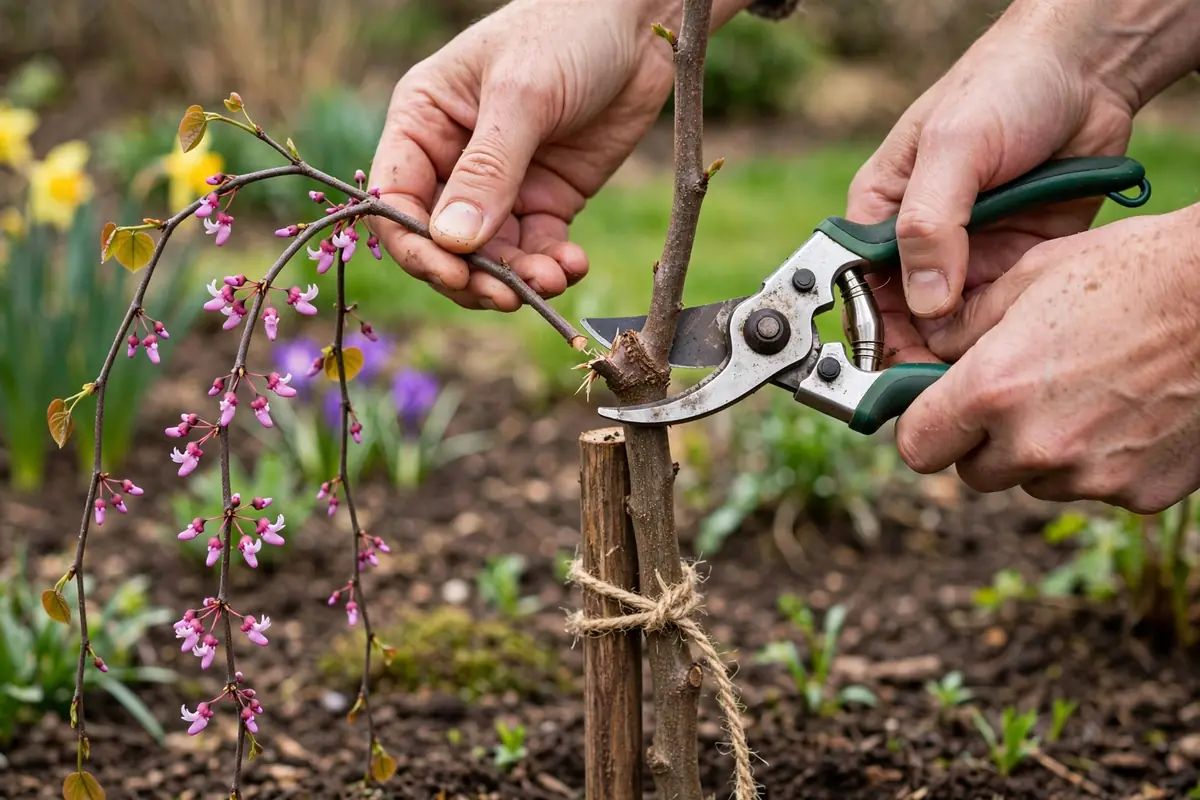
Redbuds bloom on old wood, so pruning at the wrong time erases the spring show. The rule is simple: prune right after flowering finishes in spring, never in late winter or early spring before bloom. The one exception is dead, damaged, or diseased wood, which can and should be removed the moment you spot it, at any time of year — cutting out cankered branches promptly is how you stop the disease from spreading.
Weeping cultivars need even less routine pruning than the species, because the cascading habit is the whole point. Your annual prune should be light and purposeful: remove dead or crossing branches, thin out any congested spots to let air and light into the canopy, cut back branches that drag on the ground or block paths, and remove rootstock suckers sprouting from below the graft union (these will have plain green, non-weeping growth — rub them off while small). Always cut just outside the branch collar — the swollen ring where branch meets trunk — and never leave stubs, which rot and invite disease. Do not paint or seal cuts; open wounds heal faster.
Two things to avoid: never “top” a weeping redbud or shear it into a ball — you will destroy the fountain form it was bred for, and redbud wood heals slowly from large wounds. And resist heavy corrective pruning all at once; if a tree needs major reshaping, spread the work over two or three years. For the first few seasons, your main job is training rather than pruning: keep the stake and ties adjusted so the trunk grows straight to your chosen height, remove competing leaders, and favor branches with wide, U-shaped crotches over narrow V-shaped ones that split in storms.
Landscape Uses & Design Ideas
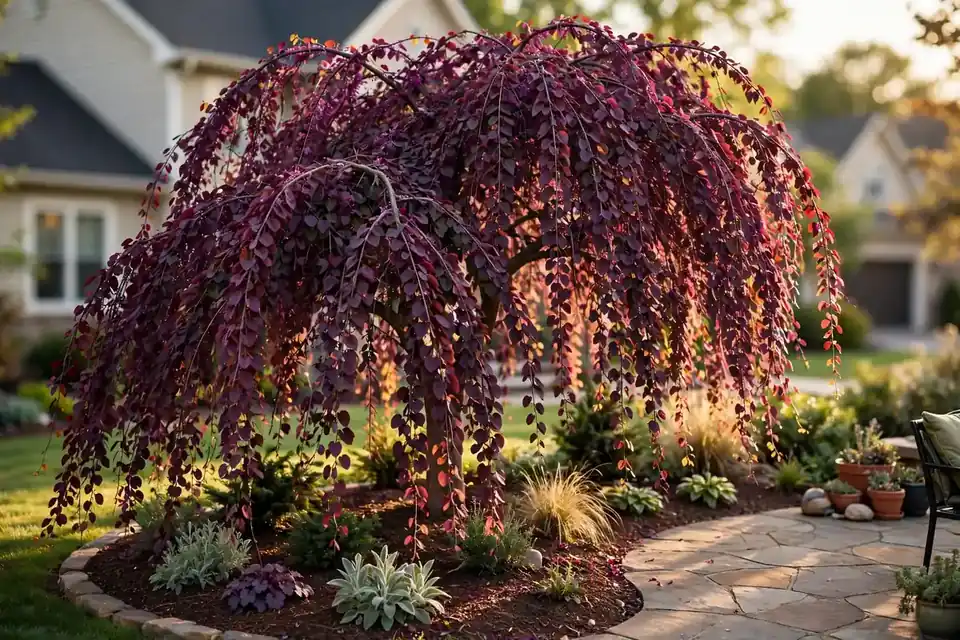
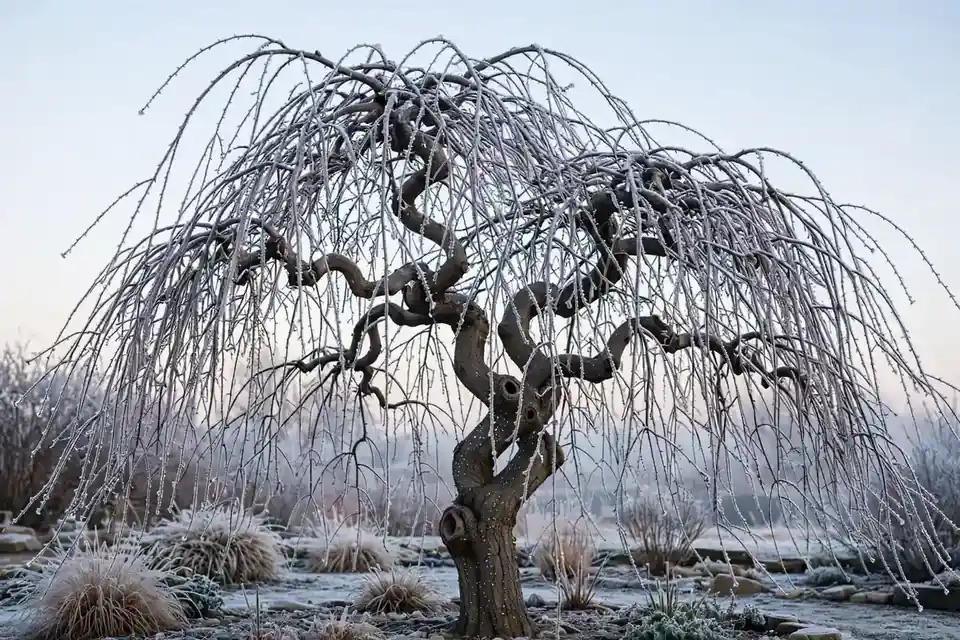
The weeping eastern redbud earns its keep as a specimen tree — one plant, placed where it can be seen from the house or street, carries an entire garden bed. Because it stays under eight feet, it fits spaces where a full-size flowering tree would overwhelm: flanking a front entry, anchoring the corner of a foundation planting, rising from the center of a circular bed, or standing alone in a lawn as a living sculpture. Its winter silhouette is a bonus — the bare, twisted, weeping branches have real architectural presence against snow or a dark fence.
Designers use it as a “thriller” in layered plantings: set the redbud slightly off-center as the focal point, ring it with mid-height perennials, and edge with low groundcovers. The burgundy foliage of ‘Ruby Falls’ is a natural partner for chartreuse and lime-green companions — golden hostas, ‘Angelina’ sedum, or Japanese forest grass make the purple leaves glow by contrast. Near patios and seating areas, the tree’s human scale shines: branches cascade to eye level, bringing the spring flowers close enough to inspect (and the hummingbirds with them). In Japanese-inspired or woodland-edge gardens, a weeping redbud beside a stone lantern, water basin, or mossy boulder looks entirely at home.
Small-space tricks worth stealing: plant one in a large decorative container by the front door for instant curb appeal; use a pair to frame a garden gate or the start of a path; or underplant a single specimen in a raised bed where the weeping branches can spill over the edge. Because it leafs out after flowering, the tree also works as a seasonal privacy screen in summer without blocking winter light — a useful trait for south-facing windows.
Best Companion Plants
The right companions extend the weeping redbud’s season of interest from a three-week spring spectacle into a four-season vignette. Think in layers, matching each plant to the light the tree creates.
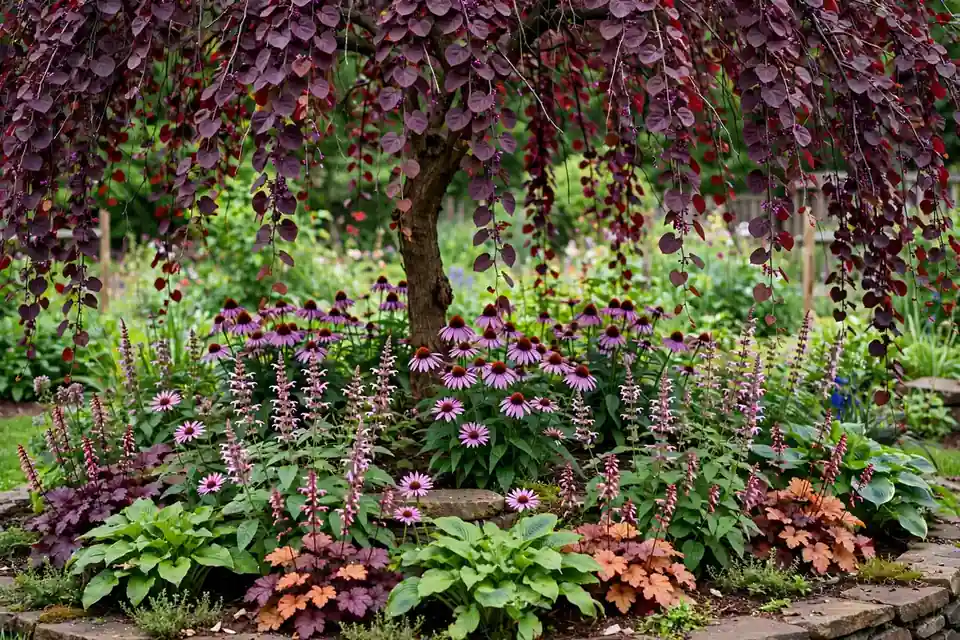
Under the canopy: once the redbud leafs out, the ground beneath gets part shade — perfect for hostas, coral bells (Heuchera), ferns, and astilbe. Plant spring bulbs — daffodils, tulips, and crocus — in the same bed in fall; they bloom in the full sun of early spring before the redbud’s leaves emerge, then go dormant as shade arrives. It is a classic succession planting that asks for nothing extra.
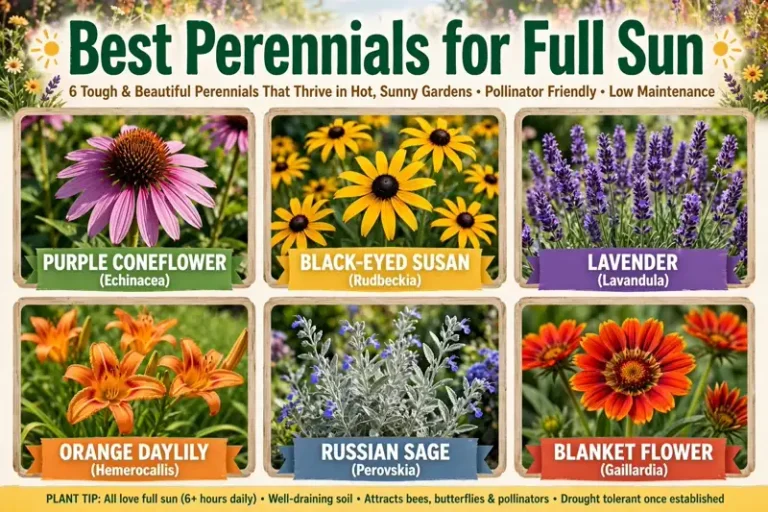
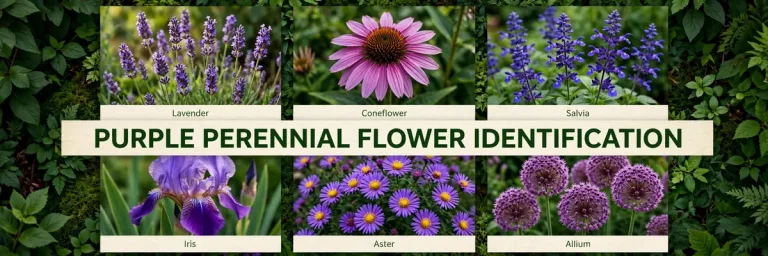
Beside it: pair burgundy foliage with contrasting colors and textures. Purple perennial flowers like coneflowers, salvias, and Russian sage echo the redbud’s pink spring bloom into summer, while the broader palette of full-sun perennials — black-eyed Susans, daylilies, ornamental grasses — thrives in the sunny ring just beyond the tree’s drip line. A hydrangea or two behind the redbud adds summer flower power in the same part-shade conditions the tree enjoys.
For fall and winter: when the redbud’s leaves turn yellow and drop, fall companions take the stage. Chrysanthemums are the obvious choice — see our mum care guide to keep them blooming into October — alongside asters and ornamental kale. Evergreen structure (boxwood, yew, or dwarf conifers) planted nearby keeps the bed from looking empty once the weeping branches stand bare.
Avoid aggressive groundcovers like English ivy or vinca under a redbud: they compete for water and hide the mulch ring, and their vines climbing the trunk trap moisture against bark. And keep lawn grass pulled back at least to the drip line — string trimmers are the number-one killer of young ornamental trees, and a bark wound on a redbud is an open door for canker.
Weeping Redbud vs. Similar Ornamental Trees
Shoppers often cross-shop the weeping redbud against other small weeping trees. Here is how the leading contenders stack up on the traits that matter in a home landscape.
| Trait | Weeping Eastern Redbud ‘Ruby Falls’ | Weeping Cherry (‘Snow Fountains’) | Weeping Crabapple | Weeping Japanese Maple (‘Crimson Queen’) |
|---|---|---|---|---|
| Spring display | Dark rose pea-flowers on bare wood; then burgundy leaves | Masses of white or pink single blossoms | Pink buds, white flowers, then small fruits | No showy flowers; red foliage unfurls |
| Summer foliage | Burgundy-purple hearts (greener in heat) | Plain green | Green, sometimes purple-tinged | Deeply dissected crimson-red |
| Mature size | 6–8 ft tall × 4–6 ft wide | 8–15 ft × 6–8 ft | 10–15 ft × 10–15 ft | 8–10 ft × 10–12 ft |
| USDA zones | 5–9 | 4–8 | 4–8 | 5–8 |
| Standout strength | Two-season color; native pedigree; heat-tolerant; edible flowers | Most spectacular two-week bloom of any small tree | Flowers plus ornamental fruit for birds | Unmatched foliage texture; superb fall color |
| Main drawback | Short lifespan (20–30 yrs); canker-prone | Bloom lasts ~2 weeks; borer and disease prone | Needs disease-resistant variety or sprays; messy fruit | Leaf scorch in hot sun; slow-growing; pricey |
Bottom line: choose the weeping redbud if you want the longest season of interest in the smallest footprint and the best heat tolerance. Choose the weeping cherry for one unbeatable fortnight of bloom, the crabapple if you want fruit for wildlife, and the Japanese maple if foliage texture matters more to you than flowers.
Common Problems: Pests & Diseases
Weeping eastern redbuds are relatively trouble-free, but they share the species’ vulnerabilities. Knowing what to look for — and acting early — is the difference between a tree that thrives for decades and one that declines in five years.
Botryosphaeria canker is the most common killer. It enters through wounds (pruning cuts, mower nicks, frost cracks) and shows up as sunken, discolored bark with dieback of the branch above. There is no cure: prune infected branches well back into healthy wood — at least six inches below visible damage — disinfecting tools between cuts, and do it in dry weather. Prevention is everything: avoid wounding the bark, prune correctly, and keep the tree vigorous with proper water and mulch.
Verticillium wilt is rarer but fatal. A soil-borne fungus clogs the water-conducting tissue, causing sudden wilting of one section of the canopy, often in midsummer. Cut stems show brown streaking inside. Infected trees cannot be saved — remove and destroy them, and do not replant a redbud (or maple, or other susceptible species) in the same spot.
Leaf spot, powdery mildew, and blight are mostly cosmetic. Spotted or mildewed leaves look rough by late summer but rarely threaten the tree’s life. Improve air circulation, water at the base rather than overhead, and rake up fallen leaves in autumn to reduce next year’s inoculum. A tree that leafs out strongly each spring is outgrowing these issues on its own.
Insect pests include redbud borers (the larvae tunnel under bark — keep trees vigorous and avoid trunk wounds, as stressed trees attract them), Japanese beetles (skeletonize leaves in midsummer; hand-pick or use traps placed away from the tree), aphids and scale (treat with horticultural oil or a strong jet of water), and caterpillars (usually minor; Bacillus thuringiensis handles outbreaks). Deer browse redbuds occasionally — protect young trees with a cage or repellent if deer are a known problem in your area.
The through-line in all of this: a properly sited, properly planted, unstressed redbud shrugs off most problems. The trees that die young are almost always the ones planted too deep, drowned, drought-starved, or wounded by mowers.
Seasonal Care Calendar
Spring (March–May). Enjoy the bloom — this is the payoff. After flowering finishes, do your annual pruning: remove dead, crossing, and ground-dragging branches, thin congested spots, and rub off rootstock suckers. Apply compost and refresh mulch to two to three inches. If a soil test calls for it, apply balanced slow-release fertilizer now. Watch for aphids on tender new growth and treat early. This is also the best season to plant a new tree.
Summer (June–August). Water deeply during dry spells, especially first- and second-year trees — about an inch a week if rain does not provide it. Container trees may need water every two to three days in heat. Do not fertilize after midsummer. Monitor for Japanese beetles in July and hand-pick them in the cool of the morning. It is normal for ‘Ruby Falls’ foliage to green up somewhat in high heat; deep, consistent watering helps the burgundy hold longer. Avoid any pruning now except removing clearly dead wood — summer cuts heal slowly and invite disease.
Fall (September–November). Let the tree harden off naturally; stop watering once regular rains return, except in drought. Fall is the second-best planting window — roots establish in warm soil while the top rests. Rake up fallen leaves and pods to reduce disease carryover. Do not prune in fall; wait for the post-bloom window. A fresh layer of mulch before winter protects shallow roots from freeze-thaw cycles.
Winter (December–February). The tree needs nothing from you — this is its rest. Inspect the bare branches for canker lesions, crossing limbs to address in spring, and stake ties that need loosening. Protect container trees from hard freezes by moving pots to a sheltered wall or wrapping them. Order your tree now if nurseries are taking spring reservations for grafted cultivars, which can sell out.
Frequently Asked Questions
How big does a weeping eastern redbud get?
‘Ruby Falls’, the most common cultivar, reaches 6–8 feet tall and 4–6 feet wide at maturity — small enough for a foundation bed or large container. The ultimate height depends on the graft: nurseries bud the weeping top onto a straight trunk, and the tree only grows taller while it is staked. Once the stake comes off, upward growth stops and the branches cascade. Sister cultivars vary: ‘Whitewater’ stays narrower at about 6 × 3 feet, while ‘Pink Pom Poms’ is the giant of the group at 12–15 feet.
How fast does a ‘Ruby Falls’ redbud grow?
Expect a moderate growth rate of roughly 12–18 inches per year once established, slowing as the tree matures. Young trees grow fastest — which is why buying small and planting young gives you the best long-term result. Do not try to rush it with heavy fertilizer; excess nitrogen produces weak, floppy growth that is more vulnerable to breakage and disease, and it comes at the expense of flowers.
Can you grow a weeping eastern redbud in a container?
Yes — it is one of the best flowering trees for pots. Use a container of at least 20 gallons with excellent drainage, filled with bark-based potting mix. Site it in full sun to part shade and water more often than in-ground trees, since pots dry quickly. In zones 5–6, protect the pot over winter: roots in containers experience much colder temperatures than roots in the ground, so move it against a sheltered wall, wrap the pot in insulation, or sink it into the ground for the coldest months.
When should I prune my weeping redbud?
Immediately after flowering finishes in spring. Redbuds bloom on old wood, so pruning in late winter or early spring removes that year’s flowers. Keep pruning light: take out dead, damaged, diseased, and crossing branches, lift branches that drag on the ground, and remove any suckers from below the graft union. Never shear a weeping redbud into a formal shape, and spread any major reshaping over several years — the wood heals slowly.
Why is my weeping redbud’s purple foliage turning green?
Some greening by late summer is completely normal for ‘Ruby Falls’ — even the NC State breeders note the shift from burgundy toward green as the season progresses. Heat accelerates it, and shade-grown trees green out faster than sun-grown ones. To hold the purple longest, plant in full sun (with afternoon shade only in the hottest climates), water consistently through summer heat, and avoid excess nitrogen. If your tree leafs out green from the start, though, check for rootstock suckers below the graft — those revert to plain green growth and should be removed. Confused by a similar-looking purple bloomer? Our purple perennial flower identification guide can help you tell redbud companions apart.
Are weeping eastern redbuds messy?
Moderately. The tree drops its flowers after the two-to-three-week spring bloom (a brief pink carpet — most gardeners consider it charming, not messy), and the flat seed pods fall in late autumn and winter. The pods are the main litter; raking them up in fall keeps beds tidy and reduces disease. If pods bother you, choose the sterile cultivar ‘Pink Pom Poms’, which sets no seed at all. Compared with fruiting ornamentals like crabapples, a weeping redbud is a tidy tree. For more spring-flowering tree ideas, browse our list of flowers that start with R.
References
- NC State Extension Gardener Plant Toolbox — Cercis canadensis ‘Ruby Falls’ — cultivar origin, growing requirements, and disease information from the university that bred it.
- Royal Horticultural Society — Cercis canadensis ‘Ruby Falls’ — hardiness rating, size, and cultivation guidance.
- The Old Farmer’s Almanac — How to Grow Redbud Trees — planting, pruning, and propagation advice for eastern redbuds.
- Gardening Know How — Care of Redbud Trees — planting depth, mulching, and structural pruning tips.
- Missouri Botanical Garden Plant Finder — Cercis canadensis ‘Covey’ — culture notes for the weeping parent cultivar, including staking guidance.