Snake Plant: Types, Meaning and Care Guide
The snake plant has survived more neglect than any plant in cultivation — office corners unwatered for a season, dark hallways, holidays, forgetful owners, and still it stands, sword leaves upright, unbothered. It also carries one of gardening’s rudest nicknames (mother-in-law’s tongue, for the leaf’s sharp point and sharper reputation) and one of its most durable myths (that it scrubs your air clean — a story this guide will tell honestly, NASA chamber and all).
This guide covers the six snake plants worth knowing (from the classic ‘Laurentii’ to the sculptural whale fin), what it means — resilience, endurance, protection and a little long-suffering patience — and the single care rule that decides whether yours thrives or rots: it is almost always too much water.
Quick Answer
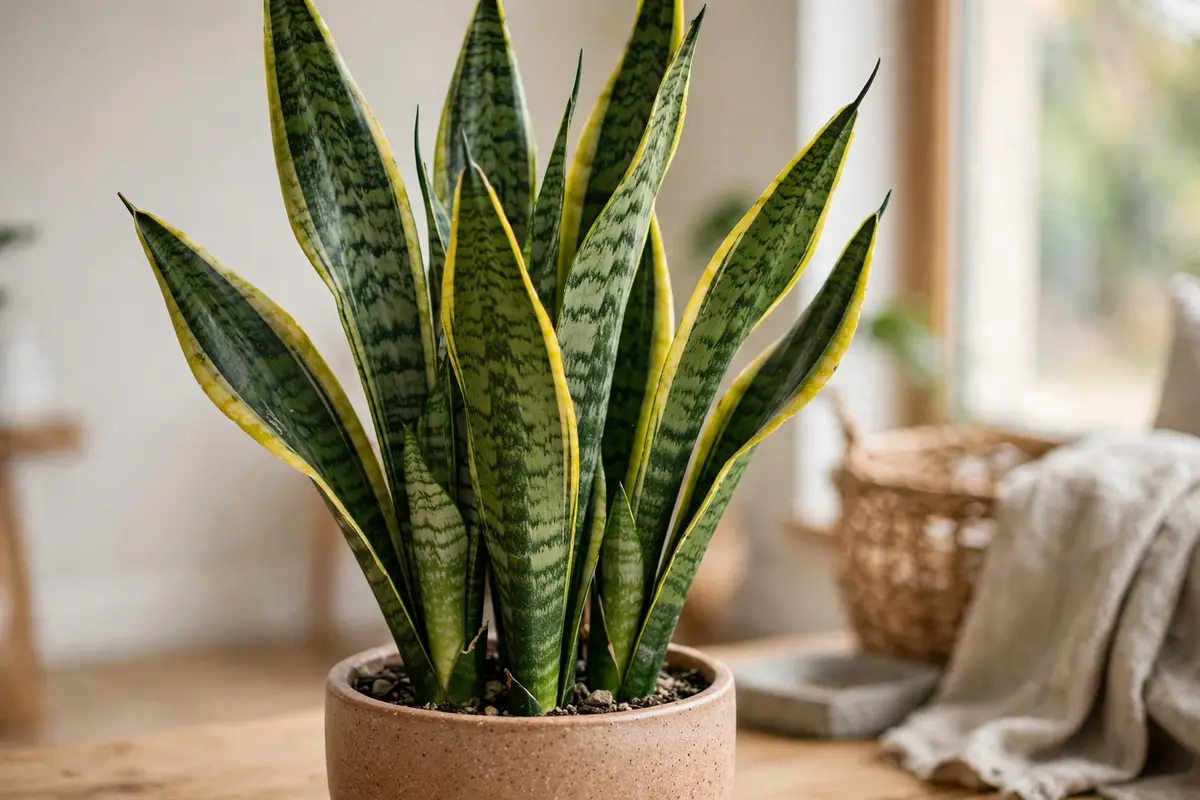
The snake plant is Dracaena trifasciata (long known as Sansevieria trifasciata), a rhizomatous succulent in the asparagus family Asparagaceae from West Africa, grown worldwide as a houseplant for its upright, sword-shaped, mottled leaves. It tolerates low light (and grows best in bright indirect light), needs water only when its soil is thoroughly dry, and lives for decades — a houseplant for USDA indoor life anywhere, or outdoors in frost-free zones 10 to 12. The snake plant means resilience, endurance, good luck and protective energy.
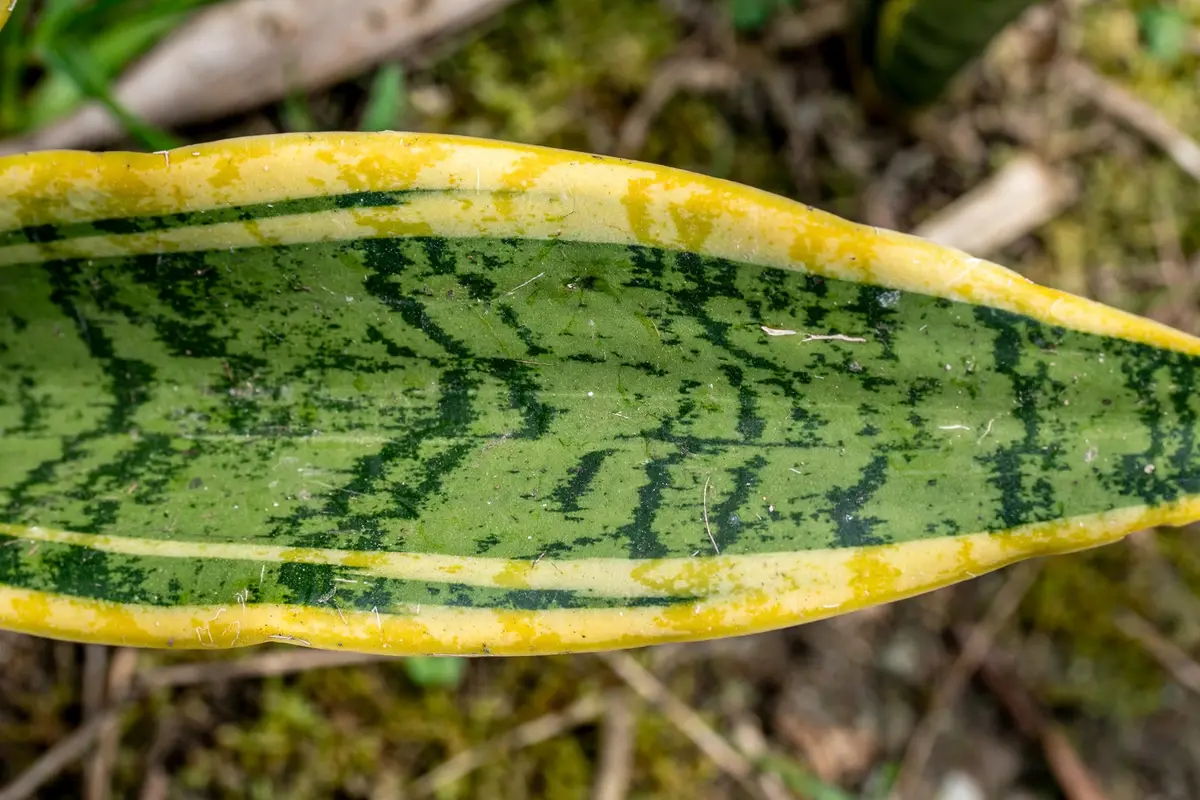
Table of Contents
- What Is a Snake Plant?
- Types of Snake Plant and 6 Kinds Worth Knowing
- Snake Plant Meaning and Symbolism
- Snake Plant Colours and Their Meanings
- How to Grow a Snake Plant
- Common Mistakes When Growing a Snake Plant
- Snake Plant vs ZZ Plant: The Neglect Championship
- Frequently Asked Questions
What Is a Snake Plant?
The snake plant is a creature of dry West African scrub: thick rhizomes creep underground, storing water, and send up stiff, fleshy leaves banded like a snake’s back — the source of its name, along with the leaf edges’ wavy profile. Botanists moved it from Sansevieria into Dracaena on DNA evidence in 2017, so the labels in shops (still usually Sansevieria) and the botanical name now disagree — same plant, two passports. Its survival kit is formidable: CAM photosynthesis (it breathes at night, saving water), leaves like canteens, and a metabolism that idles for months. Left entirely alone for years, a snake plant mostly just waits. You can read more on the Dracaena trifasciata page on Wikipedia.
And the air-purifying fame? It comes from NASA’s 1989 Clean Air Study, which found snake plants removing certain VOCs — inside small, sealed experimental chambers. Later analyses showed you would need an impractical jungle of plants to match simply opening a window in a real room. The honest version: snake plants are beautiful, resilient, and do release oxygen at night thanks to CAM — plant them for those truths, not as appliances. Meanwhile the plant does flower, rarely and fragrantly: mature, slightly root-bound plants sometimes throw up spikes of greenish-white, honey-scented night flowers — most owners never see them, which makes them a small event when they come.
Snake Plant Quick Facts
- Botanical name: Dracaena trifasciata (syn. Sansevieria trifasciata).
- Family: Asparagaceae, the asparagus family.
- Hardiness: zones 10 to 12 outdoors; a houseplant elsewhere. Frost kills it.
- Height: 1 to 4 feet indoors (rosette forms 6–8 inches).
- Light: bright indirect best; tolerates low light and some direct sun.
- Water and soil: water only when fully dry; gritty cactus/succulent mix; drainage hole mandatory.
- Good to know: mildly toxic if eaten (saponins) — keep from nibbling pets; propagation by division keeps variegation, leaf cuttings revert to plain green.
Types of Snake Plant and 6 Kinds Worth Knowing
The classic sword, the silver one, the bird’s nest and the whale fin. The table separates them; the profiles follow. For the full list of plant names, see our flower names A to Z guide.
| Type | Leaves | Height | Light sweet spot | Best use |
|---|---|---|---|---|
| ‘Laurentii’ | Green, gold edges | 2–4 ft | Bright indirect | The classic floor plant |
| ‘Black Gold’ | Dark green, yellow edges | 2–3 ft | Bright indirect | Contrast corners |
| ‘Moonshine’ | Silvery pale green | 1½–2 ft | Bright — keeps the silver | Modern interiors |
| ‘Hahnii’ (bird’s nest) | Short rosette | 6–8 in | Medium indirect | Desks, shelves, gifts |
| Whale fin (D. masoniana) | One huge paddle leaf | 1–3 ft | Bright indirect | Collector’s sculpture |
| Cylindrical (D. angolensis) | Round spears, often braided | 1–3 ft | Some direct sun | Novelty pots, spare rooms |
1. ‘Laurentii’ — the Classic
The snake plant of a million hallways: tall, stiff swords marbled in greens with a clean golden edge, growing in any light you give it and outliving furniture. Laurentii is the plant that built the genus’s reputation for immortality, and it remains the best choice for a tall, architecturally upright specimen at floor scale. Propagate it by division, never leaf cuttings, or the gold edge is lost (cuttings revert to the plain species green).
2. ‘Black Gold’ — the Dramatic Edge
Laurentii’s moodier sibling: leaves of a much darker green — near-black in low light — with the same yellow margin drawn around them, so the contrast does the decorating. Black Gold is the interior designer’s choice for pale rooms and white pots, and it grows a shade slower and stockier than the classic. All the family toughness, dressed for evening.
3. ‘Moonshine’ — the Silver One
Broad leaves of pale silvery green, almost metallic when young, darkening slowly with age and low light. Moonshine is the snake plant that reads as modern sculpture rather than office greenery — keep it in the brightest indirect light you have, because its silver is a light-dependent trait and a dim corner will green it toward ordinary. A young Moonshine in a white pot is the genus at its most elegant.
4. ‘Hahnii’ — the Bird’s Nest
The dwarf form: leaves arranged in a tight funnel rosette 6 to 8 inches tall, like a green bird’s nest — the desk and shelf snake plant, and the one sold in tiny pots as a first houseplant. Golden and silver-edged forms (‘Golden Hahnii’, ‘Silver Hahnii’) exist. It shares the family rules exactly: the same gritty soil, the same drought-first watering, in miniature. Slow, tidy, and nearly impossible to outgrow its welcome.
5. Whale Fin — the Collector’s Paddle
Dracaena masoniana grows one leaf at a time, and what a leaf: a broad, mottled paddle up to 10 inches wide, rising from the soil like a whale’s fin (or a beached surfboard). Slow, expensive, and entirely worth it to its devotees — a single fin in a plain pot is a living sculpture. Care is standard snake-plant care; the difference is patience, since each new fin may take a season to arrive.
6. Cylindrical Snake Plant — the Spears
Dracaena angolensis (the artist formerly known as Sansevieria cylindrica): round, smooth, spear-like leaves rising straight or fanning from the base, often sold braided into green plaits in small pots. It takes more direct sun than the flat-leaved kinds and grows into an architectural fan of green pencils outdoors in warm climates. Unbraid it if you buy it braided — the plant prefers its own arrangement, and so, in time, will you.
Snake Plant Meaning and Symbolism
The snake plant means endurance: resilience, perseverance, health and long life — the blessing you give in plant form, which is why it is the standard housewarming and get-well gift in half the world. In feng shui the upward sword leaves are protective energy, cutting through stagnation (the same sharpness behind the mother-in-law nickname, read kindly: a guardian, not a gossip). In West African tradition its relatives guarded homes and were tied to Ogun, the orisha of iron and war — protection again. Even its survival carries the meaning: this is the plant that is still standing when everything else in the room has been through changes — a small green emblem of carrying on.
Give a snake plant when the message is “keep going”: new homes, recoveries, new jobs, new chapters. It belongs with the architectural greens of the Australian native flowers’ tougher cousins in spirit — plants whose beauty is inseparable from their toughness.
Snake Plant Colours and Their Meanings
- Mottled greens — endurance and health: the wild pattern, camouflage for hard country.
- Gold-edged — prosperity guarded: ‘Laurentii’ and ‘Black Gold’ in feng shui corners.
- Silver — clarity and calm: ‘Moonshine’, the modern minimalist’s plant.
- Near-black green — strength in reserve: dark forms in low light.
How to Grow a Snake Plant
One rule runs everything: when in doubt, do not water. Gardeners on r/houseplants on Reddit have a standing diagnosis for snake-plant problems: “it’s the watering. It’s always the watering — specifically, too much of it, with love.”
Light, Pot and Soil
Bright indirect light grows the fastest, straightest plants and keeps variegation and silver bright; low light is survived, slowly, with darker, sparser growth; a few hours of direct sun suit the cylindrical kind and acclimatised plants generally. Use a pot with a drainage hole — non-negotiable — and a gritty, fast-draining mix (cactus/succulent soil with extra perlite or pumice). Terracotta suits it: heavy enough to counterweight tall leaves, porous enough to dry between waterings. Repot only when the rhizomes threaten the pot’s structural integrity, which — famously — they eventually do; snake plants have cracked ceramic by growth alone.
Watering and Propagation
Water thoroughly, then wait until the soil is dry all the way down — every two to three weeks in summer for most rooms, monthly or less in winter — and empty the saucer every time. Yellow, mushy leaf bases mean the rot has started: unpot, cut away everything soft back to firm tissue, let the cuts callus, and replant in dry mix. Propagation is by division (pups cut from the rhizome with roots attached — this preserves gold edges and silver) or by leaf sections rooted in water or soil, which grow slowly and revert variegated kinds to plain green — a genetics lesson in a jam jar.
Common Mistakes When Growing a Snake Plant
Mistake one, accounting for nearly all deaths: overwatering — a weekly schedule on a plant built for monthly droughts. The leaves store the water; the roots rot in the wet. Mistake two is the pot without drainage, which turns even careful watering into a swamp at the roots.
Mistake three is reading low light tolerance as low light preference: a snake plant in a dark corner is surviving, not thriving, and will etiolate and lean over years. Mistake four is propagating ‘Laurentii’ by leaf cuttings and wondering where the gold edges went — they are chimeral tissue and only division carries them. And mistake five is winter watering at summer rates: cold, wet, dark months are when the rot moves fastest. Water less in winter than feels kind; the plant is resting, not thirsting.
Snake Plant vs ZZ Plant: The Neglect Championship
The two houseplants recommended to self-confessed plant-killers, judged head to head. Snake plant (Dracaena trifasciata): upright swords; stores water in leaves and rhizomes; tolerates the lowest light of the two but sulks at cold; faster growth in good light; toxic if eaten. ZZ plant (Zamioculcas zamiifolia): glossy leaflets on arching stems from a potato-like rhizome; even slower and even more shade-proof; equally drought-proofed; also toxic if eaten. The verdicts: darker room — ZZ, by a nose; brighter room and faster architecture — snake plant; forgetful waterer — a dead heat, both forgive months. Most neglect champions end up owning both, one per problem corner.
Frequently Asked Questions
Does the snake plant really purify the air?
Not meaningfully in a real room. The fame comes from NASA’s 1989 sealed-chamber study; later work showed matching a window’s ventilation would take an impractical number of plants per room. Grow it for its looks, toughness and night-time oxygen release — the honest virtues. If your question is not answered here, the questions about the snake plant on Quora cover most of the rest.
How often should I water a snake plant?
Only when the soil is dry all the way through: typically every two to three weeks in the growing season in an average room, once a month or less in winter. Err dry — the plant forgives drought completely and forgives wet soil not at all.
Is the snake plant toxic to pets?
Mildly: the leaves contain saponins, and a pet that chews one may get nausea, vomiting or diarrhoea. It is not among the dangerous houseplants, but place it out of nibbling reach and call a vet if a pet eats a quantity.
Why is my snake plant falling over or going mushy?
Mushy, yellowing bases mean root and rhizome rot from overwatering or poor drainage — unpot, cut back to firm tissue, callus, replant dry. Leaves flopping without mush usually mean very low light over a long period (weak, stretched growth) or a very root-bound pot tipping; light and a heavier pot fix those.
Can a snake plant flower?
Yes — rarely, and usually on mature, slightly root-bound plants in bright conditions: spikes of small greenish-white, honey-scented tubular flowers, opening toward evening. It is not a sign of distress (despite the internet saying so); enjoy it, and mind the sticky nectar drips on the floor beneath.
Is it Sansevieria or Dracaena now?
Botanically Dracaena (since 2017, on DNA evidence), commercially still Sansevieria on most labels. Search either name and you will find the same plant — the swords did not change, only the filing. For more plants under the same letter, follow the S entries in our flowers that start with S guide.