
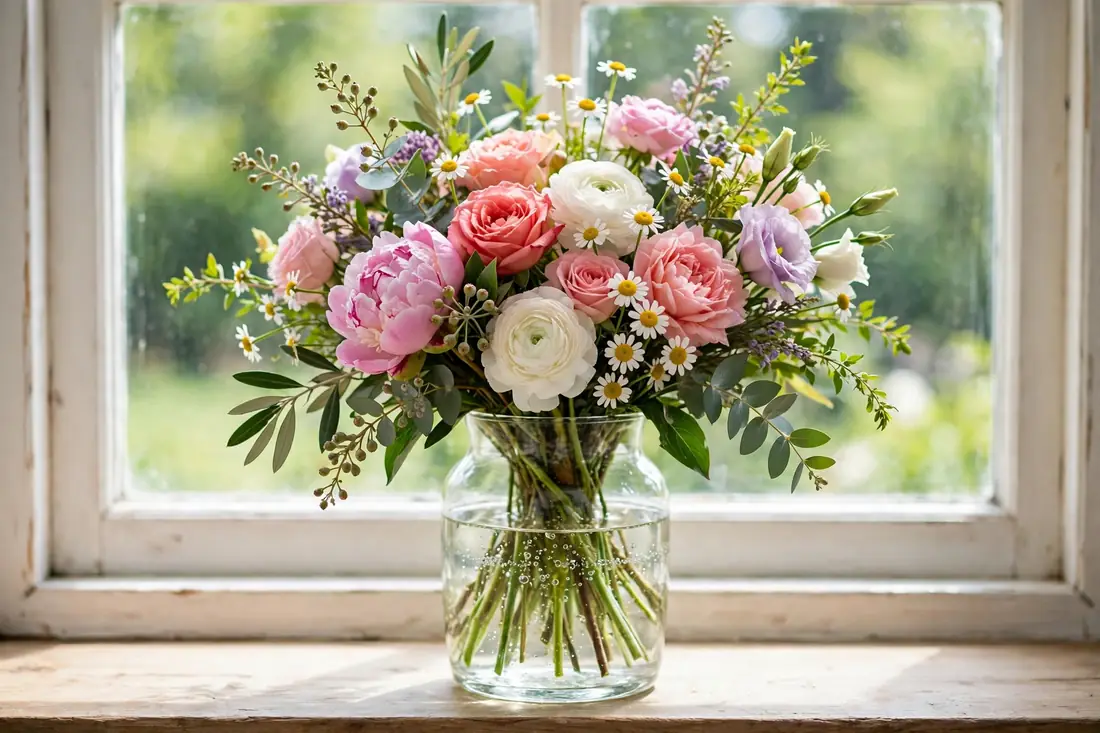
How to Make Cut Flowers Last Longer (9 Tricks That Actually Work)
A bouquet that fades in four days and one still beautiful on day ten are often the exact same bouquet. What separates them is rarely the flowers — it is the first ten minutes after they arrive, and a minute of attention each morning after that. Florists know this; most of the rest of us learn it by watching good money wilt.
Quick answer: To make cut flowers last longer, recut every stem at a 45° angle with sharp pruners, strip all leaves below the waterline, use a truly clean vase with lukewarm water and flower food, change the water every 2 days (recutting each time), and keep the arrangement cool, out of direct sun, and away from ripening fruit. Done consistently, this stretches a typical 5–7 day bouquet to 10–14 days.
Why Cut Flowers Fade: The 3 Enemies
Once a stem is cut, the flower is running on stored energy with no way to make more. Three things kill it:
- Bacteria. Microbes multiply in vase water within hours, forming slime that clogs the stem's water-conducting vessels. The flower literally dies of thirst while standing in water.
- Air. When a stem is cut in open air, tiny air bubbles (embolisms) get sucked into the vessels and block water uptake — like an air lock in a pipe.
- Dehydration and heat. Warm rooms, direct sun, and heating vents accelerate water loss through the petals faster than the damaged stem can replace it.
Every trick below attacks at least one of these three. The ones that attack all three are the ones worth your time.
1. Get Them Into Water Fast
The clock starts the moment a stem leaves water. A stem begins sealing itself within minutes of being cut, and every minute of air exposure adds embolisms.
If your bouquet arrived wrapped in paper with no water source, unwrap it and get it into water before you admire it. Flowers that arrived with water tubes on the stems (florists use these on roses) will hold for a few hours — keep the bouquet upright so the tubes keep working. Flowers carried home dry from the garden or market should go into a bucket of lukewarm water the instant you walk in the door.
2. Recut Every Stem — Properly
This is the single most important gesture, and the one most often skipped. The cut end you received is already sealing and clogging. Give every stem a fresh start:
- Cut 1–2 inches off each stem at a sharp 45° angle. The angle exposes more surface area for water uptake and keeps the stem from sitting flat against the vase bottom and sealing itself shut.
- Use a sharp knife or bypass pruners — not scissors. Scissors crush the stem's vessels; a crushed stem cannot drink. If you only own scissors, keep them razor sharp and cut decisively.
- Cutting underwater is the gold standard (it prevents new air bubbles from entering), but a fast, clean cut in air followed by immediate placement in water captures most of the benefit. Do not let recut stems sit on the counter.
Recut again every time you change the water. Stem ends re-seal and re-clog within a couple of days — a fresh centimeter reopens them.
3. Strip Every Leaf Below the Waterline
Any foliage sitting underwater rots within a day or two, and rotting leaves are a bacteria buffet. That bacterial bloom is exactly what clogs stems and clouds water.
Remove every leaf that would sit below the vase rim — pull or cut them cleanly. Leave the upper foliage; the flower still needs it. This one step, which takes thirty seconds, can add several days to a bouquet's life. It is also the step people skip because the bouquet "looks fuller" with the leaves. It looks fuller for two days, then everything dies faster.
4. Start With a Truly Clean Vase
A vase that looks clean can still carry a bacterial film from the last bouquet, and those leftover bacteria will shorten the new arrangement's life more than any additive can fix.
Wash the vase with warm water and a little dish soap, scrub the inside (a bottle brush earns its keep here), and rinse thoroughly — soap residue is also bad for flowers. For vases with narrow necks or visible film, a diluted bleach rinse followed by thorough rinsing resets them completely.
5. Use Lukewarm Water — With One Exception
Fill the vase about two-thirds full with lukewarm water for the first fill. Warm water is drawn up the stem faster than cold water (lower viscosity), which is what a thirsty, embolism-prone stem needs most.
The exception: tulips prefer cold water and hold much better in it. If your arrangement is all or mostly tulips, go cold. For mixed bouquets, lukewarm is the right call.
Fill generously. Stems drink more in the first 24 hours than at any point afterward — a vase filled to one-third will be nearly empty by morning, and stems left high and dry seal permanently.
6. Add Flower Food — or Make Your Own
Those little packets from the florist are not a gimmick. Commercial flower food contains three things, each doing a real job:
- Sugar — food energy for the bloom, since the flower can no longer photosynthesize enough to sustain itself.
- An acidifier (usually citric acid) — lowers the water pH, which improves water uptake and slows microbial growth.
- A biocide — keeps bacteria from clogging the stems.
One packet per quart of water is the standard dose. No packet? The widely used DIY version is 1 tablespoon of sugar + 2 tablespoons of lemon juice + ½ teaspoon of plain bleach per quart of lukewarm water — sugar feeds, lemon juice acidifies, bleach suppresses bacteria.
Be honest about expectations, though: in The Kitchn's side-by-side test of seven methods, commercial flower food outperformed every DIY alternative. DIY is far better than plain water; the packet is better than DIY. And plain bleach alone, or sugar alone, addresses only one piece of the problem — the three-ingredient combination is the point.
7. Change the Water Every 2 Days
This is the highest-leverage daily habit. Stale water turns cloudy, and cloudiness means bacteria have already taken hold.
Every 2 days (daily if you can): dump the old water, rinse the vase, recut a centimeter off each stem, and refill with fresh water plus fresh flower food. While you are at it, remove any spent blooms — a dying flower releases ethylene gas, which ages everything around it. Taking it out protects the rest.
Watch the water level between changes, too. Heavy drinkers — hydrangeas in particular can empty a vase overnight — should never be left with exposed stem ends.
8. Keep Them Cool, Dim, and Away From Fruit
Where the vase sits matters as much as what is in it:
- Cool beats warm. A room at 65°F preserves flowers roughly twice as long as a room at 72°F. A cool bedroom overnight beats a warm living room.
- No direct sun. Sunlight heats the water and accelerates petal breakdown. Bright indirect light is fine; a south-facing windowsill is not.
- Away from heating vents and radiators. Forced hot air is a dehydration machine.
- Away from the fruit bowl. Ripening bananas, apples, and avocados release ethylene gas, which triggers premature petal drop. Extension guidance suggests keeping flowers several feet from ripening produce.
Professional florists store arrangements in coolers for a reason. You do not need a cooler — just the coolest spot in the house, away from the kitchen's heat and fruit.
9. Know Your Flowers' Quirks
A few species-specific notes that separate good results from great ones:
- Roses: Recut deeply and remove the outer "guard petals" if they are bruised — the rose underneath is fine. Roses drink heavily; check water daily.
- Tulips: Keep growing in the vase and will bend toward light — embrace the droop or recut and rearrange. Cold water, always.
- Hydrangeas: Enormous drinkers. If a hydrangea head wilts, recut the stem and submerge the entire flower head in cool water for an hour — they can absorb water through the petals and often revive completely.
- Lilies: Snip off the pollen-covered anthers as buds open. It prevents orange pollen stains on everything and slightly extends the bloom.
- Daffodils: Their stems exude a sap that is toxic to other flowers. Condition daffodils alone in water for several hours before mixing them into a bouquet — or give them their own vase.
- Woody stems (lilac, forsythia, cherry branches): Split mythology aside, what actually helps is a fresh angled cut and — for truly woody stems — stripping bark from the bottom inch to expose more uptake surface. Hammering or boiling stem ends is folk advice with weak evidence.
6 Myths That Don't Really Work
- The copper penny. The idea is that copper kills bacteria. In practice, modern pennies are copper-plated zinc with minimal exposed copper, and tests show negligible effect.
- Aspirin in the water. No meaningful evidence it extends vase life; it is an acidifier at best, and lemon juice does that job better.
- Hammering or smashing stem ends. This destroys the vessels you are trying to keep open — the opposite of helpful.
- Putting the bouquet in the fridge overnight. It works in principle (florists do it), but a home fridge holds ripening produce whose ethylene will age the flowers faster than the cold preserves them.
- Soda (Sprite/7-Up) instead of flower food. It supplies sugar and some acidity, and tests show modest benefit — but it lacks a biocide, so bacteria still win within days.
- A splash of vodka. The theory (slowing ethylene response) has a kernel of truth, but at household doses the effect is negligible compared to just changing the water.
Frequently Asked Questions
How long do cut flowers normally last?
Most mixed bouquets last 5–7 days with basic care. With consistent recutting, flower food, and water changes every 2 days, 10–14 days is realistic for hardy varieties like carnations, chrysanthemums, and alstroemeria. Delicate flowers (sweet peas, poppies) naturally last fewer days no matter what you do.
Should I change flower water every day?
Every 2 days is the practical sweet spot; daily is slightly better. The key is consistency — a full refresh (dump, rinse, recut, refill with fresh food) beats merely topping up.
Is flower food really necessary?
It makes the biggest single difference of any additive. In side-by-side testing it outperformed all DIY alternatives. If you buy bouquets regularly, a box of flower-food packets is the cheapest vase-life upgrade there is.
Can I use sugar instead of flower food?
Sugar alone feeds the flower but also feeds bacteria — which is why DIY recipes pair it with an acid (lemon juice) and a biocide (a little bleach). Sugar water without the other two components often performs worse than plain water.
Why is my vase water cloudy after one day?
Bacterial bloom, accelerated by leaves below the waterline, a dirty vase, or warm conditions. Dump it, scrub the vase, strip submerged foliage, recut the stems, and start fresh with flower food.
Do cut flowers last longer in cold water or warm water?
Lukewarm for the first fill (faster uptake for thirsty stems), then room temperature. Tulips are the exception — they prefer cold water throughout.
Should I mist cut flowers?
Lightly misting petals can help in very dry indoor air, but it is a minor factor. Water uptake through a clean, freshly cut stem matters far more than anything you spray on the petals.
Why do my roses droop the day after I buy them?
Usually air embolism from the stems being out of water, or bacterial clogging from the original cut. Recut an inch off each stem at an angle, use warm water with flower food, and give them a few hours — most "dead" roses revive.
Can I revive wilted cut flowers?
Often, yes. Recut the stems, place them in warm water with flower food, and move them somewhere cool for a few hours. Hydrangeas can be fully submerged head-down for an hour. If the stem is slimy or the head is papery and dry, it is past saving — remove it so it does not release ethylene near the survivors.
Do I need to recut stems if the florist already did?
Yes. Even a few hours of air exposure starts the sealing process, and transport adds more. A fresh cut at home resets the clock — it takes seconds and is the highest-value step in this entire guide.
Sources consulted: The Kitchn (side-by-side test of 7 vase-life methods), My Global Flowers (cut-flower care myths vs. facts), postharvest guidance via University of Massachusetts Amherst Extension (ethylene and produce separation).

2 Comments