Flower Design: Elements, Principles, Shapes and Styles Explained
Flower design is the thinking behind flower arranging. Arranging is the hands-on craft of placing stems; design is the set of elements and principles — line, colour, balance, proportion — that decides whether the finished piece looks like a florist made it or like flowers fell into a vase.
This guide explains flower design in plain language: the five elements every design uses, the six principles that organise them, the classic design shapes and styles (from Western mass arrangements to Japanese ikebana), and how to choose a design for any occasion.
Quick Answer
Flower design (floral design) is the art of organising flowers using five elements — line, form, space, texture and colour — and six principles: balance, proportion, rhythm, dominance, contrast and unity. Classic designs follow recognisable shapes (round, triangular, crescent, S-curve) and styles: Western (full and symmetrical), Eastern/ikebana (minimal lines and space), and modern (sculptural, experimental).
Table of Contents
- What Is Flower Design?
- The 5 Elements of Flower Design
- The 6 Principles of Flower Design
- Classic Flower Design Shapes
- Flower Design Styles: Western, Eastern and Modern
- Colour Schemes in Flower Design
- How to Choose a Design for an Occasion
- Frequently Asked Questions
What Is Flower Design?
Floral design is a formal discipline with its own vocabulary, taught in floristry schools the way composition is taught in art schools. The distinction matters in practice: if you learn the design rules once, you can walk up to any flowers — a florist’s bunch, garden cuttings, even supermarket stems — and know why one combination will work and another will not. Our companion guide to flower arranging covers the hands-on building steps; this page is the theory that makes those steps succeed.
The 5 Elements of Flower Design
| Element | What it means | In practice |
|---|---|---|
| Line | The visual path the eye follows | Tall stems, branches and curved grasses create the skeleton — vertical lines feel formal, curves feel relaxed |
| Form | The shape of each flower and of the whole design | Round roses, spiky delphiniums, flat daisies — mixing forms creates interest |
| Space | The empty areas inside and around the design | Negative space is not wasted space; it is what lets each flower be seen |
| Texture | Surface quality — smooth, rough, feathery, glossy | Velvet roses against feathery gypsophila and glossy leaves read rich; all-smooth reads flat |
| Colour | The palette and how its parts relate | The fastest mood-setter: see the colour schemes section below |
The 6 Principles of Flower Design
- Balance — the design feels stable. Symmetrical balance mirrors both sides (classic, formal); asymmetrical balance weighs different elements against each other (modern, dynamic). Dark, large flowers weigh more than pale, small ones.
- Proportion — sizes relate sensibly: the arrangement about 1.5× its container’s height, flowers scaled to the vase and to each other.
- Rhythm — repetition with variation leads the eye through the design: the same colour appearing in three places, stems graduating in height.
- Dominance — one element rules: a dominant flower, colour or line that everything else supports. Two competing stars make visual arguments.
- Contrast — differences that create energy: rough against smooth, dark against light, round against spiky. Contrast is seasoning — essential, and easy to overdo.
- Unity (harmony) — everything belongs together: the flowers, the container, the setting and the occasion all telling one story.
Classic Flower Design Shapes
| Shape | Silhouette | Feels like |
|---|---|---|
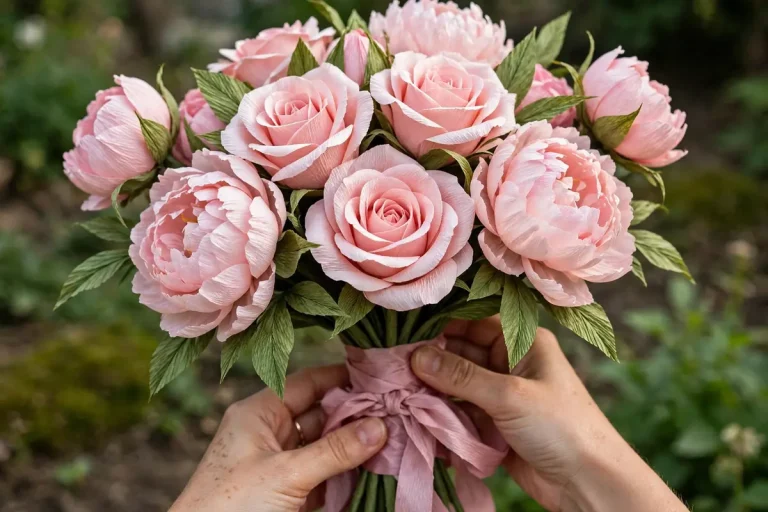
| Round | A dome viewable from all sides | Classic centrepiece; the safest shape for beginners |
| Triangular | Wide base rising to a peak | Formal and traditional — church and ceremony designs |
| Crescent | A curved moon arc | Elegant and asymmetrical; lovely on mantels and tables |
| S-curve (Hogarth curve) | A flowing vertical S | Graceful and advanced; named after the painter Hogarth’s “line of beauty” |
| Fan / radiating | Stems spreading like a fan | Ceremonial and bold — the classic funeral and altar shape |
| Horizontal | Long and low | Dining tables, where guests must see over the design |
Flower Design Styles: Western, Eastern and Modern
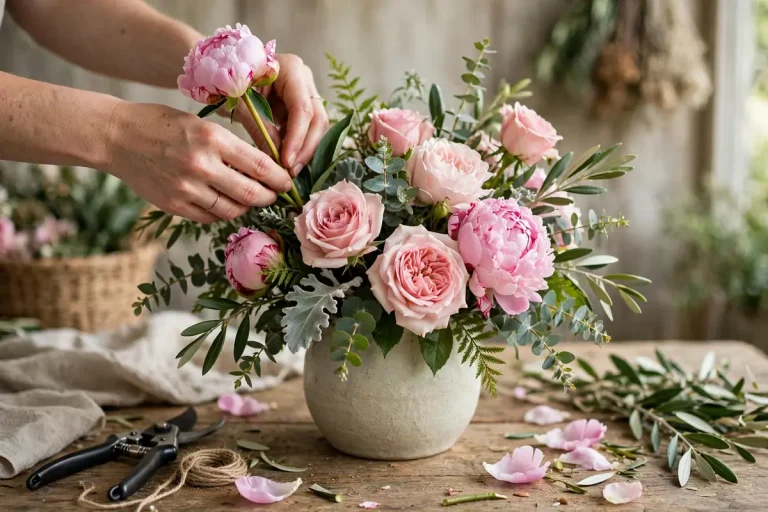
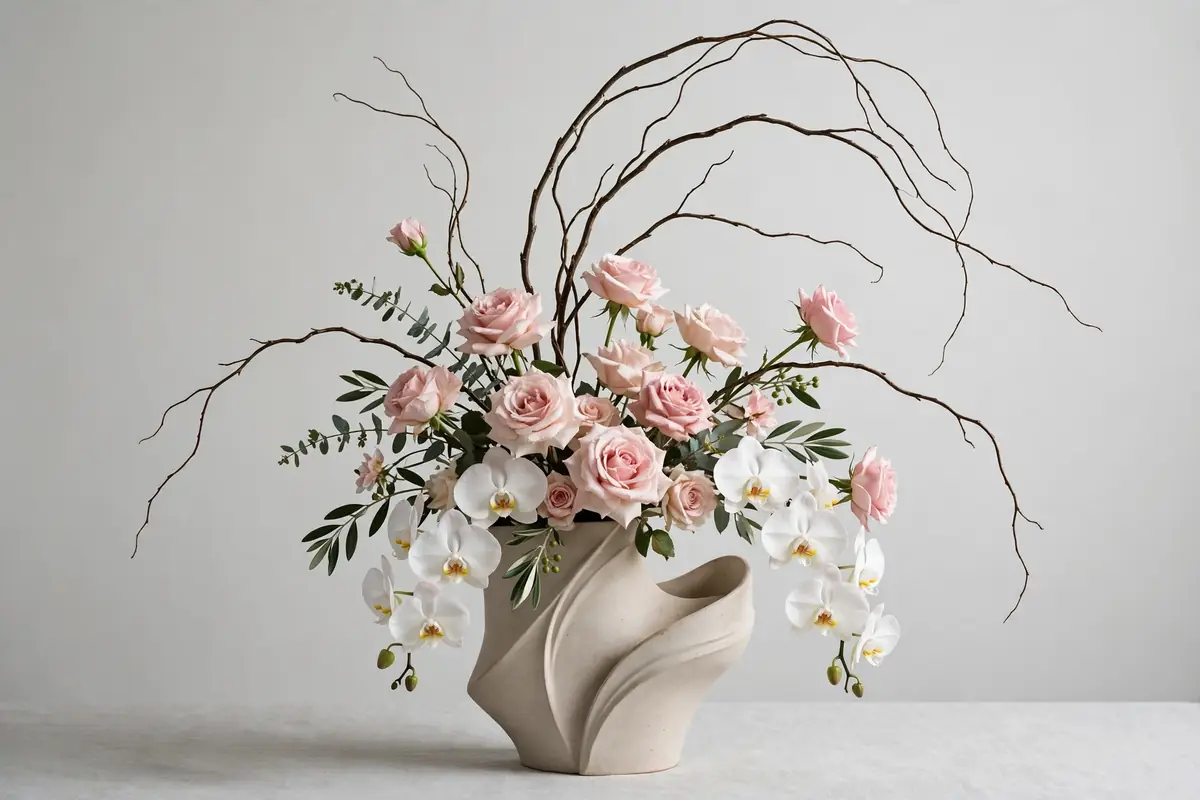
Western design is the European tradition: generous mass, many flowers, symmetry, and colour as the main event. Most wedding and event floristry descends from it. Eastern design — ikebana — is its opposite: few stems, strong lines, and space treated as an element in itself, with designs built on three main placements representing heaven, earth and humanity. Modern (contemporary) design borrows from both and adds sculpture: unusual materials, exposed mechanics, flowers used architecturally — grouped in blocks of one colour, bent, woven or suspended.
None of the three is “better” — they answer different rooms. A Western dome suits a round wedding table; an ikebana line suits a calm hallway; a modern sculptural piece suits a gallery or a brand event.
Colour Schemes in Flower Design
- Monochromatic — one colour in many shades (blush to burgundy roses). The most elegant and the hardest to get wrong.
- Analogous — neighbours on the colour wheel (pink, peach, coral). Soft, romantic, natural.
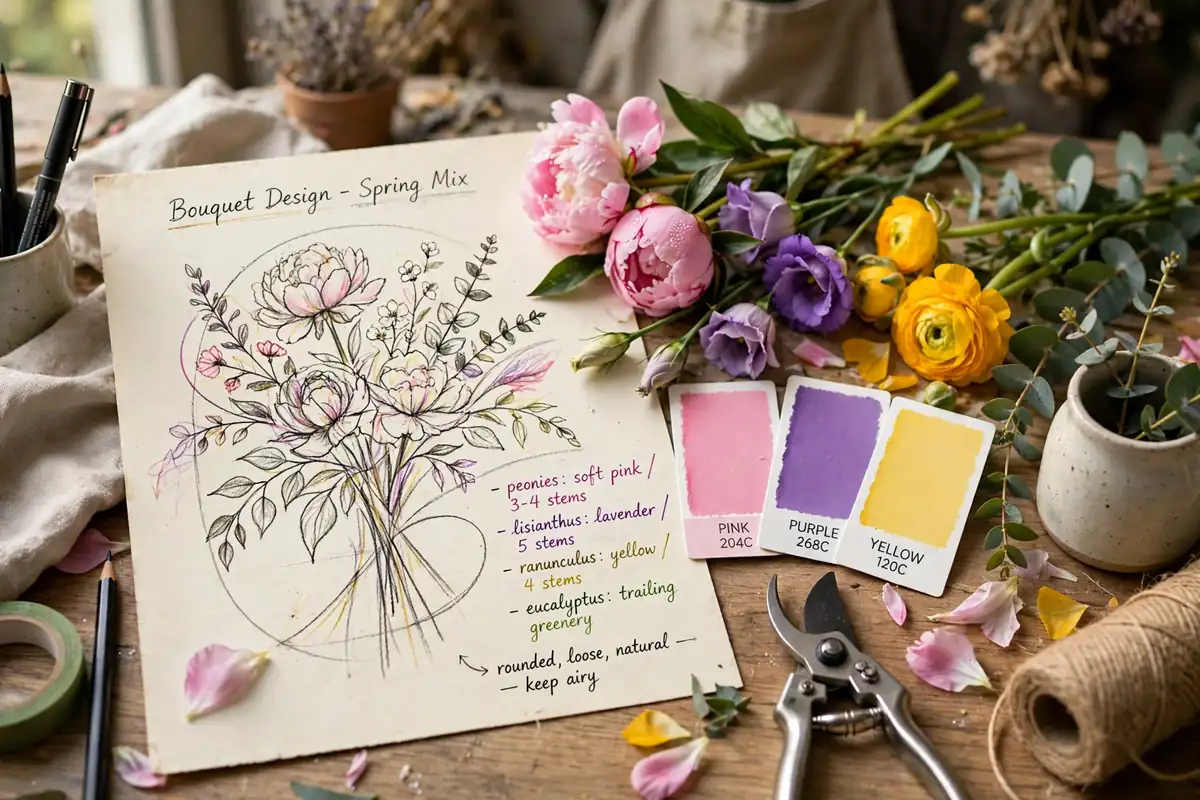
- Complementary — opposites (yellow and purple, orange and blue). High energy; use one as the main colour and the other as the accent, never 50/50.
- Triadic — three evenly spaced colours (red, yellow, blue). Festive and bold — a favourite for birthdays and summer parties.
- White and green — the florist’s neutral: works with every room, season and occasion, and photographs beautifully.
How to Choose a Design for an Occasion
Start from the setting, not the flowers. Dining table: horizontal or low round, under 30 cm tall so guests can talk over it. Hallway or console: triangular or fan — tall, one-sided designs that read from the front. Wedding: Western round and garden styles dominate; match the colour scheme to the day’s palette, not just the bride’s bouquet. Sympathy: fans, crescents and soft analogous colours — see our white flowers guide for the classic palette. A single gift vase: dominance plus rhythm — one star flower repeated at three heights with quiet support. And when in doubt, the monochromatic round design in a simple vase is the design world’s little black dress.
Frequently Asked Questions
What is the difference between flower design and flower arranging?
Flower design is the theory — the elements, principles, shapes and styles that make an arrangement work. Flower arranging is the practical craft of building it: conditioning stems, supports, placement and care. Designers plan; arrangers build; good florists do both.
What are the elements of flower design?
Five: line, form, space, texture and colour. They are organised by six principles: balance, proportion, rhythm, dominance, contrast and unity.
What is the easiest flower design for a beginner?
The round (dome) design in a monochromatic or analogous colour scheme. It is symmetrical, forgiving, and works in any round vase — most beginners’ first successful arrangement is a dome of one or two flower types.
What is ikebana?
Ikebana is the Japanese art of flower design, over 600 years old. It emphasises line, asymmetry and empty space, typically with three main stems placed at prescribed angles on a pin-holder (kenzan) in a shallow container.
How do I choose flower colours that go together?
Use a scheme: monochromatic (shades of one colour) for elegance, analogous (neighbours like pink and peach) for softness, or complementary (opposites like yellow and purple) for energy — with one colour clearly dominant and the other as an accent.