Why Is My Hydrangea Not Blooming? 7 Reasons and How to Fix Them
A hydrangea full of lush green leaves and zero flowers is one of the most frustrating sights in gardening. The good news: in almost every case, there is a specific reason — and most of them are fixable. The bad news: the fix depends entirely on why yours is not blooming, so guessing usually wastes a season.
Quick answer: The most common reason hydrangeas do not bloom is pruning at the wrong time — cutting off flower buds that were already formed. Other top causes are late frost killing buds, too much nitrogen fertilizer, too little sun, and planting a variety that is not hardy in your zone. Identify your hydrangea type first (old-wood vs. new-wood bloomer), because that single fact determines almost everything about pruning and winter care.
First: Figure Out Which Hydrangea You Have
This is the step almost everyone skips, and it is the step that matters most. Hydrangeas fall into two groups, and they behave completely differently:
Old-wood bloomers form next summer's flower buds on this year's stems, during late summer and fall. If those stems are pruned, frozen, or eaten by deer over winter, there are no flowers next year — period. This group includes:
- Bigleaf / mophead hydrangeas (Hydrangea macrophylla) — the classic blue/pink puffball types
- Oakleaf hydrangeas (Hydrangea quercifolia)
New-wood bloomers grow fresh stems each spring and form flower buds on that new growth. You can cut them to the ground in late winter and they will still bloom. This group includes:
- Panicle hydrangeas (Hydrangea paniculata) — cone-shaped flower heads, e.g. 'Limelight'
- Smooth hydrangeas (Hydrangea arborescens) — e.g. 'Annabelle'
Reblooming varieties (such as the Endless Summer series) bloom on both old and new wood, which makes them far more forgiving — even if winter kills the old buds, the new growth still flowers.
Not sure which you have? Look at the flower shape and ask when you bought it what the tag said. Panicle types have cone-shaped blooms; mopheads have round ones. When in doubt, treat it as an old-wood bloomer and prune conservatively — that is the safe default.
Reason 1: You Pruned at the Wrong Time (the #1 Cause)
This is the single most common reason, especially for bigleaf hydrangeas. Old-wood bloomers set their buds in late summer. Prune them in fall, winter, or early spring, and you are cutting off flowers that already exist in miniature on the stems.
The rule: prune old-wood hydrangeas (bigleaf, oakleaf) immediately after flowering, finishing by roughly late July. After that, hands off until next summer. New-wood types (panicle, smooth) can be pruned in late winter or early spring while still dormant.
How to fix it now: nothing will bring this year's buds back — but do not prune again until right after flowering, and next year's show should return. If you are unsure whether a stem is dead or just dormant in spring, wait until all branches have leafed out, then remove only the wood that is clearly dead.
Reason 2: A Late Frost Killed the Buds
Old-wood buds sit exposed on the stems all winter. A warm spell in March that coaxes buds to swell, followed by a hard freeze, can kill them outright — and you will never know until June, when the plant leafs out beautifully but never flowers.
How to recognize it: the plant grows vigorously from the base or lower stems but produces no flowers, after a winter with erratic temperature swings. New growth coming only from the base (not from old stems) is a telltale sign the upper buds froze.
How to fix it: for this year, nothing — but protect the plant next winter. Options that genuinely help: plant in a sheltered spot out of winter wind, mulch the root zone, and in borderline zones, wrap the shrub in burlap after the leaves drop. Long-term, the most reliable fix is switching to a reblooming variety or a new-wood type, which shrug off bud-killing frosts.
Reason 3: Too Much Nitrogen
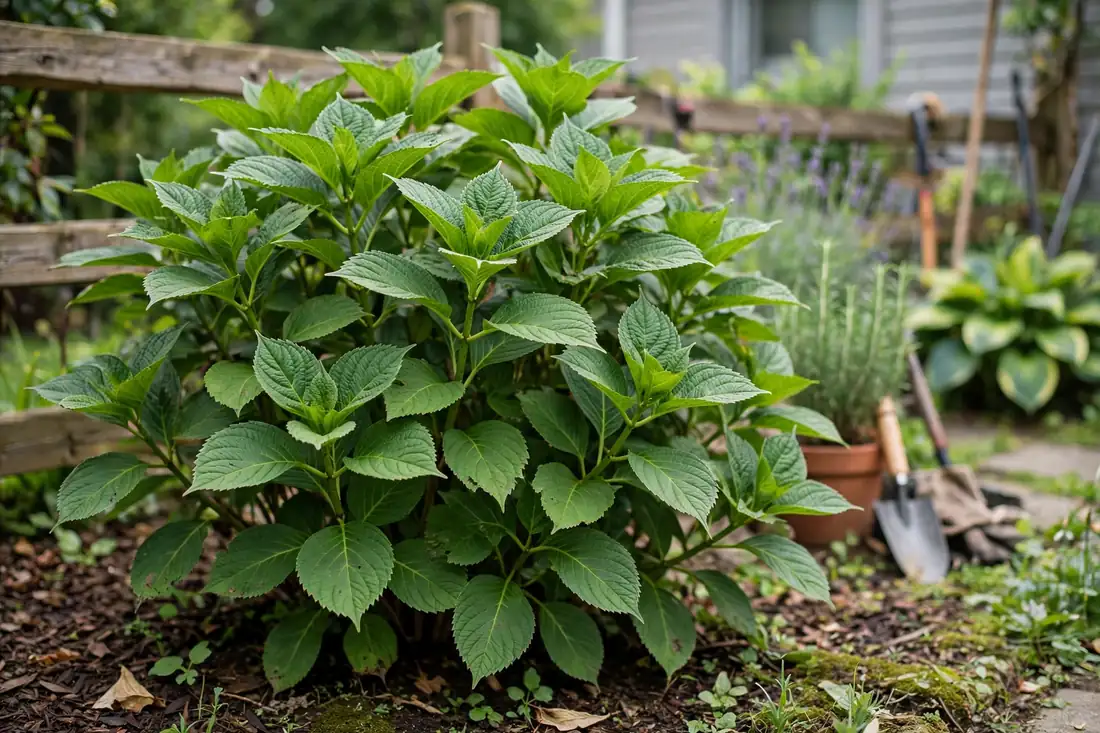
A hydrangea fed like a lawn — or planted next to a fertilized lawn — will pour its energy into big, dark-green leaves and skip flowering. Excess nitrogen pushes vegetative growth at the expense of blooms. This is also the classic result of using a high-nitrogen, all-purpose fertilizer year after year.
How to recognize it: oversized, lush, deep-green foliage; weak or floppy stems; few or no buds. If your lawn fertilizer routinely lands on the hydrangea's root zone, this is a prime suspect.
How to fix it: stop high-nitrogen feeding. If you fertilize, use a balanced formula or one slightly higher in phosphorus (the middle number), applied once in early spring. Keep lawn fertilizer off the bed. The plant will rebalance itself — usually by the following season.
Reason 4: Not Enough (or Too Much) Sun
Hydrangeas need a middle path. Deep shade gives you leaves and no flowers; brutal all-day sun scorches the leaves and stresses the plant into dropping buds. Most types bloom best with morning sun and afternoon shade — roughly four to six hours of gentle light (unverified as a universal figure; it varies by type and climate, but morning-sun/afternoon-shade is the widely taught guideline).
How to recognize it: a hydrangea under a dense tree canopy that has bloomed less each year as the tree grew is the textbook case — landscapes change, and a spot that was perfect five years ago may now be too dark.
How to fix it: limb up overhanging trees to let in dappled light, or move the plant in fall or early spring while dormant. Panicle hydrangeas tolerate (and often prefer) more sun than bigleaf types, so variety choice matters here too.
Reason 5: The Variety Is Not Hardy in Your Zone
Some hydrangeas — especially florist or gift hydrangeas sold in spring — are greenhouse-grown varieties that are simply not cold-hardy enough for your winters. They survive (the roots live), but the flower buds die every winter, so you get a green shrub that never blooms.
How to recognize it: the plant returns reliably every year, grows well, but has never bloomed for you — not once. If it bloomed the first year you planted it and never again, suspect this: nursery buds formed under greenhouse conditions, then reality set in.
How to fix it: replace it with a variety rated for your USDA zone, or with a rebloomer. Check the plant tag's hardiness rating before buying — not the "grows in zones" optimism on the display bench, but the actual tag.
Reason 6: The Plant Is Too Young
Newly planted hydrangeas often spend their first year or two building roots instead of flowers. This is normal, not a problem — especially for larger nursery plants that were pushed hard to bloom in the pot.
How to fix it: patience, plus correct care. Keep it watered through its first two summers, mulch it, and do not prune it while it establishes. Most healthy young plants bloom by their second or third year in the ground.
Reason 7: Water Stress or Pests Weakened the Plant
Hydrangeas are thirsty plants — the name comes from the Greek for water. Drought stress during late summer, exactly when old-wood types are forming next year's buds, can silently cancel next year's flowers. Inconsistent watering, especially in the bud-formation window, is an underappreciated cause. Pests (aphids, spider mites, scale) and diseases (powdery mildew, botrytis) that drain the plant's energy can have the same effect.
How to fix it: water deeply and consistently — a deep soak a couple of times a week beats a daily sprinkle, because it drives roots downward. Water at the base, not overhead, and keep a few inches of mulch over the root zone. Treat pest or disease problems promptly rather than letting them compound through the season.
What About Turning Hydrangea Flowers Blue or Pink?
This is the second-most-asked hydrangea question, so it belongs here. Only bigleaf hydrangeas (H. macrophylla) change color with soil chemistry: acidic soil (low pH) with available aluminum produces blue flowers; alkaline soil produces pink. It does not work on white varieties, and it does not work on panicle or smooth types.
To push blue: lower the pH and add aluminum (aluminum sulfate is the standard amendment — follow label rates). To push pink: raise the pH with garden lime. Either direction takes weeks to months, and the change is gradual. Test your soil pH first rather than guessing — home test kits are inexpensive and widely available.
Frequently Asked Questions
Why is my hydrangea not blooming this year when it bloomed last year?
The most likely culprits are pruning at the wrong time or a late frost that killed this year's buds. If you pruned after late July, or if there was a freeze after a warm spell in spring, those buds are gone — but the plant itself is fine, and normal care should restore blooms next year.
Should I cut off the old dead flowers (deadhead) my hydrangea?
For bigleaf types, you can snip off spent blooms just below the flower head without harming next year's buds — but do not cut deep into the stem. For panicle and smooth types, deadheading is optional; many gardeners leave the dried heads for winter interest.
When is the right time to prune hydrangeas?
Old-wood bloomers (bigleaf, oakleaf): right after flowering, by late July. New-wood bloomers (panicle, smooth/Annabelle): late winter or early spring while dormant. Rebloomers: light shaping after the first flush; avoid heavy pruning.
Can a hydrangea bloom again in the same year?
Reblooming varieties (like the Endless Summer series) flower on old wood in early summer and on new wood later in the season. Standard old-wood varieties bloom once. Deadheading will not make a non-rebloomer flower twice.
Why are my hydrangea leaves turning yellow?
Usually overwatering or poor drainage — hydrangeas like consistent moisture, not soggy roots. It can also indicate a nutrient issue (iron chlorosis shows as yellow leaves with green veins, often in alkaline soil). Check drainage first.
How much sun does a hydrangea need to bloom?
Most hydrangeas bloom best with morning sun and afternoon shade — roughly half a day of gentle light. Panicle types handle full sun better than bigleaf types. Deep shade is the most common light-related cause of no blooms.
Will my hydrangea bloom if I cut it to the ground?
Only if it is a new-wood bloomer (panicle or smooth/Annabelle type). Cutting an old-wood bigleaf hydrangea to the ground removes all of next year's flower buds. Know your type before you cut.
Why did my hydrangea change color from blue to pink?
Soil pH drifted more alkaline, or the aluminum that made it blue got used up. Blue needs acidic soil with available aluminum; pink comes with neutral to alkaline soil. A soil test tells you which direction to adjust.
Do hydrangeas need fertilizer to bloom?
Not much. A light feeding in early spring is plenty for most garden soils. Over-fertilizing — especially with high-nitrogen formulas — is a far more common cause of no blooms than under-fertilizing. When in doubt, skip it.
My hydrangea is all leaves and no flowers — is it dead?
No — all leaves and no flowers almost always means a bud problem (pruning, frost, or fertility), not a dead plant. A dead hydrangea has brittle, snap-dry stems with no green under the bark. If the stems are flexible and leaf out, the plant is alive and fixable.
Sources consulted: University of Maryland Extension (hydrangea care), Clemson Cooperative Extension (pruning hydrangeas), Memphis Area Master Gardeners (six reasons hydrangeas may not bloom).